
Time off in lieu (TOIL) is time off that an employer gives a worker instead of paying for overtime, on terms the two agree. HMRC states that the concept is not recognised in National Minimum Wage legislation, while the NHS Agenda for Change handbook regulates it in Section 3. For the minimum wage, extra hours count in the pay period in which they are worked, so a day off next month does not repair an underpaid month (HMRC, NMWM08550).
TOIL in five points
- TOIL is time off instead of overtime pay; the employer offers it and both agree the terms (GOV.UK).
- There is no automatic legal right to overtime pay (Acas).
- Average pay for all hours worked must not fall below the National Minimum Wage, £12.71 from age 21 since April 2026 (GOV.UK).
- The day off does not count as work for the minimum wage (HMRC NMWM08550).
- Agenda for Change bands 1 to 7: TOIL at plain time, paid at the overtime rate if operational reasons stop it being taken within three months (Section 3).
Time off in lieu meaning: overtime and the contract
Time off in lieu is easiest to understand through the word overtime. GOV.UK puts it this way: "If you have normal working hours, overtime usually means any time you work beyond these hours. Normal working hours are the hours fixed by your employment contract." When a receptionist stays on after the evening surgery, those hours above the contract are overtime; paying them is one option for the practice, giving the time back later another.
That second route is what the phrase means. GOV.UK describes it as a practice, not a right: "Some employers give you time off instead of paying for overtime. This is known as 'time off in lieu'. You agree the terms (for example, when it can be taken) with your employer." In payroll and rotas you will also see time in lieu, lieu time and hours in lieu; all mean the same arrangement. TOIL stands for "time off in lieu", and "in lieu" simply means "instead of".
The employment contract is where the terms usually sit. According to GOV.UK, "Your employment contract will usually include details of any overtime pay rates and how they're worked out." GOV.UK adds that you only have to work overtime if your contract says so, and even then you cannot usually be forced to work more than an average of 48 hours per week; a longer week needs an agreement in writing, signed by the worker (GOV.UK, compulsory overtime).
Paying overtime at all is not required by statute. Acas puts it plainly: "Although some employers offer overtime pay, there's no automatic legal right to it." GOV.UK adds the limit that matters for TOIL: "Employers do not have to pay workers for overtime. However, your average pay for the total hours you work must not fall below the National Minimum Wage."
TOIL, paid overtime and payment in lieu compared
Time off in lieu is often confused with two neighbours: paid overtime and the "payment in lieu" of holiday. The table shows where they differ.
| Feature | Time off in lieu | Paid overtime | Payment in lieu (holiday) |
|---|---|---|---|
| What the worker gets | Time off later | Extra pay | Pay for untaken statutory leave |
| Required by law | No | No | Yes, when the job ends |
| Where the terms sit | Agreed with the employer | Usually the contract | Holiday rules |
| Extra hours in the minimum wage check | Count when worked; the later time off is no work | Count when worked | Not applicable: pays for leave, not for extra hours |
The holiday case runs the other way round. GOV.UK states that "The only time someone can get paid in place of taking statutory leave (known as 'payment in lieu') is when they leave their job" (holiday entitlement). For leave above 5.6 weeks a year, GOV.UK says employers can agree separate arrangements. How holiday is planned, carried over and settled when someone leaves is covered in our guide to holiday entitlement in the UK.
How does time off in lieu work in a practice rota?
Time off in lieu works as a balance: extra hours go in when they are worked, and come out when the person takes the time off. Because GOV.UK leaves the terms to the employer and worker, a written TOIL policy should answer a few questions before the first hour is banked:
- Who can agree the extra hours as TOIL, and in advance or afterwards.
- The rate: whether one extra hour earns one hour off or more. No GOV.UK page sets a rate; it is part of what you agree.
- When the time can be taken, and by when it has to be used.
- What happens to a balance that has not been taken, including whether it is paid with the final pay when someone leaves.
Part-time staff need a line of their own in that policy. Acas says: "Part-time staff are not entitled to get overtime pay until they have worked more than the normal hours of full-time staff. Your organisation might have a different policy about overtime, so you should check the contract." In a practice where full-time staff work 37.5 hours, a receptionist on 30 hours who works 4 extra hours is still below that week, so under this rule the hours earn no overtime premium unless your contract or policy gives one. How to turn weekly hours into monthly target hours is shown in our article on how many hours are in a month.
Banked hours also have to fit the working time limits. GOV.UK states: "You cannot work more than 48 hours a week on average", normally averaged over 17 weeks. The rest breaks page sets 11 hours' rest between working days and one uninterrupted 20 minute break for a working day of more than 6 hours.
Day in lieu for a bank holiday
A day in lieu, in the Acas guidance on bank holidays, is a day off taken in return for bank holiday work, so it is a holiday matter rather than time off for overtime. GOV.UK's bank holidays page states: "Your employer does not have to give you paid leave on bank or public holidays." According to Acas, an employer can include bank holidays in the statutory minimum paid holiday or give them in addition, and the employment contract shows which applies. Acas adds that it is up to the employer whether a worker has to work bank holidays. The worker can ask for that swap, but the employer need not agree. Bank holiday shifts do not reduce leave: the worker must still get their full 5.6 weeks of statutory holiday entitlement as paid time off. How bank holidays are shared out in a 24/7 rota is shown in our article on the Panama shift pattern.
Tracking TOIL balances in medishift
Time off in lieu balances in medishift sit in each employee's overtime account. The account calculates the balance automatically as actual hours minus target hours, from the rota, corrections or clock-in times depending on how your practice records time. An absence type set to settle against overtime deducts the hours for the whole period as soon as you approve it, including days still to come, which show as planned in the history. Payouts and expired hours are entered as correction entries, and the account shows a day-by-day breakdown and a monthly history. The current month and the previous one stay open and recalculate; older months are frozen.
What medishift does not do is apply a rate such as one and a half hours off per extra hour, or check the National Minimum Wage for a pay period. Approved hours can be exported as an Excel workbook for payroll, without a payroll integration. More on recording hours is on our page on time and attendance software.
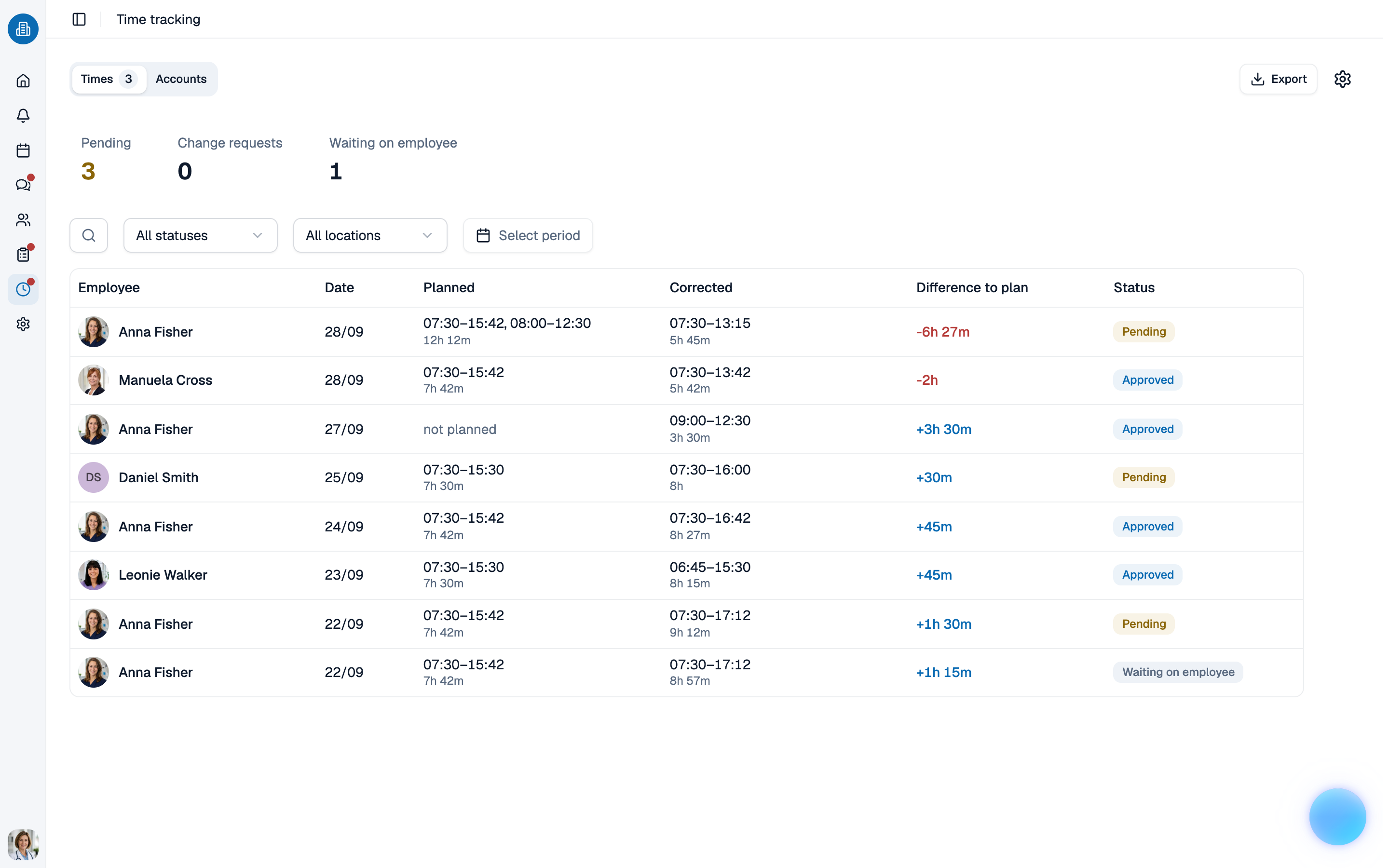 In medishift recorded hours flow into the overtime account. See the plans.
Time off in lieu and the National Minimum Wage
Time off in lieu does not change how hours count for the National Minimum Wage. HMRC's manual treats the hours worked as working time in the pay reference period in which they are worked, and the time off in lieu as time when no work is performed. For salaried hours work, HMRC adds that this time is not included as worked when excess hours are considered.
Each pay period is checked on its own. GOV.UK says a pay reference period can cover any period of time up to 1 calendar month, and employers must pay at least the minimum wage for the hours worked in each pay reference period. To check it, divide the pay for the period by the hours worked in the period.
The rate in that check is the National Living Wage of £12.71 an hour for workers aged 21 and over from April 2026, rising to £13.21 in April 2027 (GOV.UK rates). When the rate changes, GOV.UK says the increase applies to the first pay reference period starting on or after the date of the change. A receptionist employed by a GP surgery, as in the example below, is a worker in this sense and not on GOV.UK's list of exceptions, and "Contracts for payments below the minimum wage are not legally binding" (who gets the minimum wage). Hourly staff on flexible contracts face the same check, as our article on the zero hour contract shows.
Example: A receptionist at a GP surgery, aged 23, earns £13.00 an hour on 30 hours a week, paid monthly. November has 130 paid hours, so her November pay is £1,690.00. In the run-up to winter clinics she works 10 extra hours in November, agreed as TOIL to be taken in December. November now has 140 hours worked for £1,690.00: £1,690.00 / 140 = £12.07 an hour, below £12.71. The shortfall is 140 × £12.71 = £1,779.40, minus £1,690.00 = £89.40. The month tips earlier than most expect: £1,690.00 / £12.71 = 132.97 hours, so just under 3 extra hours are enough. The day off in December does not count as work and leaves November underpaid.
One way to correct the shortfall is a top-up in the next period. GOV.UK allows an employer to pay more in one pay reference period to make up for paying less than the minimum wage in the period immediately preceding, as long as the extra pay relates directly to the underpaid amount. In the example, that means at least £89.40 extra in the December pay, related to November, or paying the 10 hours in November in the first place.
Time off in lieu under Agenda for Change
Time off in lieu for NHS staff on Agenda for Change is set out in Section 3 of the NHS Terms and Conditions of Service Handbook, Amendment number 63. Under 3.1, overtime is hours worked in excess of 37.5 per week, staff in pay bands 1 to 7 are eligible for overtime payments, and the rate is time-and-a-half, with double time for work on general public holidays. Under 3.4 the overtime rates apply unless time off in lieu is taken, provided the line manager or team leader has agreed with the employee that the work is performed as overtime.
The rules for taking the time are short. Paragraph 3.5 says staff may request TOIL as an alternative to overtime payments, but staff who, for operational reasons, are unable to take it within three months must be paid at the overtime rate. Paragraph 3.7 sets time off in lieu at plain time rates, and 3.6 says senior staff in bands 8 or 9 are not entitled to overtime payments. Part-time employees receive plain time for additional hours until their hours exceed 37.5 in that week (3.3).
Example: An employee on Agenda for Change band 5, working 37.5 hours a week, does 6 approved overtime hours. Paid as overtime at time-and-a-half, that is 6 × 1.5 = 9 hours' pay. Taken as TOIL at plain time, it is 6 hours off. If operational reasons stop her taking the 6 hours within three months, she is paid at the overtime rate, so the 9 hours' pay is due.
Frequently Asked Questions
Sources
As of 15 November 2026
- GOV.UK: Overtime: your rights, time off and paid leave, compulsory overtime, retrieved 15 November 2026
- Acas: Pay for working extra hours, retrieved 15 November 2026
- HMRC: National Minimum Wage Manual, NMWM08550, retrieved 15 November 2026
- GOV.UK: National Minimum Wage and National Living Wage rates, who gets the minimum wage, calculating the minimum wage, retrieved 15 November 2026
- NHS Employers: NHS Terms and Conditions of Service Handbook, Amendment number 63, TCS Advisory Notice (04/2026)
- GOV.UK: Holiday entitlement, maximum weekly working hours, rest breaks at work, retrieved 15 November 2026