How Many Hours in a Month? The Formulas
How many hours in a month? Between 672 and 744 on the calendar, 730 on average. As working time: 174 hours on a 40-hour week, 167.48 on 38.5. All the figures as tables, the 4.35-week formula with its derivation, and the exact route via working days.
Table of Contents
How many hours in a month? It depends on what you are actually trying to work out. On the calendar, a month holds between 672 and 744 hours, 730 on average. As working time, it holds 174 hours on a 40-hour week and 167.48 hours on a 38.5-hour week. Both numbers are correct, and in everyday practice work they get mixed up constantly, usually at the exact moment someone is working out the target hours for a part-time medical assistant. This article gives you every figure as a table, the 4.35-week formula together with its derivation, the exact route via working days, and the four arithmetic mistakes that tip a monthly balance most often.
Key figures at a glance
- How many hours in a month on the calendar? Only four answers are possible at all, because there are only four month lengths, plus two exceptions no table lists: the two months with a clock change.
- The average month with its 730 hours is an arithmetic device, not a month: not one of the twelve actually holds 730 hours.
- How many hours are in a month of working time? Weekly hours × 4.35. Forty becomes 174 hours, 38.5 becomes 167.48.
- The 4.35 factor comes from 52.18 weeks per year divided by 12 months. It is an average, not a figure for any specific month.
- It only becomes exact via working days: Monday to Friday minus public holidays, times daily target hours. In 2026 that swings between 20 and 23 days per month.
- The arithmetic ceiling sits at roughly 208.8 hours a month: 48 hours per week averaged over six months, derived from § 3 of the German Working Hours Act.
How many hours in a month on the calendar
On the calendar the sum is one line long: days × 24. Since there are only four month lengths, there are only four answers.
| Month length | Calendar hours | Applies to |
|---|---|---|
| 28 days | 672 | February in ordinary years |
| 29 days | 696 | February in a leap year |
| 30 days | 720 | April, June, September, November |
| 31 days | 744 | January, March, May, July, August, October, December |
How many hours in a month on average?
Across a full year that adds up to 8,760 hours, or 8,784 in a leap year. The average month therefore runs 365 ÷ 12 = 30.4167 days and exactly 730 hours. Count leap years in and you get 365.25 ÷ 12 = 30.4375 days and 730.5 hours. In capacity and availability calculations, 730 is the number people normally reach for, simply because it writes down cleanly.
The clock change: two months break the pattern
Two months a year do not fit the scheme, and almost every table answering "how many hours in a month" misses it: the clock change. In 2026 daylight saving time starts on 29 March and ends on 25 October. March 2026 therefore holds 743 hours rather than 744, and October holds 745. For payroll on an early shift this is irrelevant. For an on-call duty running from 22:00 to 06:00 through the changeover night, it is precisely the one hour people argue about afterwards.
When you plan a specific month you do not need calendar hours anyway. You need working days. So how many hours in a month of 2026, and how many weekdays sit inside it? Here is the overview:
| Month 2026 | Days | Calendar hours | Weekdays Mon to Fri |
|---|---|---|---|
| January | 31 | 744 | 22 |
| February | 28 | 672 | 20 |
| March | 31 | 743* | 22 |
| April | 30 | 720 | 22 |
| May | 31 | 744 | 21 |
| June | 30 | 720 | 22 |
| July | 31 | 744 | 23 |
| August | 31 | 744 | 21 |
| September | 30 | 720 | 22 |
| October | 31 | 745* | 22 |
| November | 30 | 720 | 21 |
| December | 31 | 744 | 23 |
* Clock change: March loses an hour, October gains one.
The weekday counts exclude public holidays, because those differ from one German federal state to the next. For your own practice, subtract the statutory holidays in your state that fall on a Monday to Friday. Holidays landing on a weekend change nothing about target time.
How many hours are in a month of working time? The 4.35 formula
As soon as working time is the subject, the meaning shifts: how many hours in a month are actually worked? Nobody works 730 hours. What you are after is monthly target time, and that follows from weekly hours:
Monthly hours = weekly hours × 4.35
Where the 4.35 factor comes from
A year averages 365.25 days. Divided by seven that is 52.18 weeks, and divided by twelve months, 4.3482 weeks per month. Rounded to two places: 4.35. So the factor is not a rule of thumb but calendar arithmetic condensed into one number. Which is exactly why it holds for the average month and for no individual one.
Monthly hours for the common weekly models
| Weekly hours | Monthly hours (× 4.35) | Typical for |
|---|---|---|
| 40.0 | 174.00 | full time without collective agreement |
| 38.5 | 167.48 | full time under many medical-assistant agreements |
| 35.0 | 152.25 | reduced full time |
| 30.0 | 130.50 | part time, four days |
| 25.0 | 108.75 | part time, three to four days |
| 20.0 | 87.00 | a half-time position |
| 10.0 | 43.50 | close to a mini-job, two days |
The 38.5-hour week is the most common full-time figure in German medical practices; which weekly working time applies to you is set out in the collective framework agreement for medical assistants or in your own employment contract.
Why some people calculate with 4.33 instead of 4.35
There is a second rule of thumb: 52 weeks ÷ 12 months = 4.3333, or 13/3. On that basis 40 weekly hours produce 173.33 monthly hours instead of 174. The gap looks laughably small: 0.67 hours a month. Over a year it is eight hours, which is a full working day. So once you pick a formula, stay with it rather than switching whenever it suits. The reason for the discrepancy: 52 weeks are only 364 days, while a year has 365. That leftover day is exactly the difference between 4.33 and 4.35.
Calculating monthly target hours exactly: working days instead of a rule of thumb
The rule of thumb is fine for contracts and costings. For a monthly balance that a medical assistant reads through at month's end, it is too coarse. There the question is not how many hours in a month, but how many hours were in this particular month. The exact route goes via working days:
Monthly target time = (weekdays Mon to Fri − public holidays) × daily target hours
On 38.5 weekly hours spread over five days, that is 7.7 hours a day. A month with 20 working days therefore comes to 154 hours, one with 23 working days to 177.1 hours. The spread between the shortest and the longest month of the year is a good 23 hours, and with a rule of thumb that stubbornly applies 167.48 to every month, that difference disappears. It does not disappear from reality, though: the assistant genuinely works less in February than in July.
Out of that gap come the two models you choose between, as far as the employment contract or a collective agreement leaves that choice open:
- Fixed monthly target time. Every month is measured against the same figure, say 167.48 hours. The balance then swings systematically: someone collects minus hours in February and plus hours in July, and it evens out across twelve months. The upside is that the number in the contract always holds.
- Calendar-accurate monthly target time. Every month is measured against its own working days. The balance then shows real extra work rather than calendar effects. The upside is that it can be explained, so nobody argues about it.
For teams that track time, option two is almost always the right one, because the balance there becomes something people talk about. Either way there is a ceiling: eight hours per working day is the rule, up to ten is permitted provided the average across six calendar months or 24 weeks does not exceed eight (§ 3 of the Working Hours Act). Six working days times eight hours is a 48-hour week: multiplied by 4.35, roughly 208.8 hours a month as the arithmetic ceiling. And for everything beyond eight hours on a working day, the employer has to keep records (§ 16 (2) of the Working Hours Act), which does not mean the hours below that need no record: in its ruling of 13 September 2022 (1 ABR 22/21), the German Federal Labour Court (BAG) held that employers have to record their employees' working time in full.
Part time, assistant shifts and the monthly balance in practice
In a practice with eight employees, rarely do two people work the same model. That is precisely where "how many hours are in a month" turns into a per-head calculation. The route is always the same: apply the part-time quota to the full-time weekly hours, then multiply by 4.35.
| Quota | Weekly hours (base 38.5) | Monthly hours |
|---|---|---|
| 100 % | 38.50 | 167.48 |
| 80 % | 30.80 | 133.98 |
| 75 % | 28.88 | 125.61 |
| 60 % | 23.10 | 100.49 |
| 50 % | 19.25 | 83.74 |
Those values are the yardstick applied at the end of the month, and they are why one practice team can hold five different answers to how many hours in a month. An example from an ordinary week: an assistant on a 60 per cent post covers Monday, Wednesday and Friday from 7:30 to 15:15 with a 30-minute break. That is 7 hours 15 minutes net per day, or 7.25 in decimal hours (the decimal hours calculator walks through that conversion), or 21.75 hours a week, just under the 23.1 hours her contract provides for. Across the month she is around 5.9 hours short, and those get filled by an extra half day or a Saturday surgery. Differences like that are unremarkable once you see them, and infuriating when they pile up unnoticed for six months.
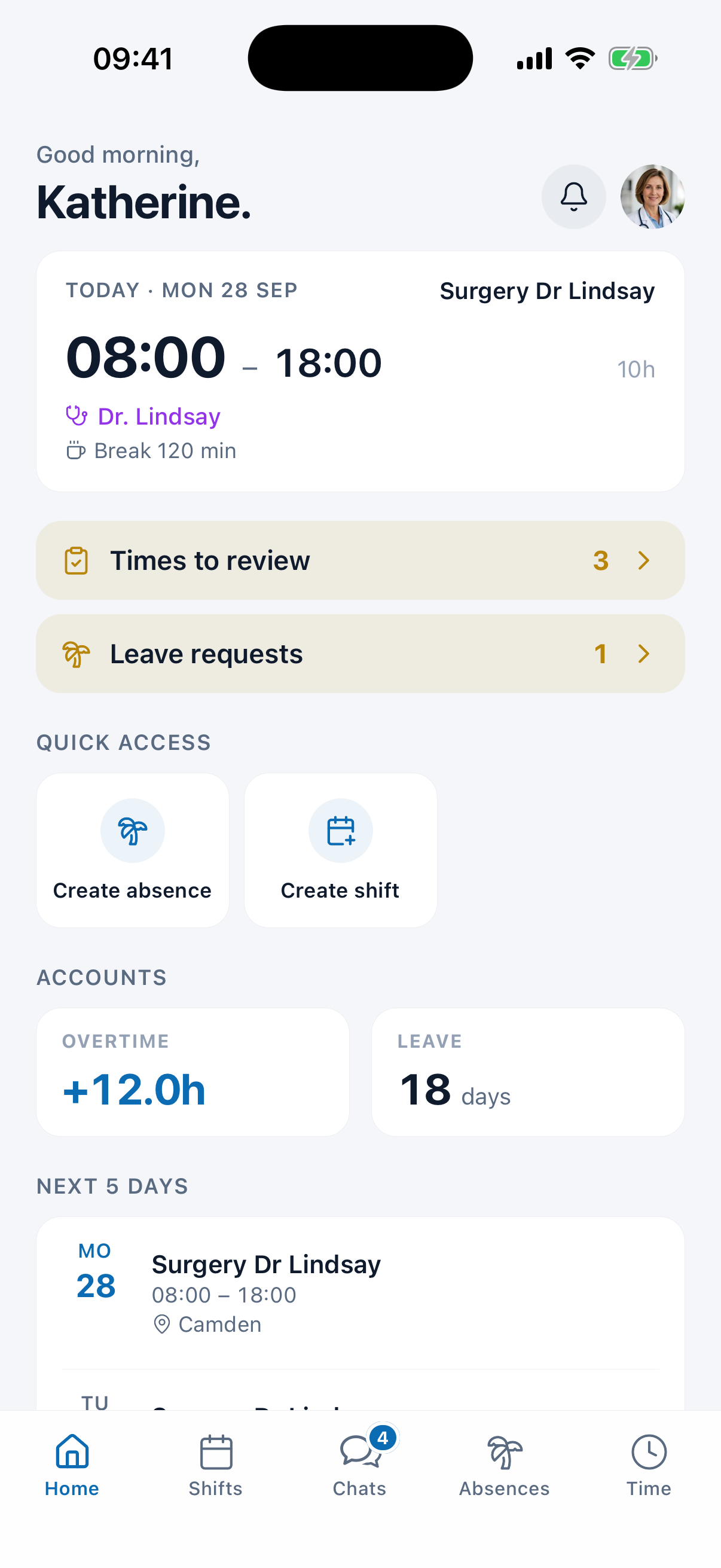 You store weekly and daily target hours per person; the overtime account with its monthly balance and the time clock shown here belong to the Premium plan. See the plans.
In medishift you set weekly target hours in half-hour steps and, beneath them, daily target hours per weekday, so zero hours for the Tuesday your colleague is not in, and 7.7 for the rest. Change those values later and a new version is created with a validity date; the earlier one stays visible, so a balance from March remains traceable. The overtime account then does the arithmetic on its own: actual hours minus target. Published shifts count as actual hours, as do absences flagged as working time and public holidays falling on working days. A public holiday is therefore credited as target time, unless a shift is genuinely worked on it, in which case there is no double credit. The current month and the previous one stay open and recalculate; older months are frozen. If you also want to record clocked hours, time tracking is available from the Premium tier: clocking in and out via timer or entering hours manually, breaks included. The recorded times feed into the same overtime account and the monthly target-versus-actual report.
Four mistakes that wreck a monthly balance
1. Mixing the rule of thumb with the calendar month. Calculating target time with 4.35 while pulling actual hours from the real working days produces a discrepancy of up to 13 hours every month that nobody can account for. Pick one of the two routes and apply it to everyone.
2. Counting public holidays twice. If the holiday is credited as target time and the shift worked anyway also lands in full on the actual side, the person ends up a whole day in credit. The underlying rule is simple: credit it or work it, not both.
3. Not deducting breaks. From 7:30 to 15:15 is 7 hours 45 minutes gross, but 7 hours 15 minutes net after a 30-minute break. Over 21 working days that is a 10.5-hour difference in the month: more than a full working day. To write gross, break and net down day by day, use the Excel timesheet template.
4. Deriving monthly hours from four weeks. Answering "how many hours in a month" with "four weeks" is the single most widespread error: 38.5 × 4 = 154 instead of 167.48. That leaves 13.48 hours missing per month and 161.7 hours per year. A month never has four weeks; it has 4.35.
Conclusion: how many hours in a month for your planning?
How many hours in a month? 672 to 744 on the calendar, 730 on average, and as working time 174 on a 40-hour week or 167.48 on 38.5. For contracts and costings the 4.35 formula is enough. For a monthly balance your team reads through, calculate to the calendar via working days and subtract the public holidays of your federal state. The rest is bookkeeping: deduct breaks, count holidays once, pick one route and stay on it. If you would rather not redo all this by hand every month, store the target hours once per person and let the balance run. medishift keeps it up to date as soon as the shifts are published.