Panama Shift Pattern: 2-2-3 Rota, Hours, UK Law
The Panama shift pattern is a 14 day 2-2-3 rota for four teams on twelve hour shifts: full calendar, hours, free weekends and the UK Working Time Regulations.
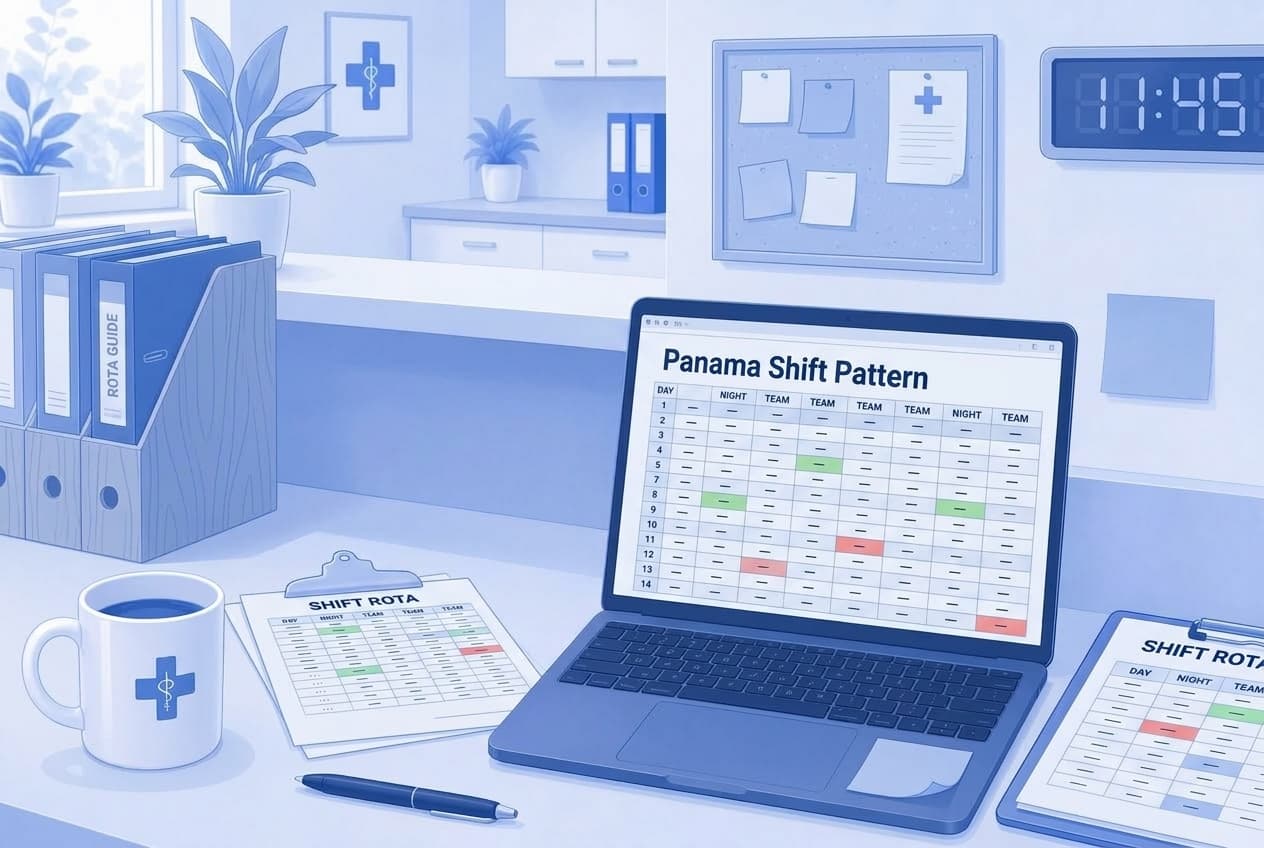
Table of Contents
The Panama shift pattern is a 14 day rota in which you work two days, have two off, work three, have two off, work two and then have three off. Shifts are twelve hours long, so four teams cover a site around the clock: two teams share the day shifts, two share the nights, and on any given day one team is on days, one is on nights and two are at home. Each person works seven shifts per fortnight, 84 hours, an average of 42 a week, and every second weekend is free from Friday to Sunday.
Key takeaways at a glance
- The Panama shift pattern follows the sequence 2-2-3-2-2-3 (on, off, on, off, on, off) over 14 days. No one works more than three shifts in a row.
- Four teams, twelve hour shifts: A and B split the days, C and D split the nights. Each team works exactly the days its partner has off.
- 84 hours per fortnight is 42 a week on average. With Monday to Sunday weeks that is 60 hours one week and 24 the next; the familiar 36 and 48 only appear if you count weeks from Wednesday.
- Every team has every other weekend off, Friday to Sunday, and works the weekends in between.
- The pattern sits inside the 48 hour average of regulation 4, but twelve hour nights need their own check under regulation 6.
What is a Panama shift pattern?
A Panama shift pattern, often just called a Panama rota or Panama shifts, is a continuous rota for workplaces that never close. No reliable source explains the name. What matters is the shape: short working blocks of two or three days, long twelve hour shifts and a cycle of exactly two weeks.
In the UK you find Panama shifts on hospital wards and in care homes with nursing, in ambulance and fire control rooms, in security teams guarding a site overnight, in warehouses with night picking and on production lines that cannot stop. Typical timings are 07:00–19:00 for days and 19:00–07:00 for nights; some wards run slightly longer shifts, such as 07:30–20:00, so that day and night staff overlap for the handover.
The 14 day Panama shift pattern calendar
Here is the full calendar with day 1 on a Monday. A night shift is listed on the date it starts.
| Day | Days | Nights | Off |
|---|---|---|---|
| 1 Mon | A | C | B D |
| 2 Tue | A | C | B D |
| 3 Wed | B | D | A C |
| 4 Thu | B | D | A C |
| 5 Fri | A | C | B D |
| 6 Sat | A | C | B D |
| 7 Sun | A | C | B D |
| 8 Mon | B | D | A C |
| 9 Tue | B | D | A C |
| 10 Wed | A | C | B D |
| 11 Thu | A | C | B D |
| 12 Fri | B | D | A C |
| 13 Sat | B | D | A C |
| 14 Sun | B | D | A C |
Every row has one team on days, one on nights and two off.
The same rota by team is easier to hand out. D is a day shift, N a night shift, a dot a day off:
| Team | M | T | W | T | F | S | S | M | T | W | T | F | S | S |
|---|---|---|---|---|---|---|---|---|---|---|---|---|---|---|
| A | D | D | · | · | D | D | D | · | · | D | D | · | · | · |
| B | · | · | D | D | · | · | · | D | D | · | · | D | D | D |
| C | N | N | · | · | N | N | N | · | · | N | N | · | · | · |
| D | · | · | N | N | · | · | · | N | N | · | · | N | N | N |
Count team A through: two on, two off, three on, two off, two on, three off. Seven shifts, seven days off. Team B runs the same sequence one week later, and days 15 to 28 repeat the table exactly.
Fixed teams or rotating days and nights
In the tables, A and B only work days and C and D only nights. Fixed teams suit people who want a stable body clock.
Many sites rotate instead, so nobody is a permanent night worker. The cleanest way is to swap at the end of each 14 day cycle: A takes over C's line and C takes A's, B and D likewise. Cover stays intact, and every changeover falls after a break of two or three days. Each person then spends a fortnight on days and a fortnight on nights. If you swap more often, check the rest period at every changeover.
Panama, 2-2-3 and Pitman: one pattern, several names
In the US the same sequence is usually called the 2-2-3 schedule. Pitman is used inconsistently: some rota guides apply it to exactly this pattern on twelve hour shifts, others to a 2-3-2 variant. Neither name is officially defined, so compare the sequence and the shift length, not the label. The 2-2-3 rhythm also exists on eight hour shifts, but that is a different rota. When people in the UK say Panama shift pattern, they mean twelve hours.
Hours on the Panama shift pattern
Seven twelve hour shifts per 14 days make 84 hours per fortnight, so 42 a week on average. The weekly split depends on where your week starts.
| Week counted from | Week 1 | Week 2 | Average |
|---|---|---|---|
| Monday | 60 h | 24 h | 42 h |
| Wednesday | 36 h | 48 h | 42 h |
Count from Monday and team A works Monday, Tuesday, Friday, Saturday and Sunday: five shifts, 60 hours. The next week holds only Wednesday and Thursday: 24 hours. Many explanations quote 36 and 48 instead; that split only appears for weeks running Wednesday to Tuesday.
This matters for overtime. If your contract pays overtime for hours above 48 in a calendar week, a Monday count produces 12 hours of it in every heavy week, while a Wednesday count never does. The 84 hours also assume each shift is paid for twelve full hours; unpaid breaks or paid handover time change the contracted figure.
The Panama shift pattern and the Working Time Regulations
This section summarises the Working Time Regulations 1998 (SI 1998/1833). It is not legal advice.
Weekly limit, night work and health assessments
Regulation 4 limits working time to an average of 48 hours a week over a reference period of 17 weeks, unless the worker has opted out. Seventeen weeks hold eight full cycles plus one extra week of two to five shifts, so 696 to 732 hours, an average of about 41 to 43. The margin is not large: overtime, bank shifts and second jobs count towards the same 48 hours.
Regulation 6 caps a night worker's normal hours at an average of eight in each 24 over the reference period. A Panama night team stays under it, whether you simply divide 84 hours by 14 days or use the stricter regulation 6(5) method worked through in our DuPont shift pattern guide.
Averaging does not help everyone. Regulation 6(7) sets a hard limit of eight hours in any 24 for night workers whose work involves special hazards or heavy physical or mental strain, as identified by a risk assessment or collective agreement. Twelve hour nights are then out, unless regulation 21 applies or a collective or workforce agreement modifies the limit under regulation 23(a); either way, regulation 24 then requires compensatory rest. And regulation 7 obliges you to offer night workers a free health assessment before they start and at regular intervals afterwards.
Daily rest, weekly rest and breaks
Regulation 10 gives adults eleven consecutive hours of rest in each 24 hour period. Two twelve hour shifts back to back leave twelve hours between them: a buffer of one hour. On a 07:30–20:00 rota only 11.5 hours remain, a buffer of thirty minutes. A handover that regularly overruns, or staying late to cover a sick colleague, uses it up. A swap that puts a day shift straight after a night is the other trap.
Weekly rest under regulation 11 is 24 uninterrupted hours in every seven days or 48 in every 14. The pattern's own breaks of two and three days cover this comfortably.
Regulation 12 entitles anyone working more than six hours to an uninterrupted rest break of at least 20 minutes, unless a collective or workforce agreement provides otherwise. Outside regulation 21 it is mandatory on twelve hour shifts; whether it is paid is a matter for the contract.
Regulation 21 lets some sectors depart from these rules, among them security needing permanent presence and hospital or residential care. Night limits including 6(7), daily and weekly rest and breaks are then relaxed, the 48 hour average runs over 26 weeks (regulation 4(5)), and regulation 24 generally requires equivalent compensatory rest.
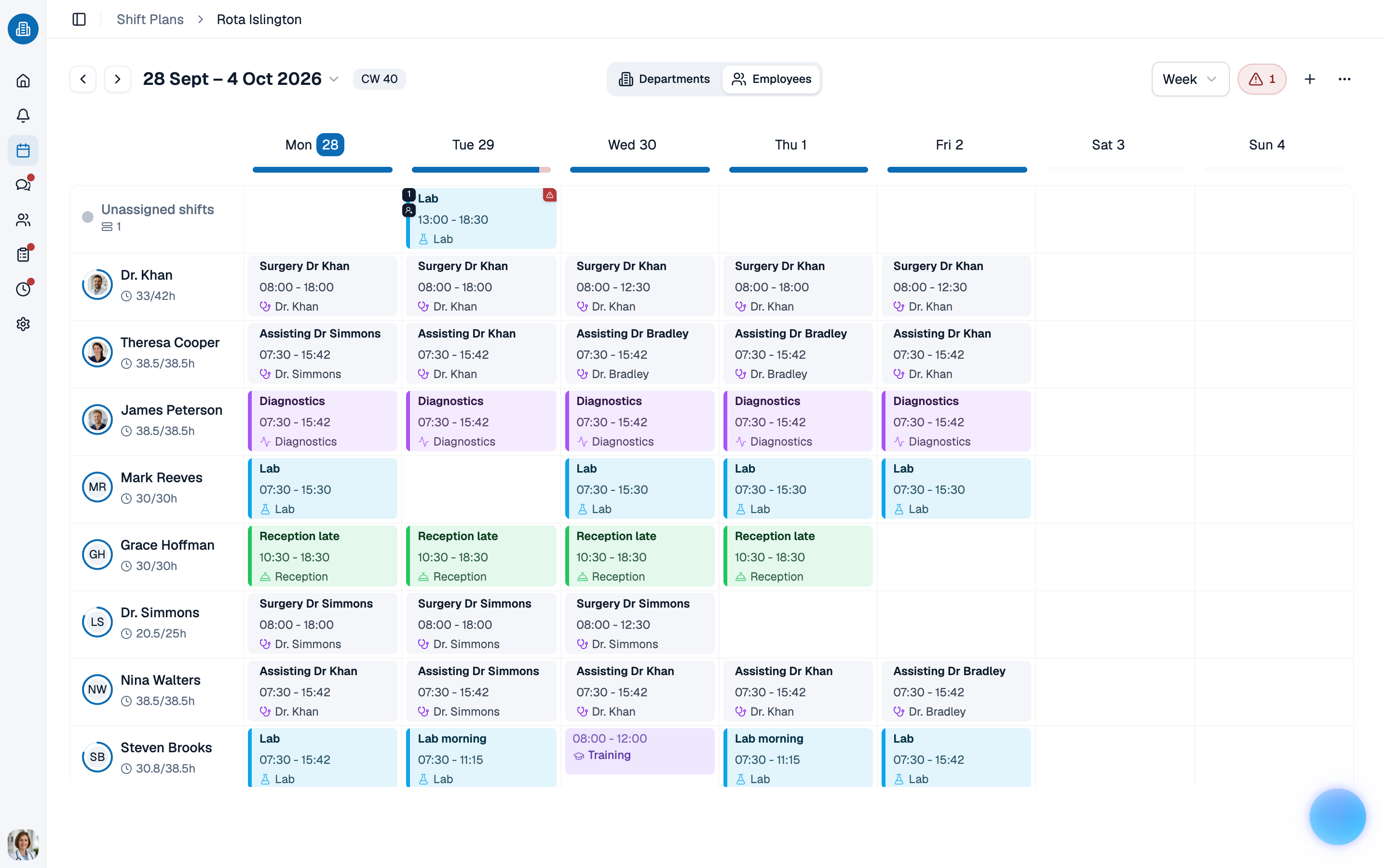 With medishift you save both weeks of the Panama cycle as templates and roll them forward for the year. See the plans!
Weekends, bank holidays and leave
Weekends
Weekends are why Panama shifts are popular. Every team works one weekend and has the next one off, and because the working weekend is a block from Friday to Sunday, so is the free one. That is 26 free weekends a year, as many as the DuPont rota gives and more than 4 on 4 off. There is a catch for night teams: team C's Thursday night ends at 07:00 on Friday, so its long weekend begins with sleep, and its working weekend ends at 07:00 on Monday.
Bank holidays
England and Wales have eight bank holidays a year, Scotland usually nine and Northern Ireland ten; the dates are on gov.uk/bank-holidays. There is no legal right to have a bank holiday off, and a 24/7 site runs through: one day team and one night team are always on. Since each person works seven days in fourteen, everyone works about half of the bank holidays over time. Enhanced pay or a day in lieu is a matter for the contract. A year is 26 cycles plus one day, so the pattern moves only one day against the calendar each year, and the same team can work Christmas several years running. Agree a swap rule early.
Annual leave in hours, not days
Statutory leave is 5.6 weeks (regulation 13 plus regulation 13A). With an average week of 42 hours, a reasonable approximation is 5.6 × 42 = 235.2 hours, or 19.6 twelve hour shifts. Check how your contract defines a week of leave, then book leave in shifts or hours, never in calendar weeks: the same Monday to Sunday week costs team A five shifts and team B only two.
Pros and cons of the Panama shift pattern
What staff like:
- Every other weekend off, three days long.
- Never more than three shifts in a row, so fatigue builds less than on longer blocks.
- About 182 full days off a year.
- A rota that is predictable months ahead.
What wears people down:
- Twelve hours is long, and with a commute the working day becomes fourteen.
- Short breaks: two days off after nights is often one day of recovery and one day of life.
- Nights: on a fixed team you are a permanent night worker; on a rotating one your body clock keeps changing.
- Childcare: few nurseries open at 06:30 or close at 19:30, and your working days change from week to week.
- Two handovers a day, each a point where information can get lost.
Who is the Panama shift pattern for?
It fits any operation that needs the same staffing around the clock: wards and care homes, control rooms, security, logistics and continuous production. It does not fit a GP surgery, a dental practice or any clinic with set opening hours, which need no nights and whose appointment day does not match twelve hour shifts. Early and late shifts on weekdays serve them better, as the overview of shift systems shows.
Panama compared with other shift patterns
| Pattern | Cycle | Shift | Teams | Avg hours | Longest block | Free weekends / year |
|---|---|---|---|---|---|---|
| Panama (2-2-3) | 14 days | 12 h | 4 | 42 | 3 shifts | 26 |
| 4 on 4 off | 8 days | 12 h | 4 | 42 | 4 shifts | about 19.5 |
| DuPont | 28 days | 12 h | 4 | 42 | 4 shifts | 26 |
All three deliver 42 hours with four teams. The difference is how the work is bunched. The 4 on 4 off shift pattern gives four day breaks, but its eight day cycle drifts against the week and only repeats by weekday after 56 days, so weekends come irregularly. The DuPont shift pattern packs work into three weeks, including a 72 hour week, then gives back seven days in a row (its two free weekends assume a Monday start). Panama keeps blocks short and weekends regular, at the price of never more than three days off.
Panama vs continental shift pattern
A continental shift pattern is a fast rotating rota. On eight hour shifts, teams typically work two mornings, two afternoons and two nights, then have two days off, so they pass through three shift types in eight days. Panama uses twelve hour shifts, only two shift types and a fixed 14 day cycle. Some employers also call a twelve hour rota of two days, two nights and four off continental, or use the word for any 24/7 rota, so check the shifts behind the label. If your site needs three shifts a day, a continental pattern or a rolling rota on eight hours fits better.
Staffing a Panama rota
Four teams, each as large as the staffing you need per shift. A ward that needs three healthcare assistants on every day and every night needs four teams of three: twelve people, with nothing left for leave or sickness. Their leave alone is about 235 twelve hour shifts a year, four or five a week. Plan bank staff or a relief line from the start, rather than calling people in on their free weekend.
Putting the Panama shift pattern into practice
A 14 day cycle is exactly two calendar weeks, easy to build even in an Excel hospital shift schedule. In medishift you set up week 1 with all four teams' shifts and assignments and save it as a week template, then do the same for week 2. You apply each template to future weeks at an interval of every second week, with a horizon of up to twelve months.
Per location you can turn on rules for minimum rest between shifts, maximum hours per day and maximum consecutive working days; the plan then flags every shift that breaks them, as warnings rather than hard blocks. Staff see their own shifts in the mobile app.
In short: the Panama shift pattern gives you a two week cycle, short working blocks and every other weekend off, in exchange for twelve hour days and an hour or less of margin on daily rest. Decide on fixed or rotating nights, the counting week for overtime and the Christmas rule before the first cycle. To try it with your own team, see the plans.
This article is general information, not legal advice. Check your contracts, collective agreements and risk assessments against the Working Time Regulations before introducing the rota.