
Holiday entitlement in the UK sets the floor for every holiday plan a practice manager draws up: how many days each person is owed, when they can take them, what happens to days left over and what a leaver is paid. Get the floor wrong and the plan on top of it fails, however neatly it is laid out. This guide covers UK holiday entitlement law as it applies in England, Scotland and Wales and then the part the law leaves to you, planning leave across a medical practice or ward so that cover holds all year.
The legal source is the Working Time Regulations 1998. They extend to Great Britain only [14], so Northern Ireland, which has its own regulations, is covered in a short section further down. Figures below are statutory minimums. Many contracts give more, and where your contract is more generous, it is the contract you plan with.
Holiday entitlement UK: the statutory minimum
Almost every worker in Great Britain is entitled to 5.6 weeks of paid holiday a year [6]. The figure is built from two parts. Regulation 13 gives four weeks of annual leave in each leave year [1], and regulation 13A adds 1.6 weeks of additional leave [2]. Irregular hours and part-year workers follow regulation 15B instead, covered below. Together they are capped at 28 days [2], which is exactly what 5.6 weeks comes to for someone working five days a week.
The cap matters for anyone working six days. Six times 5.6 would be 33.6 days, but the statutory entitlement stays at 28. Acas puts it plainly: statutory paid holiday is limited to 28 days, however many days someone works [7].
Bank holidays are the question practice managers get asked most. An employer may count them as part of the 5.6 weeks [6]. There is no separate legal right to have bank holidays off on top of the statutory leave. Many employers give them in addition anyway, and either approach is lawful as long as the contract says which one applies. What causes disputes is not the choice itself but a contract that is silent, followed by a practice that treats different staff differently.
The leave year is the period entitlement is counted in. If a relevant agreement, such as the contract or a workforce agreement, names a start date, that date applies. If not, each worker's leave year starts on the day their employment began and on each anniversary of it [1]. For a practice that is the strongest argument for fixing one leave year in writing: with ten staff and no agreement you run ten different leave years.
Working out holiday entitlement
For someone on a regular full-time pattern the calculation is the 28 days above. Everything else is a variation on proportion.
Part-time staff
Part-time staff with regular hours get the same 5.6 weeks, in proportion to the days they work. GOV.UK and Acas both give the same example: someone working three days a week is entitled to 16.8 days, three times 5.6 [6][7]. Counting their leave in their own working days keeps it fair in both directions. A part-timer who never works Fridays should not lose a day of leave for the Friday of a bank holiday weekend they would have had off anyway, and should not gain one either.
Staff who join or leave during the year
Someone who starts after the leave year has begun is entitled to a proportion of the year's leave, matching the part of the year left when they start [1][2]. In the first year of employment, leave builds up month by month. Regulation 15A has it accrue at one twelfth of the annual amount on the first day of each month, and a fraction of a day is treated as a half day if it is under half and a whole day if it is over [10]. GOV.UK works it through for a five-day worker: 28 divided by 12 is 2.33 days, rounded up to 2.5 [6].
What happens when someone leaves is covered in its own section below, because it is where most disputes start.
Irregular hours and part-year workers
Staff whose paid hours are wholly or mostly variable, such as bank receptionists or locum cover on zero hours contracts, do not fit a fixed allowance. For leave years beginning on or after 1 April 2024, regulation 15B gives irregular hours workers and part-year workers holiday that accrues on the last day of each pay period at 12.07% of the hours worked in that period, up to 28 days in a leave year [5]. Under regulation 16A their holiday pay can be paid as rolled-up holiday pay, a 12.07% uplift on their pay for work done that has to be shown separately on the payslip [13].
We cover this group in detail, with a worked example for a GP surgery, in our guide to the zero hour contract. For planning purposes the point is simpler: these staff earn leave as they work, so their entitlement has to be tracked in hours, period by period, rather than set once at the start of the year.
Holiday pay in brief
Statutory holiday is paid holiday. Regulation 16 entitles a worker to a week's pay for each week of leave [8]. For the four weeks under regulation 13, and for leave under regulation 15B, a week's pay has to include more than basic pay: commission linked to the tasks of the job and regularly paid overtime are part of it, looking back over the previous 52 weeks [8].
The detail of that calculation, which weeks count and which are skipped, is beyond a planning guide. GOV.UK sets out holiday pay in its own section [6], and that is the place to check before running payroll for anyone whose pay varies from week to week.
Booking and refusing holiday
The Working Time Regulations set default notice rules that apply unless a relevant agreement changes them [3]. Most practices replace them with their own holiday policy, but the defaults are worth knowing because they apply whenever the contract is silent.
A worker books holiday by giving notice. The notice has to arrive before a date that lies twice as many days ahead of the first day of leave as the leave is long [3]. GOV.UK describes this as twice the length of the leave plus one day, so three days of notice for a single day off [6].
An employer can refuse or cancel requested leave by giving at least as many days of notice as the leave requested [3]. For a ten-day request that means a refusal at least eleven days before the leave starts, in GOV.UK's example [6]. An employer can also require staff to take leave on particular days, for example over Christmas or for bank holidays, by giving notice at least twice as long as the leave [6].
These defaults are short. A practice that wants holiday for August settled by spring needs its own rule, and regulation 15 allows exactly that through a relevant agreement [3]. Put the deadline, the restricted weeks and the tie-break rule in the contract or holiday policy, and the statutory minimum notice becomes a fallback rather than the plan.
Carry-over, sickness and family leave
The starting point is that statutory leave is used in the leave year it belongs to. It may be taken in instalments, but it cannot be replaced by a payment in lieu except when employment ends [1]. The idea is that people actually rest, not bank days for a payout.
Carry-over is allowed in four situations:
- By agreement, for the 1.6 weeks. A relevant agreement may let the additional leave under regulation 13A be carried into the next leave year [2].
- After statutory leave. If maternity, paternity, adoption or other statutory leave stops someone taking their holiday, the untaken leave carries forward to the next leave year [1][2].
- After sickness. Leave someone could not take because they were off sick carries forward, provided it is taken within 18 months of the end of the leave year it belongs to [1]. Acas notes that this covers up to four weeks [11], and holiday keeps accruing while someone is off sick [12].
- When the employer did not play its part. If an employer fails to give a reasonable chance to take leave, fails to encourage it or does not warn that unused leave will be lost, the worker can carry up to four weeks forward [1][11].
The fourth point is the one a practice controls. A written reminder a few months before the leave year ends, naming the days still open and saying they will be lost if not taken, turns a vague expectation into the documented warning the regulations refer to. Without it, untaken leave can follow the person into the next year.
When someone leaves
When employment ends partway through a leave year, regulation 14 compares the leave taken with the share of the year that has passed [4]. If the leaver has taken less, you pay them for the difference. Leave carried forward from earlier years is paid out as well [4]. GOV.UK adds that this applies even if the worker is dismissed for gross misconduct [6].
If the leaver has taken more than their share, you can only claw it back where a relevant agreement provides for it [4][6]. GOV.UK makes the practical point: an employer cannot deduct the excess from final pay unless that was agreed in writing beforehand [6]. A sentence in the contract saves a dispute at the worst moment.
The notice period itself is often the best time to settle a balance. A leaver may be able to use the leave they still have during their notice [6], which keeps the payment in lieu small and gives the team time to plan cover.
Northern Ireland
The Working Time Regulations 1998 extend to Great Britain only [14]. Northern Ireland has its own working time rules, and nidirect is the official guide for workers and employers there [9]. The headline minimum is also 5.6 weeks, 28 days on a five-day week [9], and paid leave on a bank or public holiday can count towards it. For notice periods, carry-over and irregular hours, a practice in Northern Ireland should check the Northern Ireland rules directly rather than rely on the regulation numbers in this guide.
Planning leave across a practice team
The law sets what each person is owed. It says nothing about how many people can be away at once, which is the question a practice manager faces every week. That part is planning, and it works best as a yearly cycle rather than a pile of individual requests.
Start from minimum cover, not from the requests. For each work area, reception, clinics, treatment rooms or the ward, decide how many people must be present on a normal day. That number is the limit every approval is checked against. It is far easier to defend a refusal by pointing to a cover rule everyone knew about than by saying the week felt busy.
Collect the year's main wishes by a cut-off date. Summer, school holidays, Easter and the days between Christmas and New Year attract most requests. Asking for all of them by a fixed date, a couple of months before the leave year starts, lets you see the clashes at once and share the popular weeks with a stated rule, for example rotating who gets first choice from year to year. Requests that arrive afterwards are handled one by one, approved if cover allows.
Use bank holidays deliberately. A day of leave either side of a bank holiday weekend is the most requested booking of the year. If several people want the same bridge day, the cover rule decides, and the tie-break rule settles who goes. Make sure bank holidays are in the holiday plan for the right nation: England and Wales, Scotland and Northern Ireland do not share every date.
Watch the balances during the year, not only at the end. A quarter before the leave year closes, list who still has a large balance. That is when a reminder is cheap and cover can still be arranged. Left to the last month, everyone who saved their days wants them in the same few weeks.
Treat absence data with care. Sickness and other absences sit in the same calendar as holiday, but they are not the same thing and should not be judged the same way. If you look at short-term absence patterns, our article on the Bradford score explains what that measure can and cannot tell you.
For staff on rotating patterns, holiday has to fit the rota rather than sit beside it. Our pieces on the rolling rota and the 4 on 4 off shift pattern show how leave works on fixed cycles.
Spreadsheet or holiday planner software
For a team of three, an Excel sheet or a wall chart often does the job. The trouble starts as the team grows and part-time staff, bank holidays, carry-over and requests from different channels all have to be kept in step. The usual signs are familiar: the remaining holiday is worked out by hand twice and gives two answers, requests arrive by text, note and conversation, and nobody can check their own balance without asking.
Holiday planner software is worth it once keeping the sheet up to date takes more time than the decisions do. The comparison table below sets out the main differences. Whatever tool you use, the rules above stay the same; software only makes them easier to apply consistently.
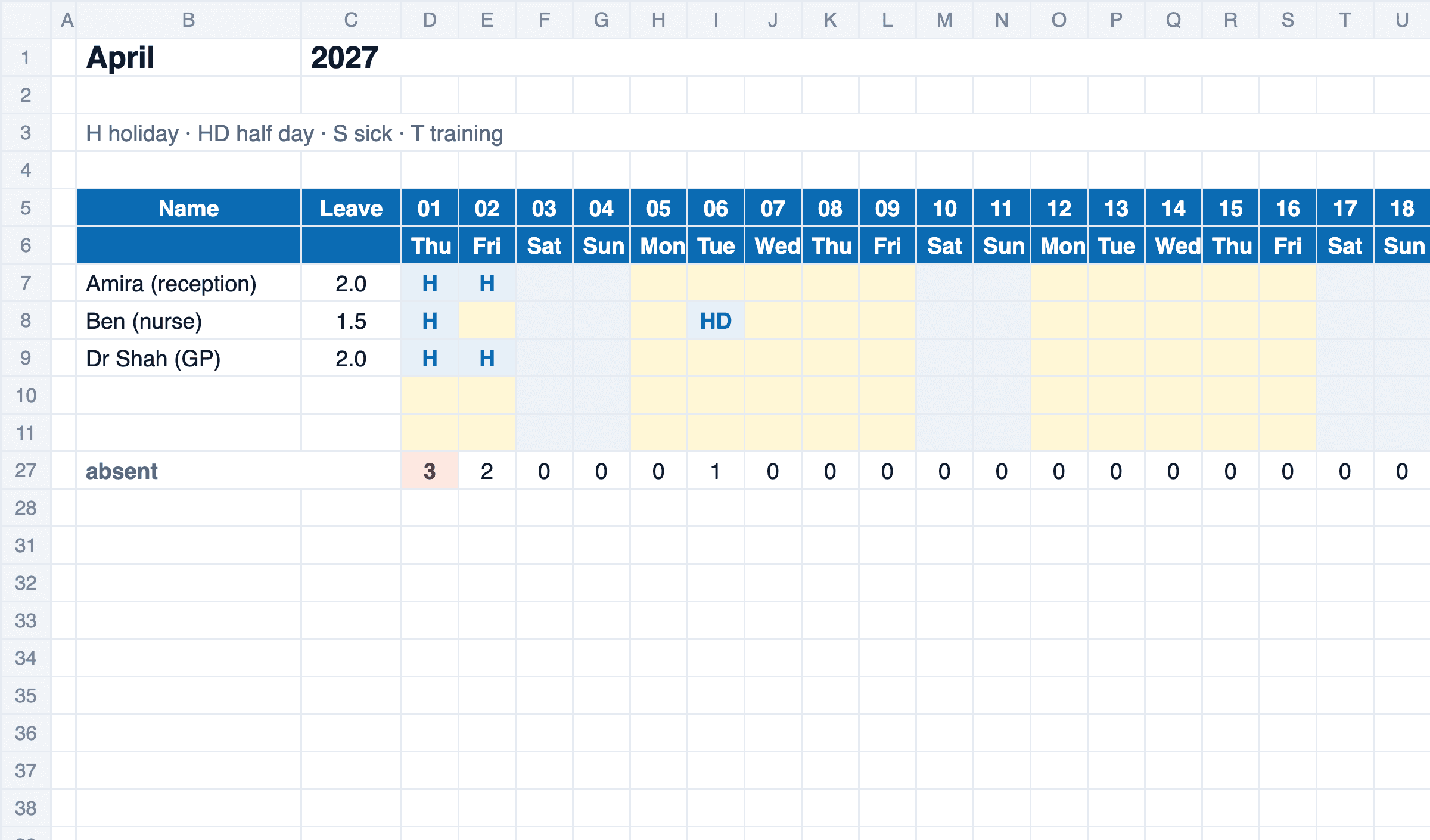
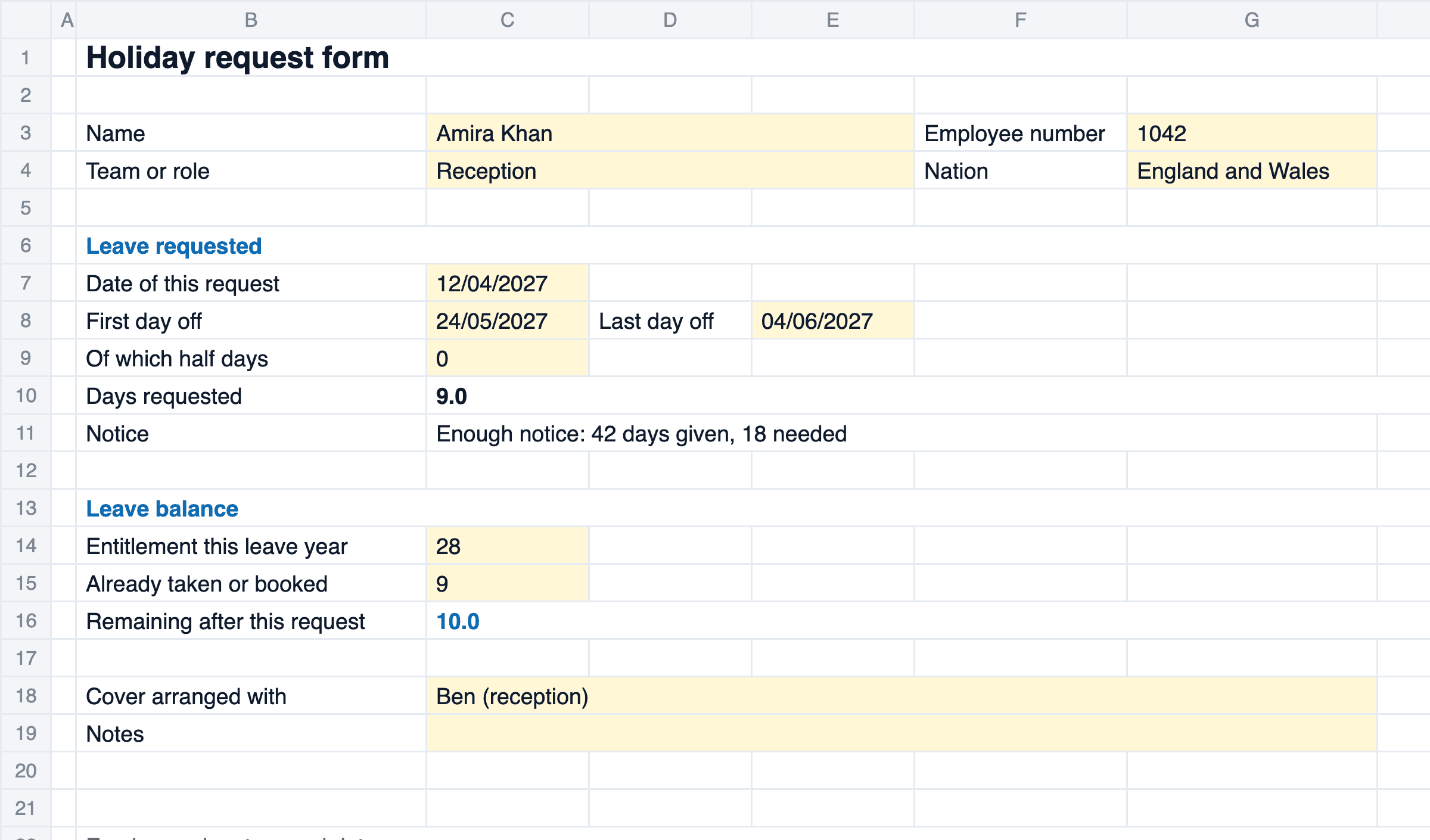
In medishift, staff request holiday in the same app they use to see their shifts, and the request lands in one list where you approve or decline it. While someone books, they and you see which colleagues in the same work areas are already away on those days. The balance follows a simple rule: annual entitlement plus carry-over, minus approved days, with pending requests not deducted until you decide. UK bank holidays are imported for the nation a site is set to, England preselected, and are left out when leave days are counted. A practice closure goes in once for everyone, and leave is counted per person on the days they work, so part-time staff are not charged for days they would not have worked.
medishift counts leave in days and half days. For irregular hours staff whose holiday accrues in hours under regulation 15B, keep that accrual in payroll, where the hours worked are already recorded. How booking and approval look in practice is shown on the page about our staff holiday booking system.
Common mistakes
Most holiday problems in practices come from a handful of repeated mistakes rather than from the law itself.
Leaving bank holidays undefined. If the contract does not say whether bank holidays sit inside the 28 days, two members of staff can reasonably read it two ways. Settle it in writing once.
Running a leave year per person by accident. Without a relevant agreement, each worker's leave year starts on their own start date [1]. A single practice-wide leave year makes balances, reminders and carry-over far easier to manage.
Giving part-time staff a full-time allowance in hours, or the reverse. Pro rata means in proportion to the work pattern. Converting carelessly between days and hours is where most part-time disputes begin.
Applying a fixed allowance to irregular hours staff. For leave years beginning on or after 1 April 2024, irregular hours and part-year workers accrue holiday at 12.07% of hours worked [5]. A fixed number of days for them is the wrong method, not just a generous one.
No reminder before the year ends. Without a documented chance to take leave and a warning that it will be lost, up to four weeks of untaken statutory leave can carry forward [1][11].
Deducting overtaken leave from final pay without agreement. That deduction needs a written agreement made beforehand [6].
Summary
UK holiday entitlement in Great Britain is 5.6 weeks a year, capped at 28 days, with bank holidays allowed inside that figure if the contract says so. Part-time staff get it pro rata, starters build it up month by month, and irregular hours and part-year workers accrue it at 12.07% of hours worked [5]. Statutory notice rules exist but are short, so most practices set their own in a holiday policy. Leave is meant to be used in its own year, with carry-over limited to agreement, sickness, statutory leave and an employer's failure to give a real chance to take it. Leavers are paid for what they have accrued and not taken.
On top of that floor sits the part only you can decide: minimum cover per work area, a cut-off for the year's main requests, a fair rule for the popular weeks and a reminder before the year closes. Write those down once, apply them the same way every year, and the holiday plan stops being a negotiation.