
A zero hour contract is an employment or worker's contract under which the employer need not offer any minimum hours of work. UK statute defines the term in section 27A(1) of the Employment Rights Act 1996, the section that bans exclusivity clauses; everything else depends on whether the person is an employee or a worker, as Acas puts it. The most concrete consequence for your rota is holiday: for leave years beginning on or after 1 April 2024, an irregular hours worker accrues annual leave at 12.07% of the hours worked in each pay period (regulation 15B(3)(b) of the Working Time Regulations 1998). The rules below are those for England, Scotland and Wales; Northern Ireland is not covered here.
Zero hour contract in five points
- The statutory definition is in s. 27A(1) ERA 1996, next to the exclusivity ban.
- A clause stopping the worker from working elsewhere is unenforceable against them (s. 27A(3) ERA 1996).
- Irregular hours workers accrue 12.07% of hours worked per pay period, at most 28 days a year (reg. 15B WTR 1998).
- The National Living Wage is £12.71 an hour from April 2026 for workers aged 21 and over (GOV.UK).
- Guaranteed hours, reasonable notice and cancellation pay are law but not in force, with no date announced (ERA 2025, Acas).
Zero hour contract or casual contract: what actually differs
A zero hour contract and a casual contract are the same thing on GOV.UK, whose employer guidance says that "zero-hours contracts are also known as casual contracts" and describes both sides as free: you do not have to give them work, and they do not have to do work when asked (GOV.UK). Acas states that rights "are based on your employment status, not on having a zero-hours contract", and that a person on such a contract can be legally classed as an employee or a worker (Acas). Classed as a worker, such a person is not entitled to redundancy, according to the same Acas page. An employee on such a contract might be offered redundancy, and being dismissed for asserting a statutory right such as rest breaks could be automatically unfair dismissal. The line that matters for a practice runs between those two statuses:
| Feature | Zero hours, worker status | Zero hours, employee status |
|---|---|---|
| National Minimum Wage, annual leave | Yes | Yes |
| Exclusivity clause enforceable | No | No |
| Must accept offered shifts | No | No |
| Statutory notice to end the contract | None, unless in written statement | Notice rules for employees |
| Unfair dismissal claim | No | After 2 years; after 6 months from 1 January 2027 |
What a zero hours contract means in law
The zero hours contract has a statutory definition, contrary to what several employer guides write. Section 27A(1) of the Employment Rights Act 1996 says that "in this section" the term means a contract of employment or other worker's contract under which the undertaking to work is conditional on the employer making work available, and there is no certainty that any work will be made available (legislation.gov.uk). The term is also written zero hour contract or 0 hours contract; the statute uses "zero hours contract".
The statutory wording covers only the employer's side and says nothing about whether the worker may turn work down; that half comes from the GOV.UK description. Section 27A(1) is to be omitted by the Employment Rights Act 2025, Schedule 2 paragraph 8, a change that legislation.gov.uk lists as not yet in force on 3 November 2026 (s. 27A ERA 1996).
Rights on a zero hours contract today
The rights on a zero hours contract start with pay and holiday: GOV.UK says zero-hours workers are entitled to statutory annual leave and the National Minimum Wage "in the same way as regular workers" (GOV.UK). From April 2026 the National Living Wage for those aged 21 and over is £12.71 an hour (GOV.UK National Minimum Wage rates). As the employer you also remain responsible for the health and safety of these staff (GOV.UK).
An exclusivity clause is the other fixed point. Under s. 27A(3) ERA 1996, any provision of such a contract that prohibits the worker from working under another contract, or from doing so without the employer's consent, is unenforceable against the worker (legislation.gov.uk). A bank receptionist who also covers at the surgery down the road is within her rights, and a consent requirement does not change that.
Holiday accrual at 12.07% of hours worked
Holiday for staff without fixed hours follows its own accrual rule for leave years beginning on or after 1 April 2024. Regulation 15F(1)(a) WTR 1998 makes someone an irregular hours worker for a leave year if the paid hours they work in each pay period are, under the terms of their contract, "wholly or mostly variable" (reg. 15F). Regulation 15B applies to irregular hours workers and part-year workers, except those covered by the Agricultural Wages (Scotland) Act 1949 (reg. 15B).
Leave accrues on the last day of each pay period at 12.07% of the hours worked in that period, and no more than 28 days can accrue in a leave year under the regulation (reg. 15B(3)(b) and (4)). Periods of sickness or statutory leave accrue under a separate rule in reg. 15B(3)(a), not at 12.07%. At any point in the year, the entitlement is what has accrued, plus anything carried forward, less what has been taken (reg. 15B(2)).
Holiday pay for this leave may be paid as rolled-up holiday pay: a 12.07% uplift on pay for work done, paid at the same time as that pay (reg. 16A(2) and (3)). It is an option ("may be paid"), not a duty. If you choose it, the itemised pay statement must show the holiday pay paid for the period (reg. 16A(7)).
Example: A GP surgery in England employs a bank receptionist on a zero hours contract, paid monthly. In October she works 64 hours at £13.00 an hour, an assumed rate above the £12.71 National Living Wage. Accrued leave: 64 × 12.07% = 7.72 hours. If the surgery uses rolled-up holiday pay instead: 64 × £13.00 = £832.00, and £832.00 × 12.07% = £100.42 paid with her October wages and shown separately on her payslip.
Leave for staff on fixed patterns is covered in our pieces on the rolling rota and the 4 on 4 off shift pattern, and holiday entitlement as a whole in our guide to holiday entitlement in the UK.
Statutory Sick Pay since April 2026
Statutory Sick Pay in 2026 is £123.25 a week or 80% of average weekly earnings, whichever is lower, paid for up to 28 weeks (GOV.UK). To qualify, GOV.UK says employees must have an employment contract, have done some work under it, have been sick for at least one full working day and give notice and proof of illness when needed (GOV.UK eligibility). The Lower Earnings Limit and the waiting period were removed from April 2026, according to the government roadmap. Guides that still quote a weekly earnings threshold or three waiting days predate that change. If you track short absences, our piece on the Bradford score covers how spells are counted.
Zero hour contract changes under the Employment Rights Act 2025
The zero hour contract reform is law but not yet in force. The Employment Rights Act 2025 received Royal Assent on 18 December 2025 (legislation.gov.uk).
Decided in the Act
The Employment Rights Act 2025 contains three measures giving the right to guaranteed hours reflecting the hours a qualifying worker worked during a reference period, reasonable notice of shifts and changes to them, and payment for shifts cancelled, curtailed or moved at short notice (GOV.UK consultation). The government states that these measures have not yet taken effect and that their details will be set out in regulations. Section 1 of the Act inserts a new s. 27BA into the ERA 1996: an employer must make a guaranteed hours offer after the end of every reference period in which the worker is a qualifying worker (s. 1 ERA 2025). The Act also caps "short notice": Ministers may define it in regulations, but not as more than 7 days (consultation document).
Proposed in the consultation
The consultation on ending one-sided flexibility sets out the government's preferences, not rules. It prefers an initial reference period of 12 weeks and an hours threshold within the range of 8 to 20 hours per week (consultation document). A worker will be able to decline the guaranteed hours offer and remain on their existing contract. For reasonable notice, the government rejects one fixed period for every case and will set out in regulations a presumption that tribunals start from. On cancellations it says no short notice payment is due when the worker cancels, does not turn up, or when two workers voluntarily agree to swap a shift.
Still open
The open questions on the Employment Rights Act 2025 are the numbers and the date. The consultation ran from 2 June 2026 to 25 August 2026, and GOV.UK still says "We are analysing your feedback" (GOV.UK consultation). Acas, last updated 30 October 2026, says the government "has not announced when the zero-hours and low-hours contract changes will happen" (Acas). The government roadmap, updated 22 October 2026, lists ending the exploitative use of zero hours contracts among measures for 2027, without a day (roadmap). The level of the cancellation payment and the length of short notice and reasonable notice are not fixed yet.
Keeping a record of zero hours shifts in medishift
Shift records for staff on a zero hours contract will matter more once notice and cancellation become rights, because who cancelled and when decides whether a payment is due under the government's reading. In the consultation's reading, two receptionists at the GP surgery in the example who agree to swap a shift trigger no payment. In our demos and onboarding we often see rotas sent round the team on WhatsApp, with changes in the same chats, where the current version easily gets lost. We also see cover for a dropout found through phone chains.
In medishift a shift stays a draft, visible only to admins, until you publish the week; publishing and any later change notify the team automatically. Each shift has a change history recording who changed what and when, including assignment changes and replacement requests, visible to admins. Staff can request cover themselves, and when a colleague takes the shift, the assignment switches and everyone involved is notified. What medishift does not do is calculate a cancellation payment, a guaranteed hours offer or the holiday accrual. Approved hours from time tracking can be exported as an Excel workbook with a sheet per employee, which someone then hands to payroll; there is no payroll integration. How the week is built is on our page on how to create a rota.
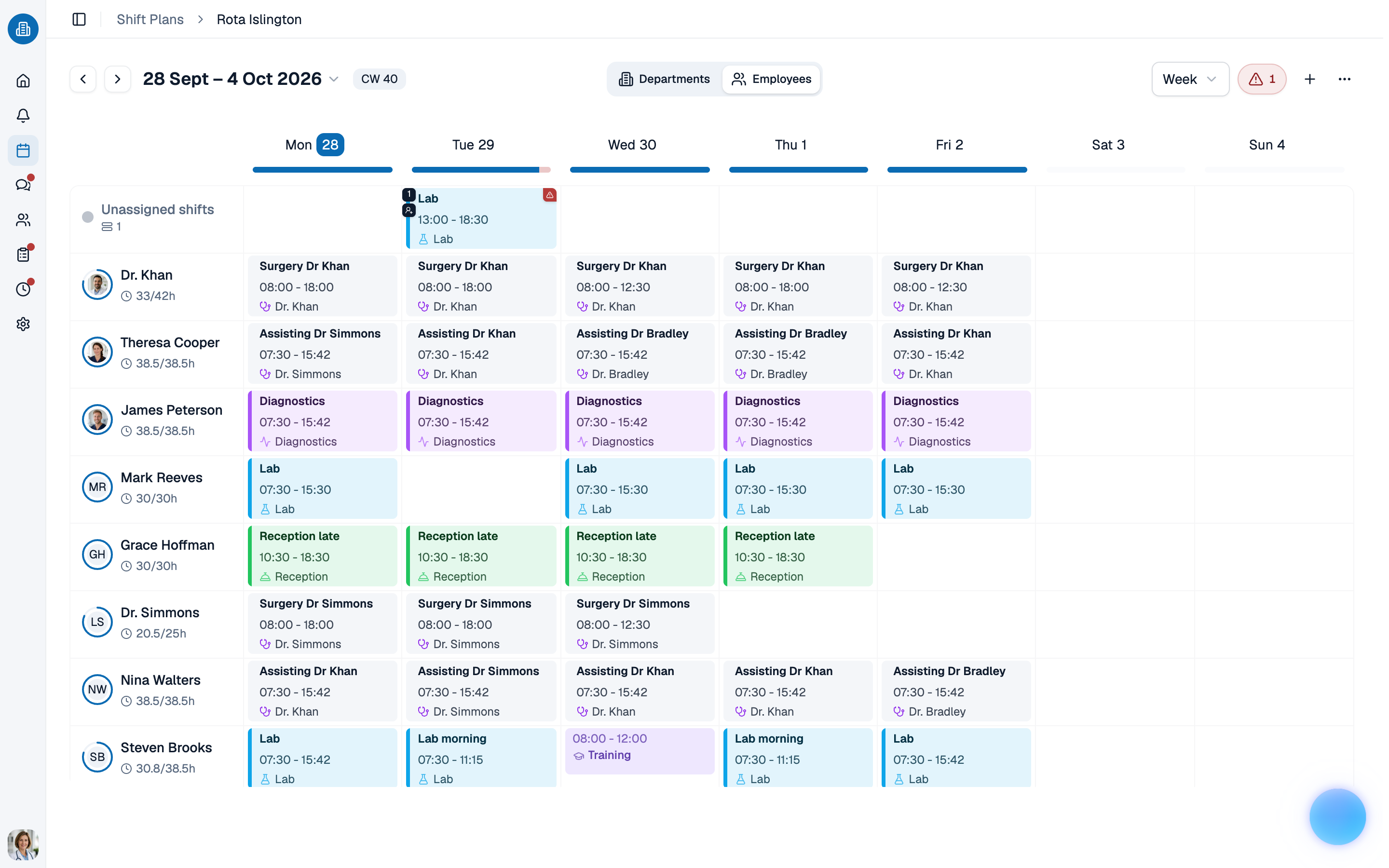 In medishift the week is drafted, published and changed in one place. See the plans.
Ending a zero hours contract and gaps between shifts
Ending a zero hours contract follows the status of the person. For a worker there is no statutory notice requirement on either side, and any notice the employer wants must be in the written statement; Acas notes this rule for workers only (Acas). Workers cannot claim unfair dismissal; employees can, after 2 years now and after 6 months from 1 January 2027 (Acas).
Gaps between shifts have their own trap. According to Acas, a full calendar week without work, meaning 7 consecutive days from Sunday to the following Saturday, usually counts as a break in employment, with exceptions such as up to 26 weeks of sickness, regular seasonal breaks or an agreed arrangement like a career break (Acas). Acas also recommends, as good practice rather than a duty, a fair and transparent process for sharing out work and a clear policy on cancelling work, including the notice and any compensation.
Sources
As of November 3, 2026
- legislation.gov.uk: Employment Rights Act 1996, section 27A, up to date with changes in force on or before 3 November 2026
- legislation.gov.uk: Working Time Regulations 1998, regulation 15B, regulation 15F, regulation 16A, no outstanding effects on 3 November 2026
- legislation.gov.uk: Employment Rights Act 2025, introduction and section 1, retrieved 3 November 2026
- GOV.UK: Contract types and employer responsibilities: zero-hours contracts, National Minimum Wage rates, Statutory Sick Pay: employer guide and eligibility, retrieved 3 November 2026
- GOV.UK: Ending one-sided flexibility: consultation and consultation document, retrieved 3 November 2026
- GOV.UK: Implementing the Employment Rights Act: roadmap, updated 22 October 2026, retrieved 3 November 2026
- Acas: Zero-hours contracts, last updated 28 March 2024, and Employment Rights Act 2025, last updated 30 October 2026, retrieved 3 November 2026