Bradford Score: Formula, Triggers, Risks
The Bradford score squares the number of absence spells and multiplies by the days lost, so six odd days off outscore a month in hospital. The formula, worked examples from a practice week, what counts as an acceptable Bradford score, and where the Equality Act 2010 bites.
Table of Contents
The Bradford score turns a sickness record into a single number, and it is built to punish one thing: absence that keeps happening. Six single days off across a year score 216. One continuous month off, about twenty rostered days, scores twenty. Same person, same desk, wildly different verdicts, and that gap is the design rather than a bug. This article works the formula through a reception rota and a nursing team, shows what a trigger threshold actually commits you to once you do the arithmetic, and sets out where UK law makes the metric dangerous to apply mechanically.
Key takeaways at a glance
- The Bradford score formula is S squared times D: the number of separate spells, squared, multiplied by the total days lost, over a rolling window that is usually the last 52 weeks.
- Ten days off in ten separate spells scores 1,000. The same ten days in one spell scores 10. Squaring the spell count does all the work.
- Every spell costs at least one day, so someone whose absences are all single days scores exactly the cube of their spell count: five odd days is 125, six is 216, eight is 512.
- There is no official threshold. Acas is explicit that "there are no legal rules about how or when absence should be reviewed", so what is an acceptable Bradford score is your decision, and it has to be defensible as one.
- Disability related absence is the sharp edge. Acas lists not counting it towards trigger points, or raising the trigger, as examples of reasonable adjustments.
- You do not need a Bradford score calculator. It is two multiplications per person. What takes the time is deciding what counts as one spell.
What the Bradford score actually measures
The metric is usually credited to work at the Bradford University School of Management in the 1980s, and you will meet it under two names: Bradford Factor in most HR policies, Bradford score in most spreadsheets. They are the same arithmetic.
Take a window, normally the rolling 52 weeks behind today. Count S, the number of separate spells of absence in it. Count D, the total days lost across those spells. The score is S squared times D. Nothing else goes in: not the reason, not the notice given, not the cost of cover, not the contract.
| Pattern across 52 weeks | Spells (S) | Days (D) | Arithmetic | Score |
|---|---|---|---|---|
| One operation and recovery | 1 | 10 | 1 x 10 | 10 |
| Two bouts of flu, five days | 2 | 10 | 4 x 10 | 40 |
| Five absences of two days | 5 | 10 | 25 x 10 | 250 |
| Ten single days | 10 | 10 | 100 x 10 | 1,000 |
Ten days lost in every row, four scores spanning a factor of a hundred. That is the metric doing what it was built for: making frequent short absence visible in a way a raw day count never does.
The squaring has a consequence policies rarely spell out. A spell cannot be shorter than one day, so for a person whose absences are all single days, D equals S and the score is S cubed. Five odd days is 125, six is 216, seven is 343, eight is 512. The number climbs steeply enough that the difference between "off a bit" and "on a warning" can be two Mondays.
How the Bradford score calculation works in a practice week
The formula is trivial. A Bradford score calculator will do the multiplication for you, but it cannot tell you what counts as one spell. That is where the Bradford score calculation goes wrong, and both of the decisions below belong in writing before the first number exists, rather than in an argument afterwards with someone sitting in front of it.
What counts as one spell
A receptionist is off on Friday and off again the following Monday. Three defensible answers, three different numbers.
- Two separate spells of one day each: 2 squared times 2 gives 8.
- One spell bridged across the weekend, counted in calendar days: 1 times 4 gives 4.
- One spell bridged across the weekend, counted in rostered days: 1 times 2 gives 2.
At this size the gap is trivial. Applied all year to a team of twelve, the bridging rule decides whether anyone reaches the review list at all. Night work makes it worse: a care assistant who calls in for one night shift that starts on Tuesday and ends on Wednesday has been absent on two dates and for one shift. Decide which one your record counts, and decide it once.
Which days you count
A practice nurse contracted for Monday, Tuesday and Wednesday is signed off from Monday to Friday. Counted in calendar working days that is five. Counted in rostered days it is three. Because D is only multiplied while S is squared, this choice barely moves the short frequent absences the metric exists to find, and moves the long ones a lot. Counting rostered days is the fairer read, and it is the one your rota already knows.
That leaves the distortion no counting rule fixes. Two receptionists each have eight single day absences, so both score 512. One works five days a week, the other works two. Eight days is a far larger share of the part timer's working year, and the Bradford score has no term for contracted hours at all. If half your front desk is part time, the league table it produces is not comparing like with like, and anyone who has been ranked by it will work that out quickly.
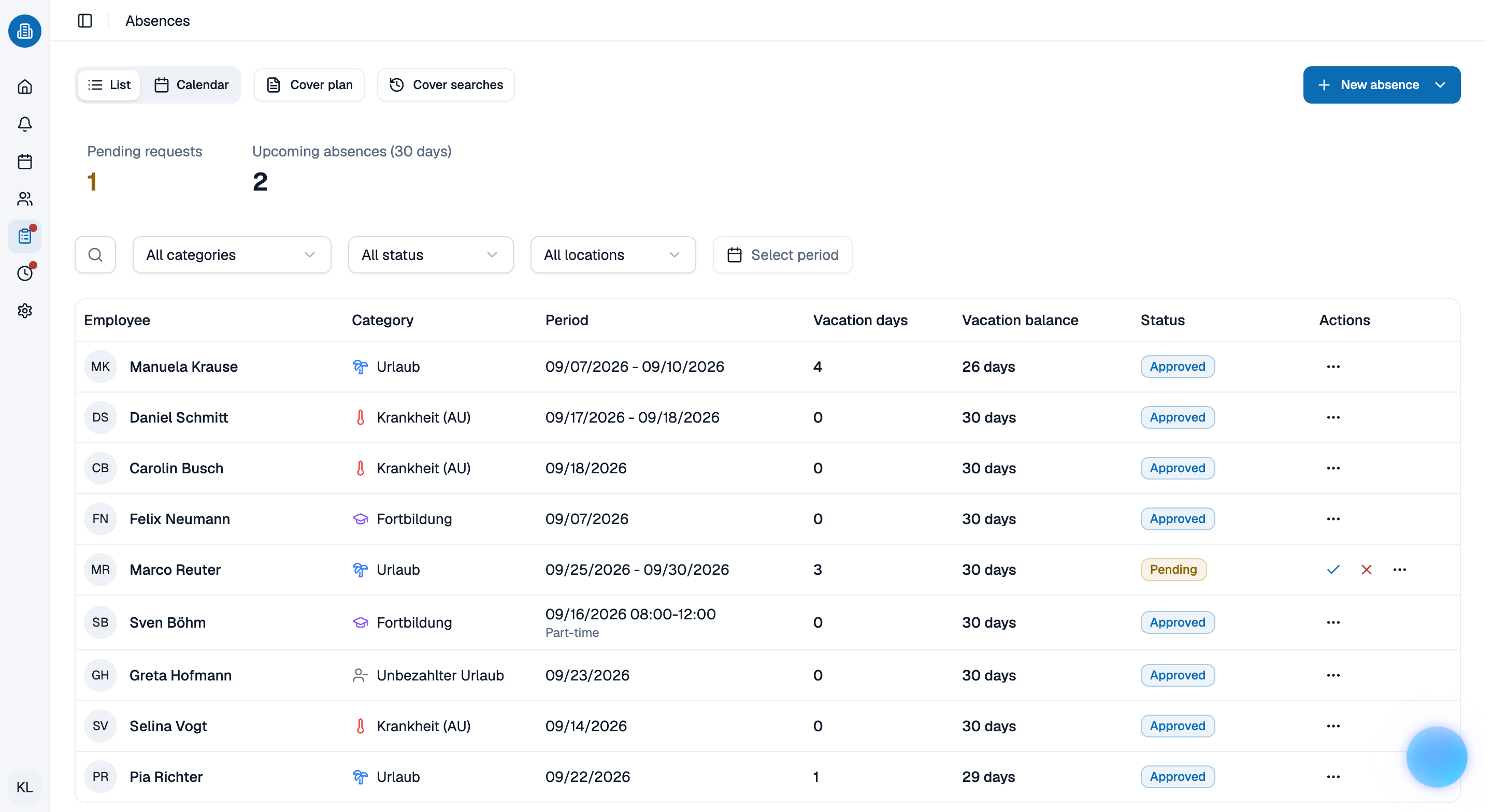 In medishift the absences sit in one list with category, dates and status, so the spells are countable without a spreadsheet. See the plans!
What is an acceptable Bradford score?
Every search on this metric ends at the same question, and the honest answer is that nobody official has set one. Acas states plainly that "there are no legal rules about how or when absence should be reviewed" and its guidance mostly calls the numbers employers set review points rather than trigger points, which reads like a deliberate choice of word. The answer to what is an acceptable Bradford score is a number you picked yourself, and you may have to explain why you picked it.
So do the arithmetic before you pick. Suppose you set the threshold at 200.
| Reached by | Spells | Days needed | Score |
|---|---|---|---|
| One spell | 1 | 200 | 200 |
| Two spells | 2 | 50 | 200 |
| Four spells | 4 | 13 | 208 |
| Six spells | 6 | 6 | 216 |
Read the top and bottom rows together. A threshold of 200 declares that six odd days off across a year deserves the same response as two hundred days of continuous illness. Written out like that, most practice managers reach for a different number.
You will see 50, 125, 200 and 500 quoted in policy templates that get passed between employers. None of them carries an authority behind it. A better method is to run the Bradford score calculation backwards from the pattern you actually want a conversation about. If that pattern is four separate absences of roughly two days in a year, the score is 4 squared times 8, which is 128, and your threshold belongs just under it at 125. Now the number has a reason, and the reason survives being questioned.
Two details decide whether the threshold means anything. The window has to roll, so old spells drop out instead of counting forever. And the recalculation needs a fixed day, because a number recomputed every morning crosses and re-crosses a line that a monthly run shows as one clean event.
Where a Bradford score gets you into trouble
Medishift gives no legal advice. What follows is where this particular metric meets UK law, not what your absence policy should say.
The exposure runs through the Equality Act 2010. Section 6 and Schedule 1 define disability as an impairment with a substantial and long term adverse effect on normal day to day activities, and plenty of repeat absence in a practice or a care home has a cause that meets it. Sickness absence is then the textbook example of "something arising in consequence of" a disability under section 15: treating someone unfavourably because of it is discrimination unless the employer can show the treatment is a proportionate means of achieving a legitimate aim, or under section 15(2) that it did not know and could not reasonably have been expected to know of the disability. A Bradford score is a machine for producing precisely that unfavourable treatment, automatically, in a form that looks objective because it arrived as a number.
The reasonable adjustments duty in section 20 is the other half. In Griffiths v The Secretary of State for Work and Pensions, decided by the Court of Appeal in December 2015, the employee had a long absence of which most was caused by her disability and received a formal warning under an attendance management policy. The court held that a requirement to maintain a level of attendance in order to avoid sanctions is a provision, criterion or practice that can put a disabled employee at a substantial disadvantage, so the duty to consider adjustments is engaged by the policy itself. Her appeal was still dismissed, because the tribunal was entitled to find the two specific adjustments she asked for unreasonable on the facts. Engaged and satisfied are different things, and the first one is not optional.
Acas spells out what those adjustments can look like: not counting some or all disability related sickness absence towards trigger points, or increasing the number of absences that trigger a review. Pregnancy sits alongside it, with its own protection in section 18, and Acas lists the same treatment for pregnancy related absence. Practically this means the flag has to be set when the absence is recorded. Reconstructing which of last spring's spells were disability related, eleven months later, from a line in a spreadsheet, is not a job anyone does well.
Then there is the effect the metric has on people who are not protected by anything. Acas warns that a review point system read as punishment can produce more absence, because "employees might try to come back to work too early when they're unwell, to avoid reaching a review point", and adds that an employer should not use review points to trigger disciplinary action automatically. In a GP surgery or a care home that is not only an HR problem. A receptionist who comes back on day two of a stomach bug to protect their score is standing between a waiting room and a door handle. The metric that was meant to reduce absence has just bought you an outbreak.
For scale, the Office for National Statistics put the sickness absence rate at 2.6% of working hours in 2022, with 5.7 days lost per worker. What a Bradford score reads is the shape of those days rather than the quantity, and shape alone cannot tell a chronic condition from a pattern worth a conversation.
How to use the Bradford score without it using you
Used as a torch it is genuinely useful: it finds the records worth looking at, which scanning a year of rota never does. Used as a verdict it is an expensive mistake. Six rules keep it on the right side of that line.
- Write the spell rule down before the first Bradford score calculation: weekends bridged or not, night shifts crossing midnight, part days.
- Count rostered days rather than calendar days, and say so in the absence policy.
- Flag disability and pregnancy related absence at the moment of recording, and decide whether it is discounted or the trigger is raised before anyone is ranked.
- Derive the threshold from a pattern you can describe in a sentence, then leave it alone.
- Let the number open a review rather than an automatic sanction, which is what Acas asks for. The review is where you find out that a nurse with eight single days is a nurse with a child in nursery.
- Keep the reasons for absence out of the ranked sheet. The score needs dates and spell counts. It does not need a diagnosis, and neither does the list of people who can see it.
The inputs are the part software can actually help with. In medishift every absence is recorded with its category and period, and categories are configured per location, each flagged for whether it draws down the leave balance and whether it counts as working time. Sickness entered after the event is supported, which is the normal case when a fit note arrives on Wednesday for a Monday. The absence list shows employee, category, period and status side by side, an overlap warning flags who in the same working area is already away, and the twelve month view per person is where a pattern becomes visible without anyone computing anything.
What medishift does not do is hand you a Bradford score. Neither should any other scheduling tool, and neither should a Bradford score calculator you found online, before the policy behind it exists. Kira, the assistant built into the product, answers questions and produces evaluations in the chat on every plan, so the counting starts from the record rather than a fresh spreadsheet; downloading one as CSV belongs to the Premium plan.
The honest verdict
The Bradford score has survived for decades because it puts a real pattern into one number, and has been criticised for just as long for the same reason. Short frequent absence is disruptive in a practice in ways that a long planned absence is not: one is covered with a locum and a fortnight's notice, the other is covered at ten past eight by whoever answers the phone. A metric that says so out loud is worth having. A metric that says so automatically, with a warning attached, in a team where a third of the staff are part time and one of them has a long term condition, is a discrimination claim with a formula in front of it. Set the threshold with the arithmetic in view, exclude what the law expects you to exclude, and treat every number it produces as a question rather than an answer. For the wider picture, our leave planning topic hub covers time off end to end, and the free employee leave planner gives you the record to count from.