4 on 4 off Shift Pattern: Weekends/Nights/Leave
The 4 on 4 off shift pattern runs an eight day cycle against a seven day week, so it only repeats after 56 days. What that does to your weekends, what the Working Time Regulations 1998 say about twelve hour nights, and how to turn annual leave into shifts.

Table of Contents
The 4 on 4 off shift pattern is four twelve hour shifts, then four days clear, repeating forever. It is the standard answer on UK sites that never close: care homes, custody suites, ambulance stations. Its cycle is eight days and the calendar week is seven, so the two drift apart, and almost everything odd about it follows from that. Your hours are never 42 in any week even though they average 42. Your weekends are dealt out before anybody asks for one. A booked week of leave costs three shifts or four depending on where it lands.
Key takeaways at a glance
- Eight day cycle, seven day week: the 4 on 4 off shift pattern only repeats after 56 days. Plan in blocks of eight weeks.
- Whatever weekday you start on, those eight weeks hold three fully free weekends, three worked right through and two split. The start date changes which, never how many.
- Twenty eight shifts of twelve hours is 336 hours over eight weeks, 42 a week on average. No week holds 42: four of 36 follow four of 48.
- Twelve hour nights clear the eight hour night average in regulation 6(1), because regulation 6(5) averages over calendar days, not over each shift. But regulation 6(7) caps night work at eight hours outright where a risk assessment finds special hazards or heavy strain, and averaging cannot reach that.
- Statutory leave of 5.6 weeks is 19.6 shifts, or 235.2 hours. Book it in shifts or hours, never in calendar days.
- Four lines cover one round the clock post exactly, at 42 hours each, leaving nothing for leave, sickness or a vacancy.
What does 4 on 4 off mean in practice?
The 4 on 4 off shift pattern is a rolling cycle in the sense our guide to the rolling rota uses the word: a fixed block that repeats while people move through it. What makes this block awkward is its length, eight days against a seven day calendar.
Four shifts of twelve hours, then four days off. The usual UK setup runs 07:00–19:00 on days and 19:00–07:00 on nights. Days five to eight are clear, day nine is day one again. Nothing in it refers to Monday, or to weekends, or to the first of the month: it counts to eight and starts over.
What does 4 on 4 off mean for your weekly hours?
Every 56 day block holds 28 shifts, because 56 divided by eight is seven and each cycle carries four. At twelve hours each that is 336 hours over eight weeks, an average of 42 a week, inside the 48 hour average of regulation 4(1).
No week actually contains 42. Counting from a Monday the totals run 48, 48, 48, 48, 36, 36, 36, 36: four heavy weeks, then four light ones. Against a 42 hour target the balance climbs to plus 24 by the end of week four and walks back to zero by week eight, and an overtime account measuring actual hours against a weekly target (included from Premium in medishift) shows the whole swing. The 4 on 4 off shift pattern is behaving correctly there, not the payroll failing. Easier to explain before the first month closes than after.
Reading a 4 on 4 off calendar
A 4 on 4 off calendar has to run the full 56 days before it says anything new, because half a block shows either the heavy weeks or the light ones and hides the rest. Here it is from a Monday start: hours, running balance, and what each weekend does.
| Week of the cycle | Hours | Balance vs 42 h | Saturday | Sunday |
|---|---|---|---|---|
| 1 | 48 | +6 | off | off |
| 2 | 48 | +12 | off | off |
| 3 | 48 | +18 | worked | off |
| 4 | 48 | +24 | worked | worked |
| 5 | 36 | +18 | worked | worked |
| 6 | 36 | +12 | worked | worked |
| 7 | 36 | +6 | off | worked |
| 8 | 36 | 0 | off | off |
So what does 4 on 4 off mean once the site runs nights too? A longer cycle. Four days on, four off, four nights on, four off is sixteen days, and sixteen and seven share no common factor either, so that version only comes round after 112 days. Sixteen weeks. Print that 4 on 4 off calendar end to end, or nobody, including you, knows what happens in week nine.
The 4 on 4 off shift pattern and your weekends
Across 56 days there are eight Saturdays and eight Sundays. Four of the eight cycle positions are working ones, and each meets each weekday exactly once over the block, because eight times seven is 56. So you work four Saturdays and four Sundays: half the weekend days.
In the 4 on 4 off shift pattern how many weekends do you actually work?
Half the weekend days is not half the weekends, and that gap is the whole point. Read the last two columns above: three weekends fully free, three worked right through, two split. Work through all eight possible starting positions and that split comes out identical every time. Shifting the start date, the usual answer when somebody complains, changes which weekends land where. It cannot change the count. Asked of the 4 on 4 off shift pattern how many weekends come out genuinely free, the answer is three in eight however you arrange it.
But weeks three to seven all carry weekend duty, five in a row, and that is what people feel, not the headline three. If it is unacceptable in your setting, no start date rescues you and no swap does either; the fix is a different cycle length, and our overview of shift systems compares them. What it offers instead is certainty. In the 4 on 4 off shift pattern how many weekends you work is settled the day the cycle is written, not the day somebody asks nicely.
Nights, rest and the 4 on 4 off shift pattern
The Working Time Regulations 1998 apply in Great Britain; Northern Ireland has its own working time regulations from 2016. Medishift gives no legal advice: what follows shows where this cycle meets the rules, not what your own rota should do.
Are you a night worker at all?
Regulation 2(1) defines night time as at least seven hours including midnight to 5 a.m., fixed by a relevant agreement or, failing that, 11 p.m. to 6 a.m. A night worker works "at least three hours of his daily working time during night time" as a normal course, meaning on the majority of the days that person works.
So a 07:00–19:00 day shift never touches 11 p.m. to 6 a.m. and makes nobody a night worker, while a 19:00–07:00 night shift covers all seven hours of it every time. Where the 4 on 4 off shift pattern alternates blocks of days with blocks of nights, the majority test turns on how those blocks fall across the year: a question about your rota, not about the pattern.
The eight hour night average, and the trap underneath it
Regulation 6(1) says a night worker's normal hours "shall not exceed an average of eight hours for each 24 hours" over the applicable reference period, 17 weeks by default under regulation 6(3)(b). Twelve is more than eight, so twelve hour nights look doomed. They are not, and the reason is the formula rather than an exemption.
Regulation 6(5) divides A by B minus C: A is normal working hours in the reference period, B the number of days in it, and C the regulation 11 weekly rest, divided by 24. On the usual reading, only regulation 11 rest leaves B; the four off days stay in it. Run sixteen weeks of pure nights through it, 112 days and fourteen complete cycles: A is 672 hours, B is 112, C is sixteen weekly rest periods of 24 hours divided by 24, so 16. That leaves 672 divided by 96, exactly 7 hours. Over the statutory 17 weeks the same sum lands between 6.9 and 7.1.
Then the part averaging does not rescue. Regulation 6(7) is a ceiling, not an average: where night work involves "special hazards or heavy physical or mental strain", the worker must not work more than eight hours in any 24 hour period during which night work is performed. Regulation 6(8) counts work as that if a collective or workforce agreement says so, or if the employer's own risk assessment under regulation 3 of the Management of Health and Safety at Work Regulations 1999 recognises it as a significant risk. Your own risk assessment can therefore rule out a twelve hour night shift outright, and no reference period helps. Check it before you build the cycle.
Health assessments, breaks and the pattern itself
Regulation 7(1) requires the employer to offer each night worker a free health assessment before the assignment begins and at appropriate intervals afterwards, free meaning at no cost to the worker under regulation 7(3). Regulation 7(6) is the forgotten part: where a doctor has advised that a worker has health problems connected with night work, and suitable day work exists, the employer is to transfer them where possible.
Regulation 12(1) gives one rest break once daily working time passes six hours, and regulation 12(3) makes it an uninterrupted twenty minutes away from the workstation, subject to any applicable collective or workforce agreement. Twelve hours buys the same twenty minutes that six and a half hours does; anything more belongs in the contract.
Regulation 8 is the one nobody cites. Where the pattern of work puts health and safety at risk, "in particular because the work is monotonous or the work-rate is predetermined", the employer shall ensure adequate rest breaks. It speaks to the pattern rather than the shift, which is the question here.
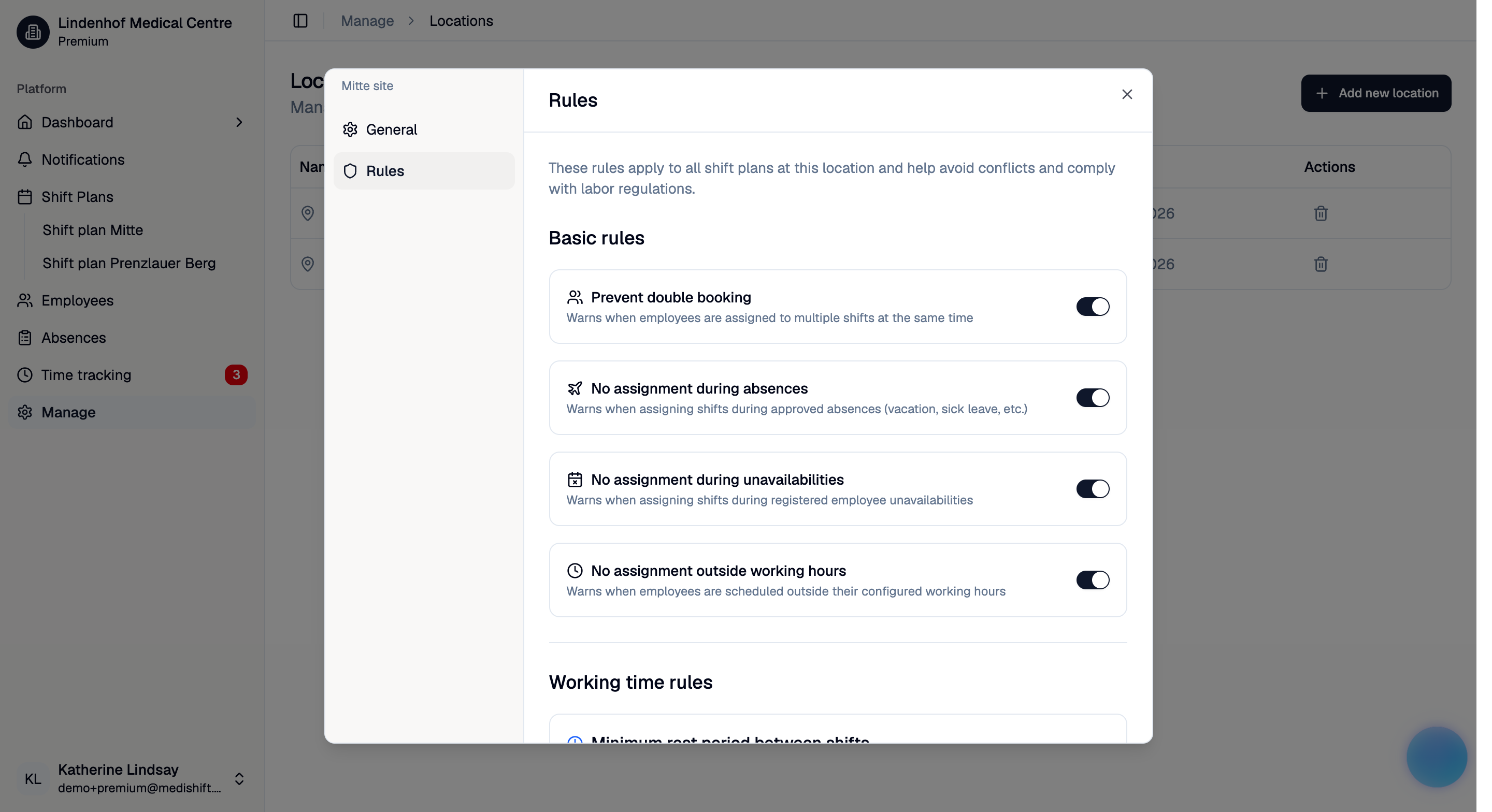 Per location in medishift you can switch on a minimum rest period between shifts (from Premium); the plan then marks every shift that breaks it. See the plans!
Leave, bank holidays and staffing a 4 on 4 off shift calendar
Turning 5.6 weeks into shifts
Leave is granted in weeks, not days: four weeks under regulation 13(1) plus 1.6 weeks under regulation 13A(2)(e), capped together at 28 days by regulation 13A(3).
A week on this cycle is 3.5 shifts, because four shifts every eight days is four times seven divided by eight. So 5.6 weeks of regulation 13 and 13A comes to 19.6 shifts, or 235.2 hours. The cross check works: 5.6 weeks at the 42 hour average is 235.2 hours too. The 28 day cap never bites, since 19.6 is nowhere near it.
Nobody takes 0.6 of a shift, so round it and write the rounding down before anybody books: nineteen shifts plus 7.2 hours, or twenty flat, are both defensible, but deciding case by case is not. For leave years beginning on or after 1 April 2024, workers on irregular hours or part year contracts fall under regulation 15B instead, which matters the moment bank staff join the rota.
Why a booked week costs 36 or 48 hours
Leave is where the 4 on 4 off shift pattern quietly costs you money. Somebody asks for next week off; depending on where that week sits in the cycle it covers four shifts or three: a third more hours for the same seven calendar days.
People work this out quickly, and within a couple of cycles the heavy weeks are spoken for and the light ones are not. So stop deducting in weeks: deduct the shifts a request actually covers, publish that rule next to the rota, and let your 4 on 4 off shift calendar show which shifts are touched before you approve anything.
Bank holidays behave the same way, because nothing in the regulations attaches leave to a named date. A given bank holiday either lands on a working cycle position or not, and half the positions are working. Across several years that evens out; within one year it does not.
How many teams a round the clock post needs
A care home nurse post never left unstaffed needs 168 hours of cover a week, and the 4 on 4 off shift pattern delivers 42 hours per person. Four lines, four times 42, 168 hours: exactly one continuous post. That is why the pattern is everywhere on 24 hour sites, and why it breaks.
Exactly means exactly. There is no room in 168 for the 5.6 weeks of leave every line is owed, close to eleven percent of the year, let alone sickness, training or an unfilled post. Four nurses cover that post for roughly 46 weeks a year between them, so the honest headcount is four plus the cover to carry them. A 4 on 4 off shift calendar showing only four weeks will not warn you: that is half a block, and the cycle needs eight.
Where software helps, and where it does not
The mechanical part is the calendar. In medishift you save a finished week as a template with its shifts and assignments, then apply it across future weeks in one pass, at an interval of every first, second, third or fourth week and a horizon of up to twelve months (from the Plus tier). An eight week block does not fall out of a four week interval, so the 4 on 4 off shift pattern takes more than one pass.
The rule that earns its keep is not the one people reach for. Inside a block the cycle clears the eleven hour daily rest in regulation 10(1) by itself: 19:00 to 07:00 and back at 19:00 leaves twelve. Breaches come from the exceptions, such as an overtime shift on the first of four off days, which pushes the consecutive working day count to five. Per location you can switch on a maximum number of consecutive working days, four here, and a minimum rest period between shifts (from Premium); the plan marks what breaks them. Warnings, not hard blocks, which is right: under regulation 22 a short changeover can be a decision, with compensatory rest owed under regulation 24.
What no software settles is the leave rule, and that is the whole case for the 4 on 4 off shift pattern in miniature. It is rigid, and the rigidity is the product: nobody negotiates for a Saturday, because the arithmetic dealt them out before anyone arrived. It asks only that you count once, over 56 days instead of a week, and write the answer down. To build that block, start with medishift for free, or adapt a cycle from the nursing schedule template.