
A rolling rota is a fixed cycle of weeks that repeats, with every person moving one line further along each time the cycle comes round. Week one you are on earlies, week two on lates, week three you have the Saturday. Then it starts again. Most hospital wards, GP surgeries and dental practices drift towards it once a fixed rota starts feeling unfair.
Key takeaways at a glance
- A leave week is 37h30 on line A, 34h00 on line C: set one conversion rule.
- Rolling rota meaning: the pattern is fixed, the people in it rotate.
- Cycle length matters: an eight day cycle needs eight weeks to come round.
- Daily rest of eleven hours (reg. 10(1)) may narrow at the cycle seam (reg. 22), owing compensatory rest (reg. 24).
- The 48 hour limit averages over 17 weeks (reg. 4(1)), a prime no week cycle divides.
- Hospital roles may use the continuity exception (reg. 21(c)(i)): daily rest, weekly rest and breaks can go, compensatory rest never.
What is a rolling rota?
So what is a rolling rota, in practice? A rota with a cycle. You write down a set of weeks, call them lines, fix what each line contains, and move people through them in order. Each week everybody shifts along by one, and after as many weeks as there are lines they are all back where they started and the cycle rolls again.
The regulations use almost the same words. Regulation 22(2) of the Working Time Regulations 1998 defines shift work as "any method of organizing work in shifts whereby workers succeed each other at the same workstations according to a certain pattern, including a rotating pattern". A rolling rota is that rotating pattern, written down.
Rolling rota meaning, in one sentence
The rolling rota meaning comes down to this: the shift pattern is fixed, the person standing in it is not. A fixed rota nails one receptionist to Tuesday lates forever; a rolling rota keeps Tuesday lates in the plan and rotates who covers it. That is why it comes up in the same conversation as fairness: the unpopular slots are shared out by construction, not by who is best at saying no.
Cycle length decides your weekends
Cycle length is the one number in a rolling rota you cannot change later without rewriting everything. It wants as many lines as you have interchangeable people or teams, and short enough to hold in your head: past four weeks nobody knows what they are on without looking it up.
Take the 4 on 4 off shift pattern, the best known rolling rota on UK hospital wards. Its cycle is eight days and the week is seven, so it comes round only when the two line up again, at 56 days or eight weeks. That is long enough to deal every position in the cycle the same four Saturdays and four Sundays off, which is not the same as four free weekends. Our guide to the 4 on 4 off shift pattern counts those weekends out one by one.
The hours are less even, and the pattern itself is the source: twenty eight shifts of twelve hours is 336 hours over eight weeks, an average of 42 a week, though no single week holds 42. If the cycle starts on a Monday the weekly totals run 48, 48, 48, 48, 36, 36, 36, 36: four heavy weeks, then four light ones. Start on another weekday and the split moves around, but the eight week total does not.
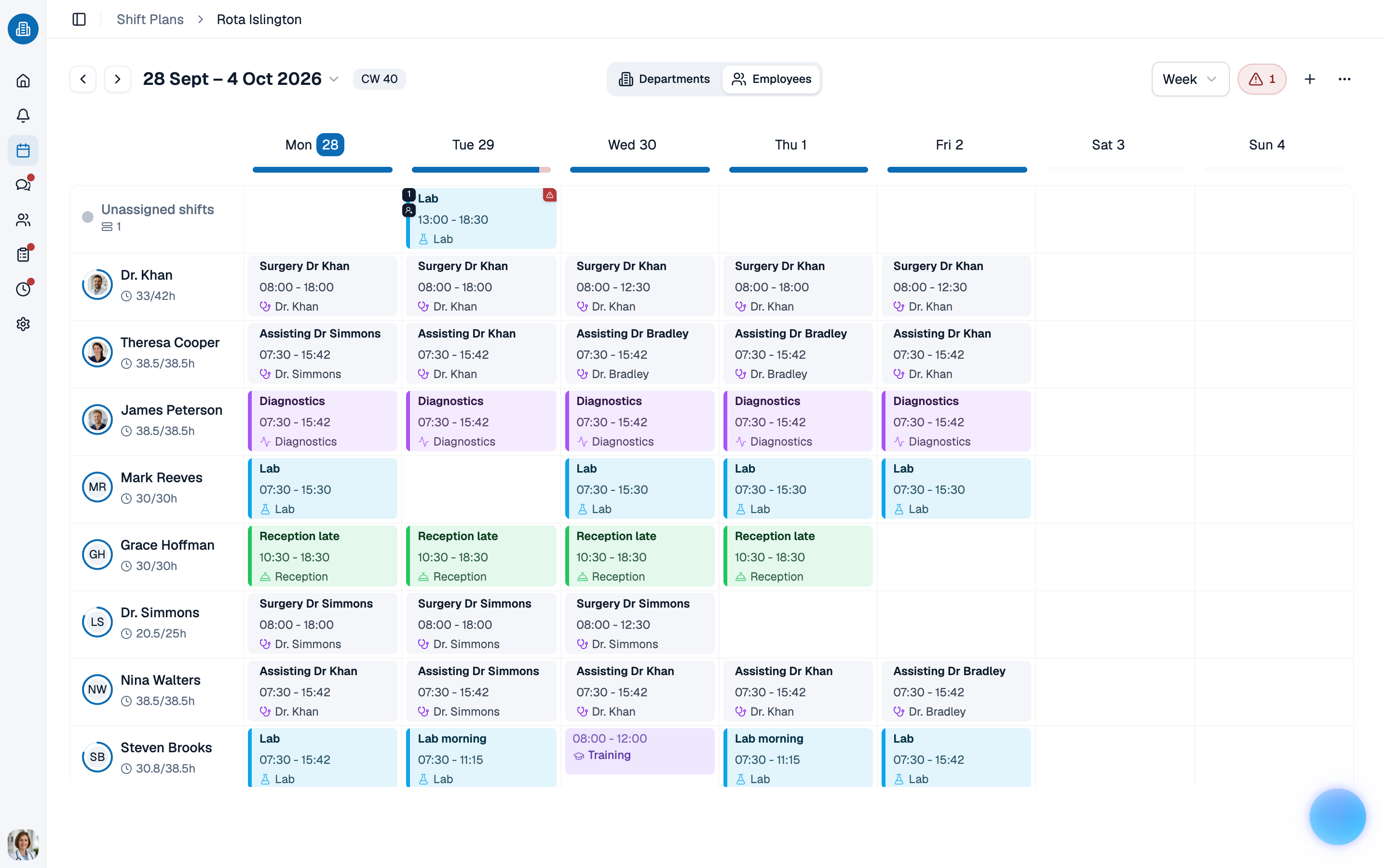 With medishift you save a finished week as a template and apply it across future weeks in one pass (from Plus), which is exactly the move a rolling rota is made of. See the plans!
What the Working Time Regulations do to a rolling rota
The Working Time Regulations 1998 apply in Great Britain; Northern Ireland has its own working time regulations from 2016. Medishift gives no legal advice: what follows shows where a cycle meets the rules, not what your own rota should do.
The seam between cycles: rest at changeover
Regulation 10(1) entitles a worker to "a rest period of not less than eleven consecutive hours in each 24-hour period during which he works". In a rolling rota the break is almost never inside a line. It is the joint where two weeks written separately have to meet.
Take a two week rolling rota on a hospital ward. Week A ends with a Sunday late, 14:00 to 22:00. Week B opens with a Monday early, 06:45 to 14:45. Between them sit eight hours forty five minutes, worked out from those two times. Each line reads well on its own. Together they are two hours fifteen minutes short of the eleven.
Whether that is unlawful is not a yes or no question. Regulation 22(1)(a) says regulation 10(1) "does not apply in relation to a shift worker when he changes shift and cannot take a daily rest period between the end of one shift and the start of the next one", and a rolling rota is shift work by regulation 22(2)'s own definition. The condition sits in that "cannot": the exception speaks to a changeover a worker cannot rest through, which is a thinner argument for a gap designed into every cycle on purpose. That exception is expressly subject to regulation 24, which requires the employer wherever possible to allow an equivalent period of compensatory rest, and otherwise to give appropriate protection for health and safety. So the seam is not automatically a breach, and not automatically fine. It is where a debt is created, and the compensatory rest has to turn up in the next cycle.
Weekly rest works the same way and hands you a lever. Regulation 11(1) is 24 uninterrupted hours in each seven day period, but regulation 11(2) lets the employer determine instead either two uninterrupted 24 hour periods or one uninterrupted 48 hour period in each 14 days. For a two week rolling rota that can decide whether the pattern fits, and it is a choice the employer makes rather than a default. Regulation 11(7) adds the part that gets missed: weekly rest is not meant to swallow the daily rest under regulation 10(1), unless objective, technical or work organisation reasons justify it.
The 48 hour average, and why 17 being prime matters
Regulation 4(1) caps working time at "an average of 48 hours for each seven days" over the applicable reference period, unless the employer has first obtained the worker's agreement in writing to work beyond it, an agreement the worker can end on seven days' written notice under regulation 5(2)(b), or on whatever different notice period the agreement itself sets, which regulation 5(3) caps at three months.
The reference period is 17 weeks under regulation 4(3), unless a collective or workforce agreement extends it to 52 weeks under regulation 23(b). Seventeen is a prime number, which has a consequence nobody mentions: no whole week rolling cycle of two, three, four, six or eight weeks divides into 17 evenly. Every reference window cuts a cycle somewhere in the middle, so the cycle average and the reference period average are never quite the same number.
That is less alarming than it sounds, because there are only as many distinct windows as there are weeks in the cycle. Take the 4 on 4 off case above. Seventeen weeks is two full eight week cycles, 672 hours, plus one week: opening on a heavy week gives 720 divided by 17, or 42.35 hours, and on a light one 708 divided by 17, or 41.65. Eight windows to check, and only the worst counts.
Weeks over the limit are survivable too, if the cycle average carries them. A four week cycle whose weeks run 52, 52, 44 and 40 averages 47, because 188 divided by 4 is 47, and its worst window opens on a 52 hour week at 804 divided by 17, or 47.29. Every window is inside the limit, though half the weeks are not.
Hospitals and the continuity exception
Regulation 21 lists activities where regulations 10(1), 11(1) and (2) and 12(1) do not apply. Paragraph (c)(i) names "services relating to the reception, treatment or care provided by hospitals or similar establishments ... residential institutions and prisons" as a case where continuity of service may require it. Where a role falls inside that, three constraints soften at once: daily rest, weekly rest, and the twenty minute break that regulation 12 gives once daily working time passes six hours.
Two things do not move. Regulation 24 still applies, so compensatory rest is owed wherever possible. And regulation 4 is not in regulation 21's list at all, so the 48 hour average survives intact. What changes is the window: regulation 4(5) substitutes 26 weeks for 17 where a worker is excluded by regulation 21. A longer window is easier to average into. Whether a role sits inside regulation 21(c)(i) is a question about the role, not the sector, so take written advice first.
Start from the hospital shift schedule template.
Building it: a three week worked example
Our guide to creating a rota covers assembling one week from a blank grid. What follows sits a layer above it: turning three finished weeks into a cycle. A GP surgery open 08:00 to 18:30, an extended hours Saturday morning, three interchangeable reception staff.
| Line in the cycle | Monday to Thursday | Friday | Saturday | Net hours |
|---|---|---|---|---|
| A (early) | 07:45 to 15:45 | 07:45 to 15:45 | off | 37h30 |
| B (late) | 10:45 to 18:45 | 10:45 to 18:45 | off | 37h30 |
| C (mixed) | 08:30 to 16:30 | off | 08:00 to 12:00 | 34h00 |
Each weekday shift is eight hours gross with an unpaid thirty minute break, so seven and a half net. The Saturday is four hours with no break, because regulation 12(1) only bites once daily working time passes six hours.
The table adds up to a cycle of 37h30 plus 37h30 plus 34h00, so 109 hours over three weeks, an average of 36h20 a week. If the contracts say 36, the rolling rota gives away one hour per cycle. A year holds about 17.3 cycles, so that is roughly 17 hours, or just over two extra shifts, quietly created by a rota nobody thought was generous.
The seam is clean here, and it is worth seeing why. Line A finishes Friday 15:45 and line B starts Monday 10:45; line B finishes Friday 18:45 and line C starts Monday 08:30; line C finishes Saturday 12:00 and line A starts Monday 07:45. Every changeover lands across a weekend, because the cycle is a whole number of weeks and no line starts before 07:45. Even the tightest of the three, line C's Saturday finish into line A's Monday start, leaves more than forty hours.
Annual leave and bank holidays in a rolling rota
The regulations grant leave in weeks rather than on named days: four weeks under regulation 13(1) plus 1.6 weeks under regulation 13A(2)(e), capped together at 28 days by regulation 13A(3). For leave years beginning on or after 1 April 2024, workers with irregular hours or part year contracts fall under regulation 15B instead, which matters once bank staff sit on the same rota.
That poses a question a fixed rota never does. In the three week cycle above, a week of leave on line A costs 37 hours 30 minutes and the same week on line C costs 34. Fix the conversion in advance and apply it identically for everyone, or people will work out which week of the cycle is the cheap one to book. Bank holidays are the same story: nothing there attaches leave to a date, so a bank holiday lands on whichever line covers that day, and what balances over many cycles need not balance within one year.
When a rolling rota stops working
Three failure modes account for most abandoned cycles. Part time and term time contracts do not fit lines built for full time hours, and bolting them on breaks the rotation for everyone else. Long term sickness in a three line cycle leaves two people carrying three lines. And a cycle checked once at the seam and never again drifts, because every change to one line silently edits the changeover into the next.
Software helps with the mechanical part. In medishift you save a finished week as a template with its shifts and assignments, then apply it across future weeks in one pass, at an interval of every first, second, third or fourth week and a horizon of up to twelve months. Two, three and four week cycles map onto that interval directly; six or eight week cycles take more than one pass. Applying a template across many weeks is included from the Plus tier.
The rule system watches the seam for you. Per location you can switch on a minimum rest period between shifts (from Premium), a maximum number of hours per day and a maximum number of consecutive working days; the plan then marks the shifts that break them, grouped by type for the whole week. They are warnings rather than hard blocks, which is right here: after regulation 22 and regulation 24 you know a short changeover is sometimes a decision rather than a mistake.
What is a rolling rota worth, then? It turns a weekly argument into a one off design decision. Get the cycle length right, check the seam once, write down how leave converts into hours, and the rest is repetition. To try that part, start with medishift for free and apply your first cycle across the next three months from the Plus tier.