Workplace Safety Medical Practice Checklist 2026
Workplace safety medical practice checklist for owners and staff: daily, weekly, monthly and annual duties, plus risk assessment and mandatory employee training under German law.
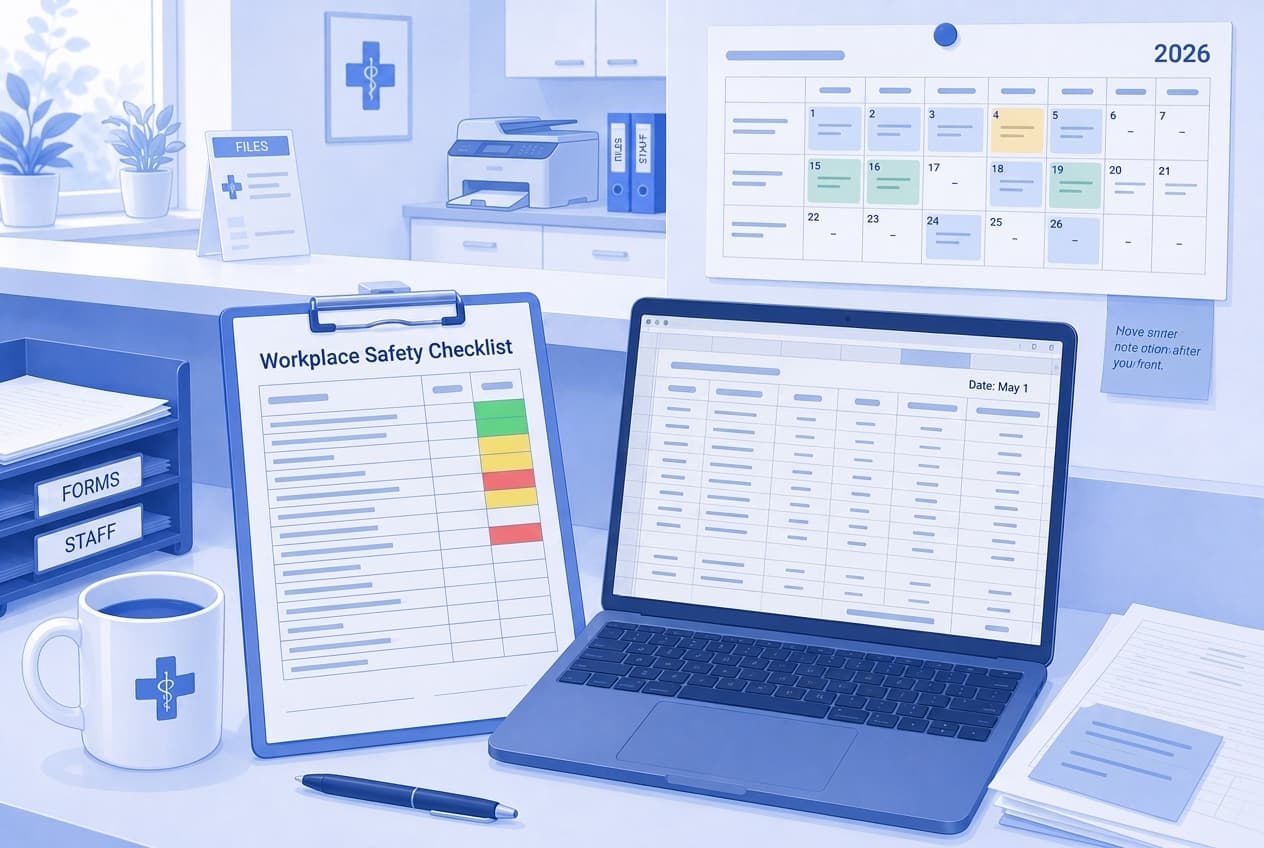
Table of Contents
A workplace safety medical practice checklist answers three questions that otherwise get lost in daily practice life: who checks what, at what interval, and where the result is recorded. Workplace safety in medical practices is not only a legal obligation but also an essential factor for your team's health and smooth practice operations. In medical facilities, employees are exposed to special hazards daily, from biological risks through patient contact to psychological stress from high work demands. A well-thought-out medical practice safety checklist helps you keep track of all relevant aspects and meet legal requirements.
In this comprehensive guide, you'll learn everything you need to know about occupational safety in medical practices: from the legal framework and risk assessment to specific preventive measures and practical checklists for everyday practice.
Key Takeaways
Workplace safety in medical facilities is based on occupational health and safety legislation, which requires every employer to take protective measures. At the center of this is the risk assessment, a systematic identification and evaluation of all hazards in the workplace. In medical practices, biological hazards play a particularly important role, as employees regularly come into contact with blood, body fluids, and potentially infectious materials.
All workplace safety measures must be documented in writing (§ 6 ArbSchG), and employees must be trained on existing hazards and corresponding protective measures at least once a year (§ 12 ArbSchG). In addition, §§ 2 and 5 of the German Occupational Safety Act (ASiG) require every practice to appoint an occupational physician and a safety specialist.
The practical tool for all of this is a workplace safety medical practice checklist organised by inspection interval: daily, weekly, monthly, annually. That is exactly how the checklist in this article is structured.
Legal Framework for Workplace Safety
Occupational Health and Safety Legislation
Occupational health and safety legislation forms the central legal foundation for workplace safety. It obliges every employer (including you as a practice owner) to take measures to prevent work accidents and work-related health hazards. The law requires the implementation and documentation of a risk assessment. From this assessment, appropriate protective measures must be derived and implemented. Employees must be informed about hazards, and all measures must be documented. Finally, the employer must also enable occupational health surveillance.
Workplace Regulations
Workplace regulations specify the requirements for workplace design. For your medical practice, this means that you must ensure adequate ventilation and lighting. Room temperatures must be appropriate, and workplaces should be ergonomically designed. Special attention is required for safe walkways and escape routes as well as sanitary facilities and break rooms. Depending on the patient clientele, accessible entrances may also be required.
Biological Agents Regulations
Particularly important for medical practices are regulations on biological agents. These govern the handling of biological substances: microorganisms, cell cultures, and parasites that can cause infections, allergies, or toxic effects in humans. In daily practice work, this includes blood and blood products, various body fluids such as saliva and urine, wound swabs and laboratory samples, as well as contaminated instruments and materials. The correct handling of these biological agents is a central component of workplace safety in medical facilities.
Industry-Specific Guidelines
Professional associations and health authorities issue specific guidelines for workplace safety that are particularly relevant for medical practices. General prevention principles are covered in foundational guidelines, while specific information addresses healthy working in medical practices. Complementary regulations govern the handling of biological agents in healthcare and provide concrete recommendations for everyday practice.
Risk Assessment in Medical Practices
Risk assessment medical practice duties are the heart of occupational health and safety. § 5 ArbSchG requires the assessment before work begins, and you must update it when working conditions change significantly.
The Systematic Process of Risk Assessment
The sequence is always the same: identify hazards, evaluate risks, define protective measures, check effectiveness, document everything. The documentation is not an end in itself but your evidence towards the authorities. How to work through the five steps in practice is set out below under "Conducting the Risk Assessment".
Typical Hazards in Medical Practices
Biological Hazards as the Greatest Risk
Biological hazards pose the greatest risk in medical practices. At the top of the list are needlestick injuries, which are the most common cause of infections in healthcare. Contact with blood carries a risk of infection with Hepatitis B, Hepatitis C, and HIV. Additionally, droplet infections can lead to the transmission of respiratory diseases, while contact infections can occur through contaminated surfaces or hands. Certain medical procedures also generate aerosols, which pose an additional infection risk.
TRBA 250 requires a graded package in response: safety needles with sharps protection, protective gloves for every patient contact, hand disinfection, and safe disposal of contaminated materials. The details follow below under personal protective equipment.
Chemical Hazards in Daily Practice
Various hazardous substances are used in medical practices that can pose health risks if handled improperly. Disinfectants can irritate skin and airways with frequent contact. The same applies to cleaning and sterilization agents. Particular caution is required when handling medications, especially cytostatic drugs, which are considered carcinogenic. Depending on the practice equipment, laboratory chemicals or, in older practices, X-ray chemicals may also be relevant.
The German Hazardous Substances Ordinance requires a hazardous substances register, operating instructions per substance, suitable protective equipment and a substitution check: can the dangerous substance be replaced by a less dangerous one? Adequate ventilation comes on top.
Physical Hazards in the Workplace
Physical stresses in the workplace are often underestimated but can lead to significant health impairments in the long term. Musculoskeletal stress arises from frequent lifting and carrying as well as from awkward postures during patient treatment. In practices with X-ray equipment, ionizing radiation poses an additional risk. Noise from medical equipment can be stressful with prolonged exposure. Trip and fall hazards as well as electrical hazards from medical equipment complete the spectrum of physical risks.
Ergonomic workplace design is the most important protective factor. Radiation protection has followed the Radiation Protection Act (StrlSchG) and Radiation Protection Ordinance (StrlSchV) since the old X-ray Ordinance lapsed on 31 December 2018. Regular equipment inspections and clear, safe walkways cover the rest.
Taking Psychological Hazards Seriously
Psychological strain has been an explicit part of the risk assessment since 2013: § 5 (3) no. 6 ArbSchG lists it as a hazard source in its own right, alongside physical, chemical and biological exposures. In daily practice it is still the one most often skipped. The drivers are work intensity, time pressure, emotional strain and staff shortages; how to capture them and what helps is covered in its own section below.
If you want to learn more about your employees' rights regarding shift scheduling, also read our article on employee rights in shift planning.
Conducting the Risk Assessment
The practical implementation of a risk assessment takes place in several successive steps. First, you divide your practice into meaningful work areas such as reception and waiting area, treatment rooms, laboratory, preparation room or sterilization, storage and utility rooms, as well as office and administration.
For each of these areas, you then systematically identify all possible hazards. On-site inspections, conversations with employees, the evaluation of accident statistics and near misses, as well as checklists and guidance from professional associations help with this.
Each identified hazard is then evaluated according to its probability of occurrence and the severity of possible consequences. This evaluation results in prioritization for action planning according to the hierarchy of controls: First, engineering controls such as safety needles or extraction systems are examined, then administrative controls such as work instructions and training, and finally personal protective equipment such as gloves and protective clothing.
After implementing the measures, responsibilities and deadlines must be set, effectiveness checked, and the risk assessment regularly updated.
Workplace Safety Medical Practice Checklist by Interval
This comprehensive medical practice safety checklist helps you systematically review all important aspects of workplace safety. The workplace safety medical practice checklist is organised by time interval, so it is clear what comes up daily and what only needs doing once a year.
| Interval | Focus | Who usually does it | Evidence |
|---|---|---|---|
| Daily | Escape routes, hygiene, sharps containers, devices | Assistant on the early or late shift | Cleaning and hygiene log |
| Weekly | PPE stock, hazardous substances, environment | Safety officer or practice management | Inspection and stock list |
| Monthly | Emergency lighting, first aid, notices, incidents | Practice management | Walk-through report |
| Annually | Risk assessment, training, electrical testing | Owner with physician and safety specialist | Training record, test certificate |
Daily Checks
General Safety:
- Walkways and escape routes free of obstacles
- First aid materials complete and accessible
- Fire extinguishers accessible and not obstructed
- Lighting functional
- Room temperature appropriate
Hygiene and Infection Control:
- Hand disinfectant available at all wash stations
- Disposable gloves in sufficient quantity
- Sharps containers not overfilled
- Disposal containers for contaminated waste available
- Cleaning of treatment rooms documented
Equipment:
- Medical equipment checked for obvious defects
- Electrical equipment checked for cable/plug damage
- Emergency equipment ready for use
Weekly Checks
Work Equipment:
- Stock of protective equipment checked (gloves, masks, protective clothing)
- Disinfectant supply checked
- Safety data sheets for hazardous substances current and accessible
- Waste disposal carried out properly
Work Environment:
- Trip hazards identified and eliminated
- Shelves and cabinets stable
- Emergency exits and signage intact
- Ventilation systems functional
Documentation:
- Cleaning and disinfection logs maintained
- Refrigerator temperatures documented
- Sterilization logs complete
Monthly Checks
Safety Equipment:
- Emergency lighting function tested
- First aid kit checked for completeness
- Eye wash stations functional
- Smoke detector function checked (if present)
Organization:
- Notices current (emergency numbers, evacuation plan, etc.)
- Training needs checked (new employees, new procedures)
- Work accidents and near misses evaluated
Annual Measures
Documentation and Planning:
- Risk assessment reviewed and updated
- Safety training conducted for all employees
- Operating instructions reviewed and updated
- Hazardous substances register updated
- Occupational health surveillance planned
Inspections:
- Electrical systems and equipment inspected
- Fire extinguishers inspected
- Medical products maintained according to manufacturer specifications
- Processing of medical devices validated
Support:
- Inspection by occupational physician/safety specialist conducted
- Safety committee meeting held (required only for more than 20 employees, according to § 11 ASiG; the committee meets at least quarterly)
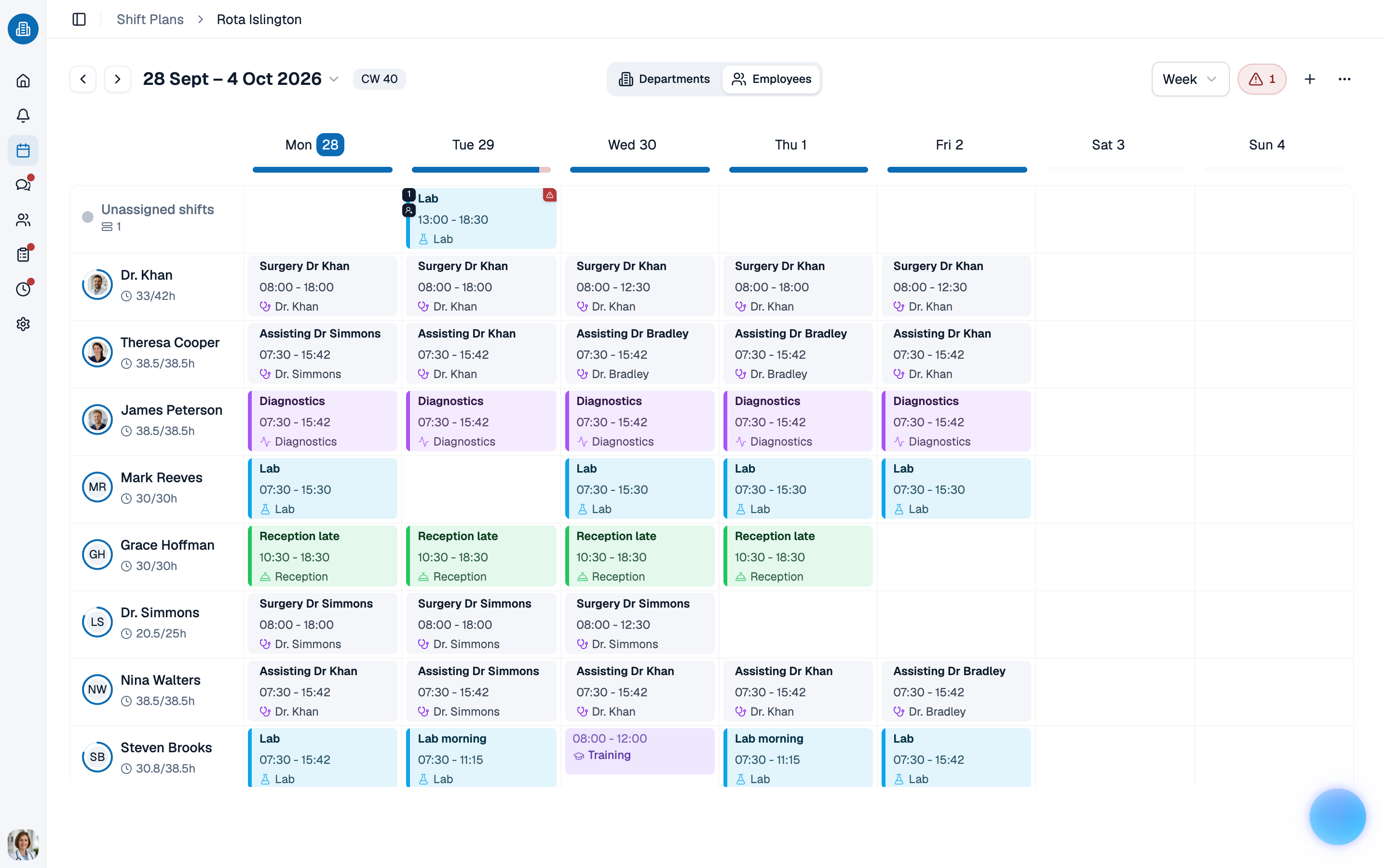
Working a medical practice safety checklist reliably starts with a duty roster that makes responsibilities visible. medishift lets you plan that digitally, and you can start for free.
Prevention Measures in Detail
Using Personal Protective Equipment Correctly
The right personal protective equipment is crucial for occupational safety in medical practices. For protective gloves, disposable gloves made of latex, nitrile, or vinyl have proven effective for every patient contact. Due to the lower allergy risk, nitrile gloves should generally be preferred. Special chemical-resistant gloves should be used for handling disinfectants. All gloves should be stored according to manufacturer instructions and changed immediately if damaged.
Protective clothing includes work attire such as scrubs and trousers for all employees. When there is an increased risk of contamination, protective gowns should also be worn; for certain activities, disposable aprons can be useful. Regular changing of work clothes is a given.
For face protection, medical masks are used during normal patient contact, while FFP2 or FFP3 masks are required for aerosol-generating procedures. The correct wearing technique must be trained, and wear time limits must be observed.
Eye protection in the form of safety glasses is required when there is a splash risk; face shields may be necessary when there is increased risk. Eye protection should also be worn during cleaning work with aggressive agents.
Establishing Safe Work Procedures
Prevention of needlestick injuries requires consistent measures in daily work. First and foremost is the use of safety products such as needles with sharps protection mechanisms. So-called recapping (putting the needle back into its protective cap) must be strictly avoided. Used needles must be disposed of in the sharps container immediately after use. These sharps containers must be positioned within reach and must not be overfilled. An optimized work environment with good lighting and sufficient space additionally minimizes the risk of injury.
Hand hygiene is the most important measure for infection prevention. The World Health Organization has defined the five moments of hand hygiene: before patient contact, before aseptic procedures, after contact with potentially infectious material, after patient contact, and after contact with patient surroundings. Hand disinfection should be preferred over hand washing, with the contact time of 30 seconds being observed. A skin protection plan ensures that the skin remains healthy despite frequent disinfection.
For more information on hygiene, see our article on the hygiene checklist for medical practices.
Workplace Ergonomics
Ergonomic workplace design effectively prevents musculoskeletal disorders. At reception and office workstations, height-adjustable desks enable switching between sitting and standing. Ergonomic office chairs with comprehensive adjustment options support a healthy sitting posture. The monitor should be positioned at eye level, and regular movement breaks should be planned.
In treatment rooms, height-adjustable examination couches ensure a back-friendly posture, instrument tables within easy reach, and swivel stools for flexible positioning.
When lifting and carrying: use trolleys, keep loads close to the body, lift from the legs rather than the back, and call in a second person for heavy loads.
Employee Training
Legal Requirements and Timing
Training employees is required by § 12 ArbSchG and must take place at certain times. Every new employee must be trained before starting work. This training must be repeated at least annually. When there are significant changes to working conditions, such as the introduction of new equipment or procedures, renewed training is required. Event-related training should also take place after work accidents or near misses.
Contents of Complete Training
Complete training includes information about all hazards in the workplace and the corresponding protective measures including their application. Employees must be trained in the correct use of personal protective equipment and know how to behave in emergencies and provide first aid. Operating instructions for hazardous substances and equipment are as much a part of training as hygiene regulations and reporting obligations for accidents and incidents.
Documentation as Evidence
Every training session must be documented, recording the date and topic of training, the name of the trained person, their signature, and the name of the trainer. This documentation is important for verification to authorities and professional associations and should be carefully preserved.
Occupational Health Support
Support Models for Medical Practices
As an employer, §§ 2 and 5 ASiG oblige you to obtain occupational health and safety advice. For regular support, an occupational physician and safety specialist are appointed, whose scope of support depends on the size of the organization. The concrete hours are set in Annex 2 of DGUV Regulation 2, which assigns each business to one of three support groups by risk level; for medical practices, usually 0.2 to 0.5 hours per employee per year are provided.
Alternatively, needs-based support under Annex 3 of DGUV Regulation 2 is available for organizations with up to 50 employees. Here, the entrepreneur participates in motivation and information measures and calls in experts on an event-related basis as needed.
Tasks of the Occupational Physician
The occupational physician takes on diverse tasks in workplace safety. They conduct occupational health surveillance, differentiated into mandatory, offered, and requested examinations. They advise on risk assessment medical practice duties, conduct inspections of workplaces, and provide recommendations on protective measures. They also support the reintegration of employees after prolonged illness. It pays to send them the workplace safety medical practice checklist before the annual walk-through: then you spend the visit on open items rather than on taking stock.
Occupational Health Surveillance in Medical Practices
Various health examinations are relevant in medical practices. Mandatory examinations must take place before starting work and concern activities with infection risk from Hepatitis B, C, or HIV as well as wet work of more than four hours daily.
Offered examinations must be offered to employees and include activities at computer workstations, activities with lower infection risk, and skin-stressing activities.
Documentation Requirements in Workplace Safety
Importance of Proper Documentation
Proper documentation is not only legally required but fulfills several important functions. It serves as evidence during inspections by authorities and forms the basis for continuous improvement of workplace safety. In the case of work accidents, documentation is also of significant importance for liability issues.
What Must Be Documented
You must document the risk assessment together with its measures, effectiveness review and updates, the hazardous substances register with operating instructions and safety data sheets, and all inspections and maintenance.
On top of that come all accidents and incidents, expressly including minor injuries, near misses and needlestick injuries. If an employee is unable to work for more than three days, § 193 SGB VII requires you to file an accident report with the insurance carrier.
Emergency Management in Practice
Organizing First Aid
Appoint and train first aiders, keep first aid materials stocked, and display emergency numbers visibly. Under § 26 of DGUV Regulation 1, first aiders must attend refresher training every two years.
Ensuring Fire Safety
Fire extinguishers belong in sufficient number at easily accessible points, and escape routes must be marked and kept clear. Larger practices add a fire safety officer.
Response to Needlestick Injuries
In the event of a needlestick injury, bleeding should first be encouraged by squeezing the wound. The wound should then be thoroughly disinfected. The affected person should immediately visit the occupational physician or a designated doctor. The incident should be documented and, if possible, the serostatus of the patient determined. If indicated, post-exposure prophylaxis can be initiated.
Psychological Hazards as an Underestimated Risk
Stressors in Daily Practice
Psychological stress is widespread in medical facilities and is nevertheless often underestimated. The high responsibility for patient health and constant time pressure with tight schedules lead to chronic stress. The emotional burden from seriously ill patients or deaths can leave deep marks. Conflicts with difficult patients, but also staff shortages, overtime, and irregular working hours add additional stress to the team.
Prevention Through Good Work Organization
Prevention of psychological stress begins with work organization. Realistic time planning with sufficient buffer times between appointments prevents chronic time pressure. Clear task distributions provide orientation, and regular breaks enable necessary recovery.
Good scheduling can make a big difference here. Learn more in our article on practice organization.
Social Support and Individual Measures
Team meetings on a fixed rhythm, supervision or case discussions catch what individuals would otherwise carry alone. Stress management seminars and flexible working hours work alongside them.
Special Hazards to Consider
Protection for Pregnant and Breastfeeding Employees
Pregnant and breastfeeding employees enjoy special protection. A separate risk assessment must be created for them. Handling certain hazardous substances and contact with infectious materials without adequate protection are not permitted. Night work and overtime are prohibited, and special break regulations must be observed.
Special Regulations for Young Workers
Special regulations apply to trainees under 18. Working hours are restricted, and dangerous work must not be performed. Increased supervision and training is required, and a medical initial examination must take place before training begins.
The Responsibility of Leadership
Overall Responsibility of the Practice Owner
As a practice owner, you bear overall responsibility for workplace safety. This includes organizing workplace safety and providing the necessary resources. You serve as a role model and monitor the implementation of measures. Sanctions for violations are also your responsibility.
Delegation to Suitable Employees
You can delegate workplace safety tasks to suitable employees. This delegation must be in writing and clearly define tasks and authority. However, the supervisory duty remains with the employer, and the delegated person must be competent for the transferred tasks.
Costs, Benefits and Sanctions in Workplace Safety
Who inspects, and what violations cost
Workplace safety is monitored by various authorities, including health and safety authorities and professional associations. Health departments may also conduct inspections where applicable.
Violations can result in significant consequences. The fine levels are set in § 25 (2) ArbSchG and come in two tiers: up to 5,000 euros for breaching an occupational safety ordinance, and up to 30,000 euros if you as the employer disregard an enforceable official order issued under § 22 (3) ArbSchG.
The sequence matters here, and it is frequently reported wrongly: a missing risk assessment does not cost you 30,000 euros on the spot. The authority first orders you to carry it out; the expensive part is ignoring that order. Anyone who persistently repeats such conduct, or who intentionally endangers an employee's life or health, commits a criminal offence under § 26 ArbSchG, punishable by up to one year's imprisonment or a fine. After a work accident, recourse claims from the professional association may be added on top.
What workplace safety costs and what it returns
The cost side consists of safety products, support from occupational physicians and safety specialists, training, and regular inspections and health surveillance.
But good workplace safety pays off. Fewer work accidents mean less downtime, healthier employees are more productive, and lower turnover saves onboarding costs. A better work climate leads to higher motivation. And the arithmetic works out on the sanctions side alone: a single fine under § 25 ArbSchG exceeds a small practice's annual cost for regular occupational health support many times over.
Digital Support for Workplace Safety
Modern software can significantly facilitate workplace safety. Digital checklists simplify regular inspections, automatic reminders ensure that no appointments are forgotten. Central documentation of all training replaces hunting through the binder.
Good staff planning is also important for workplace safety, because overload and stress are common causes of accidents. With medishift, you plan schedules and absences digitally, allowing you to identify overload situations early and ensure balanced shift distribution. This actively helps minimize workplace safety risks. Learn more in our practice management guide.
Frequently Asked Questions About Workplace Safety in Medical Practices
Conclusion: Using the Workplace Safety Medical Practice Checklist
Workplace safety in medical practices is not an annoying obligation but an investment in your team's health. A systematic approach and regular reviews achieve a high level of protection without disrupting practice operations.
Five points carry the rest: create your risk assessment and keep it current, implement protective measures according to the hierarchy of controls, train your team at least annually, document carefully, and use your occupational health support.
Use the workplace safety medical practice checklist from this article as a starting point for your own safety concept. For questions or uncertainties, professional associations and safety specialists are available to advise you.
A safe workplace is the foundation for satisfied employees and a successful practice. And because overload and time pressure are among the most common causes of accidents, good safety starts with the roster: see how medishift handles that digitally.