

A 9/80 work schedule is a compressed schedule that fits 80 hours into nine workdays over two weeks, with the tenth day off, usually every other Friday. No federal law defines the term for private employers: 5 U.S.C. 6121(5) defines a compressed schedule as "an 80-hour biweekly basic work requirement which is scheduled for less than 10 workdays", but only for federal agencies, and California regulates days of more than eight hours as an alternative workweek schedule under IWC Order 4-2001. For a dental practice or medical office covered by the Fair Labor Standards Act (FLSA), overtime is counted per workweek of 168 hours, so where that workweek begins decides whether the same 80 hours cost overtime (29 CFR 778.105).
9/80 work schedule: key takeaways
- Eight 9-hour days and one 8-hour day make 80 hours in nine workdays (OPM).
- The FLSA counts overtime per workweek, never averaged over two weeks (29 CFR 778.104).
- A workweek starting Friday at 12:00 PM turns a 44/36 split into 40 and 40 (29 CFR 778.105).
- California charges daily overtime on 9-hour days unless two thirds of the affected employees vote in an alternative workweek schedule (IWC Order 4-2001).
- The FLSA requires no holiday pay; an 8-hour holiday on a 9-hour day leaves one hour to your policy (DOL).
9/80 schedule over two weeks: hours, lunch and exempt staff
A 9/80 work schedule alternates a long week and a short week; in this example, week A holds 44 hours and week B 36, together 80, and each time span in the table includes 30 unpaid minutes for lunch.
| Day | Week A | Week B |
|---|---|---|
| Monday | 9 hours, 7:30 AM to 5:00 PM | 9 hours, 7:30 AM to 5:00 PM |
| Tuesday | 9 hours, 7:30 AM to 5:00 PM | 9 hours, 7:30 AM to 5:00 PM |
| Wednesday | 9 hours, 7:30 AM to 5:00 PM | 9 hours, 7:30 AM to 5:00 PM |
| Thursday | 9 hours, 7:30 AM to 5:00 PM | 9 hours, 7:30 AM to 5:00 PM |
| Friday | 8 hours, 8:00 AM to 4:30 PM | Off |
| Total | 44 hours | 36 hours |
Does a 9/80 include lunch?
A 9-hour day on a 9/80 counts working time only, so an unpaid lunch comes on top: 7:30 AM to 5:00 PM with a 30-minute lunch is 9 hours of work. Under 29 CFR 785.19(a), bona fide meal periods "are not worktime", the employee "must be completely relieved from duty", and "ordinarily 30 minutes or more is long enough for a bona fide meal period." This is the federal rule; state meal break rules are not covered here.
Exempt and non-exempt staff on a 9/80
An executive, administrative or professional employee is exempt only if "compensated on a salary basis at a rate of not less than $684 per week" (29 CFR 541.600(a)) and the duties tests are met, so a dental assistant paid by the hour is non-exempt. Subject to the exceptions in 29 CFR 541.602(b), an exempt employee "must receive the full salary for any week in which the employee performs any work" (29 CFR 541.602(a)(1)), so the 44-hour week and the 36-hour week pay a salaried exempt employee the same.
9/80 work schedule, workweek and pay period compared
A 9/80 work schedule mixes three time frames that the FLSA keeps apart: the schedule itself, the workweek and the pay period. A workweek is "a fixed and regularly recurring period of 168 hours" that "may begin on any day and at any hour of the day" (29 CFR 778.105). A pay period is the span your payroll pays at once; federal employees on the 5-4/9 plan work "eight 9-hour days and one 8-hour day for a total of 80 hours in a biweekly pay period" (OPM handbook on alternative work schedules).
| Feature | 9/80 schedule | FLSA workweek | Biweekly pay period |
|---|---|---|---|
| Length | Two calendar weeks | 168 hours | 14 days |
| Can start | Any day the practice picks | Any day, any hour | On the payroll calendar |
| Holds on a 9/80 | 80 hours in 9 workdays | 40 hours if split on Friday | 80 hours |
| Decides FLSA overtime | No | Yes | No |
9/80 pros and cons for the practice and the team
A 9/80 work schedule is worth it if the practice can solve the two points below, Friday coverage and the payroll workweek, and the team would trade longer days for a regular free Friday.
For the practice:
- Fridays need a plan: if everyone takes the same Friday off, the practice closes or staffs that day with people outside the 9/80.
- Payroll needs a fixed workweek that starts on Friday at midday; with a Sunday workweek every long week brings 4 overtime hours per person.
For the team:
- A three-day weekend every other week, and a free weekday for errands that only run on weekdays.
- Days of 9.5 hours at the practice with a 30-minute lunch.
9/80 overtime: where the workweek split goes
A 9/80 causes FLSA overtime only where a workweek holds more than 40 hours, apart from a hospital rule at the end of this section. Under 29 U.S.C. 207(a)(1), a covered employee who works a "workweek longer than forty hours" gets "not less than one and one-half times the regular rate" for the excess hours. The FLSA covers enterprises with at least two employees and an annual dollar volume of sales or business done of at least $500,000, and hospitals (DOL Fact Sheet #14); employees can also be covered individually.
With a Sunday workweek, a dental assistant at $22 an hour works 44 hours in week A, and 4 of them are paid at $33 instead of $22, which adds $44 per two weeks. Because 29 CFR 778.104 does not permit averaging over 2 or more weeks, the 36 hours of week B do not offset that. A workweek that starts on Friday at 12:00 PM puts the Friday morning in one workweek and the Friday afternoon in the next, so each workweek holds 40 hours; the full calculation with both workweeks side by side is in our work schedule guide.
Under 29 CFR 778.105, the workweek start stays fixed whatever the hours worked and may be changed if the change is meant to be permanent and not to evade overtime. A hospital on the 8 and 80 system under 29 U.S.C. 207(j) owes overtime past eight hours in any workday once a 14-day period was agreed before the work, so the Friday split does not help there; how that system and the regular rate work is in our guide to time and a half overtime.
9/80 in California: the alternative workweek election
A 9/80 in California costs daily overtime unless the affected employees first adopt it in the election below. A nonexempt adult employee gets "one and one-half times his or her regular rate of pay for all hours worked over eight hours in any workday and over 40 hours in the workweek", according to the DLSE overtime FAQ. Without an alternative workweek schedule, each 9-hour day brings one overtime hour under that DLSE rule, eight per two weeks; at $22 an hour, the premium half alone is 8 × $11 = $88 per assistant per two weeks.
IWC Order 4-2001, Section 2(A), defines an alternative workweek schedule as "any regularly scheduled workweek requiring an employee to work more than eight (8) hours in a 24-hour period", so a 9/80 is one. Under Section 3(B)(1), a schedule adopted "pursuant to the election procedures set forth in this wage order" may run up to ten hours a day "within a 40 hour workweek" without daily overtime, while work beyond the agreed schedule up to 12 hours a day, or beyond 40 hours a week, is paid at time and a half. Because Section 3(B)(1) keeps the 40-hour workweek, the Friday split from the overtime section applies in California too.
The election under IWC Order 4-2001 runs in four steps.
- Disclose the proposal in writing and hold meetings, "duly noticed, held at least 14 days prior to voting", on the effects of the schedule (Section 3(C)(3)); a disclosure that breaks these rules voids the election.
- Hold a secret ballot election before the new schedule is worked, during regular working hours at the work site; it passes only with at least two thirds of the affected employees in the work unit voting for it (Section 3(C)(2)).
- Report the results to the Office of Policy, Research and Legislation "within 30 days after the results are final"; the report is a public document (Section 3(C)(6)).
- Start the new hours no earlier than 30 days after the final results are announced, because affected employees "may not be required to work those new work hours" before then (Section 3(C)(7)).
Whether your practice staff fall under Order 4 or another wage order is not covered here, so confirm it with counsel.
9/80 with staggered Fridays in a dental practice
A 9/80 does not have to close the practice every other Friday: two groups take alternate Fridays off, and one workweek boundary fits both. Under 29 CFR 778.105, a single workweek may be set for the whole establishment, or "different workweeks may be established for different employees or groups of employees." With staggered Fridays, the same Friday 12:00 PM start gives both groups 40 hours in every workweek.
Example: A dental practice with 6 employees and $900,000 in annual revenue is covered by the FLSA under the enterprise test of DOL Fact Sheet #14. Its two dental assistants, Dana and Luis, earn $22 an hour and are paid by the hour, not on a salary basis, so both are non-exempt. Monday to Thursday both work 7:30 AM to 5:00 PM with a 30-minute unpaid lunch, 9 hours. On a working Friday they work 8:00 AM to 4:30 PM with an unpaid lunch from 12:00 to 12:30 PM, 8 hours. Dana works the Friday of week A and has the Friday of week B off; Luis does the reverse. The workweek for both starts Friday at 12:00 PM.
Workweek Dana: Fri + Mon to Thu + Fri Luis: Fri + Mon to Thu + Fri Friday A noon to Friday B noon 4 + 36 + 0 = 40 hours 0 + 36 + 4 = 40 hours Friday B noon to Friday A noon 0 + 36 + 4 = 40 hours 4 + 36 + 0 = 40 hours Every Friday one dental assistant is in the practice from 8:00 AM to 4:30 PM, and neither goes past 40 hours in any workweek.
9/80 A and B weeks in medishift
A 9/80 work schedule with staggered Fridays needs two weekly patterns, and in medishift you build each one once. Dana's week and Luis's week become two weekly templates, each applied to alternate weeks, so every Friday on the schedule shows either Dana or Luis. With even and odd weeks switched on, a person's daily target hours can differ between the two weeks; which week applies follows the calendar week.
US federal and state holidays are imported for each location, and a holiday on a workday is credited with that day's target hours in the overtime account unless a shift is worked. For a holiday on Dana's 9-hour Monday that means 9 hours in the account, not the 8 a policy may pay, so check pay against your policy, not against the account. The overtime account compares actual with target hours; it does not calculate FLSA overtime per workweek or use a workweek that starts on Friday at 12:00 PM, so that stays with your payroll. More on planning a practice in our healthcare employee scheduling software.
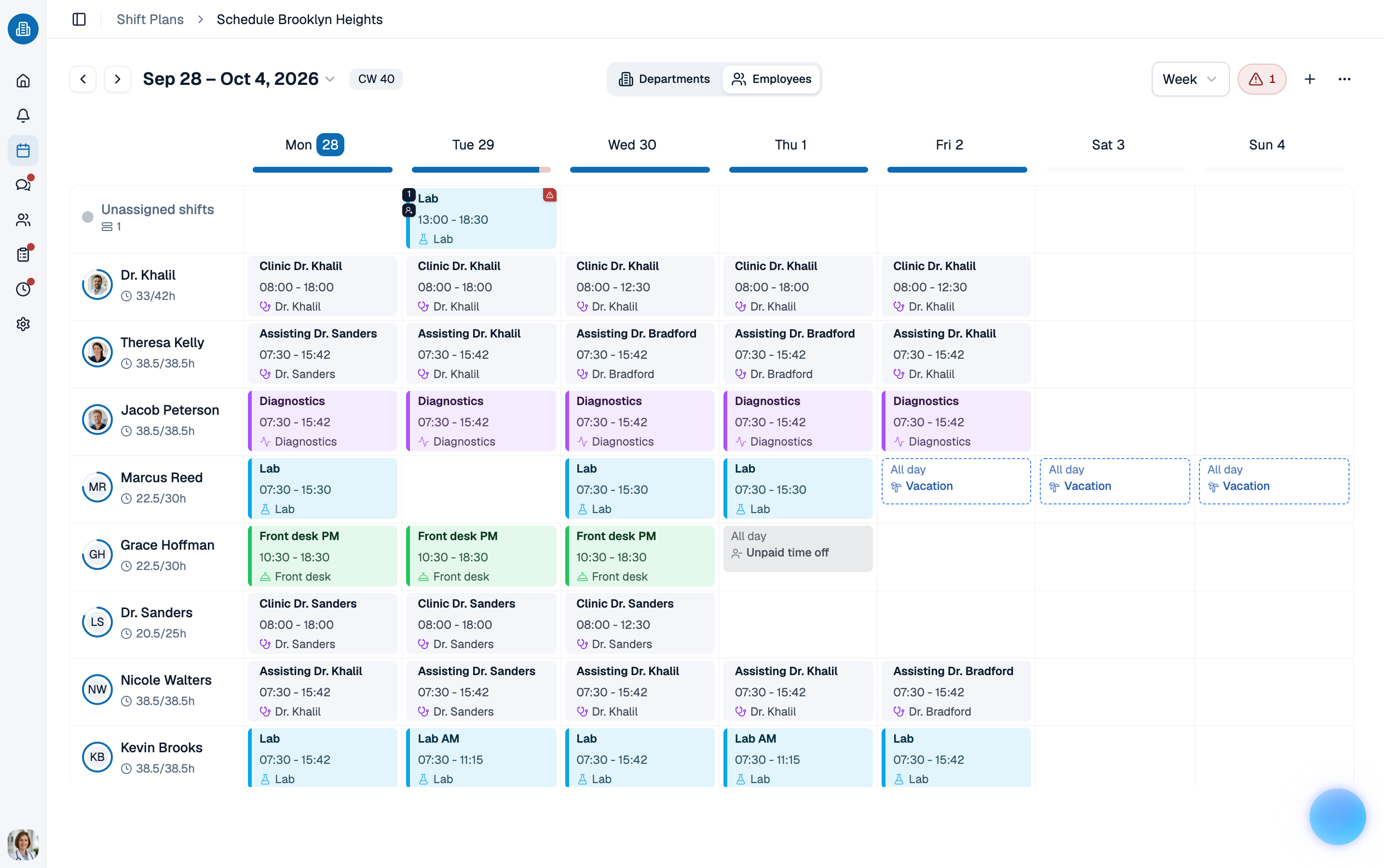
Weekly templates and even and odd weeks are part of medishift. Compare the plans.
9/80 holidays and PTO: the missing hour
A holiday on a 9/80 lands on a 9-hour day, on the 8-hour Friday or on the Friday off, and the FLSA settles none of these cases. "The Fair Labor Standards Act (FLSA) does not require payment for time not worked, such as vacations, sick leave or federal or other holidays", says the DOL on vacation and holiday pay; these are "matters of agreement between an employer and an employee", with an exception for Service Contract Act work on government contracts. If your policy pays 8 holiday hours, as a policy written for 8-hour days does, a holiday on a 9-hour day leaves the employee one hour short.
Federal agencies solve this for their own staff: a full-time employee on a compressed work schedule who is off on a holiday gets basic pay "for the number of hours of the compressed work schedule on that day" (OPM handbook, 5 CFR 610.406(a)). That rule binds federal agencies only, but a practice can copy it and pay 9 holiday hours on a 9-hour day.
Holiday pay roughly equal to normal earnings stays out of the regular rate, and "no part of such payments may be credited toward overtime compensation due" (29 CFR 778.218(a)). A holiday on the Friday off is a different case: 29 CFR 778.218(b) separates holidays from "regularly scheduled days of rest", and the 9/80 Friday off is such a day of rest. Whether the employee gets another day off or nothing for it is up to your policy.
Example: Memorial Day falls on a Monday in Dana's workweek with 40 planned hours, and the practice pays 8 holiday hours. Dana works 4 hours on Friday afternoon and 27 hours Tuesday to Thursday, 31 hours, and is paid for 31 + 8 = 39 hours, one hour ($22) short of her usual 40. The practice has three options: Dana uses 1 hour of PTO, works one extra hour in the same workweek (Tuesday until 6:00 PM, 32 worked hours), or the policy pays 9 holiday hours on a 9-hour day. Under 29 CFR 778.218(a), the holiday hours do not count toward overtime, and outside California there is none with 31 or 32 worked hours.
Sources
As of November 15, 2026
- govinfo: 5 U.S.C. 6121, United States Code, 2024 edition
- govinfo: 29 U.S.C. 207, United States Code, 2024 edition
- eCFR: 29 CFR 778.104, 29 CFR 778.105 and 29 CFR 778.218, up to date as of November 12, 2026
- eCFR: 29 CFR 541.600 and 29 CFR 541.602, up to date as of November 12, 2026
- eCFR: 29 CFR 785.19, up to date as of November 12, 2026
- U.S. Office of Personnel Management: Handbook on alternative work schedules, retrieved November 15, 2026
- U.S. Department of Labor, Wage and Hour Division: Fact Sheet #14, coverage under the FLSA, retrieved November 15, 2026
- U.S. Department of Labor: Vacation leave, retrieved November 15, 2026
- California Labor Commissioner (DLSE): Overtime FAQ, retrieved November 15, 2026
- Industrial Welfare Commission: Order 4-2001, effective January 1, 2002, as amended, retrieved November 15, 2026