
The DuPont schedule is a 28-day rotation in which four crews work 12-hour day and night shifts to cover a post 24/7. No federal labor regulation defines it, and the Fair Labor Standards Act (FLSA) sets no limit on weekly hours for employees 16 and older; for covered, nonexempt employees it only requires at least time and one-half for hours over 40 in a workweek (Department of Labor). Because the FLSA does not permit averaging hours over two or more weeks (29 CFR 778.104), one DuPont crew on 12 paid hours per shift earns 16 to 48 overtime hours per cycle when its workweek starts at a shift change, depending on the weekday cycle day 1 falls on.
The DuPont schedule in brief
- Each crew: 4 nights, 3 off, 3 days, 1 off, 3 nights, 3 off, 4 days, 7 off (Snap Schedule).
- Averages 42 hours a week, 72 on cycle days 8 to 14 (Snap Schedule).
- No federal regulation defines the pattern; no FLSA hour limit from age 16 (DOL).
- Workweek starting at a shift change: 16 to 48 FLSA overtime hours per crew per cycle, by start day (29 CFR 778.104).
- Hospital 8 and 80, periods starting at a shift change: 56 overtime hours per cycle, any start day (29 CFR 778.601).
- One 24/7 post needs four people, none in reserve.
What is the DuPont schedule? The 28-day cycle week by week
The DuPont schedule gives every crew the same 28 days. The scheduling vendor Snap Schedule describes it this way: "During a 4-week cycle, each team works 4 consecutive night shifts, followed by 3 days off duty, works 3 consecutive day shifts, followed by 1 day off duty, works 3 consecutive night shifts, followed by 3 days off duty, works 4 consecutive day shift, then have 7 consecutive days off duty."
| Cycle week | Days on and off | Shifts | Hours |
|---|---|---|---|
| Week 1 (days 1-7) | 4 nights, 3 off | 4 | 48 |
| Week 2 (days 8-14) | 3 days, 1 off, 3 nights | 6 | 72 |
| Week 3 (days 15-21) | 3 off, 4 days | 4 | 48 |
| Week 4 (days 22-28) | 7 off | 0 | 0 |
| Cycle | 7 day and 7 night shifts | 14 | 168 |
Snap Schedule puts the result in two lines: "Personnel works an average 42 hours per week", and a crew "must work 72 hours in one week every 4 weeks", which is cycle week 2 in the table.
- Crew: one of the four teams that share the post; everyone in a crew works the same shifts.
- 12-hour shift: the day splits into a day shift and a night shift of 12 hours each.
- Night shift: 7 of a crew's 14 shifts per cycle are nights, in a block of four and a block of three.
- 28-day cycle: four weeks, then the sequence starts over; Snap Schedule notes that Day 1 "can be any day of the week."
- 24/7 coverage: on every day of the cycle, one crew is on days, one on nights and two are off.
Because only a 28-day February matches the cycle, a monthly DuPont schedule starts almost every month on a different cycle day. If you are looking for a 12-hour shift rotation schedule, Snap Schedule calls the DuPont "a 12-hour rotating shift pattern".
DuPont crew size for one 24/7 post
A DuPont schedule needs four people for every post that runs 24/7, one per crew: two 12-hour shifts on 7 days are 168 hours a week, which four people cover at 42 hours each. The crews start 7 days apart, crew A on day 1, B on day 8, C on day 15 and D on day 22. Vacation and sick days come on top; four people leave no spare. In our demos and onboarding, we often see that when someone calls out, the replacement is still found through a phone tree.
DuPont schedule overtime: why the start day decides
DuPont schedule overtime is counted per workweek under the FLSA, never as a cycle average. Under 29 CFR 778.104, "The Act takes a single workweek as its standard and does not permit averaging of hours over 2 or more weeks", "regardless of whether the employee works on a standard or swing-shift schedule". Under 29 CFR 778.105, a workweek is "a fixed and regularly recurring period of 168 hours" that "may begin on any day and at any hour of the day".
Snap Schedule says the pattern "Requires an average of 2 overtime hours per employee per week", and Teambridge says of the DuPont and the Panama: "Both average roughly two hours of weekly overtime under federal rules". allGeo writes that the 42-hour average "translates to an average of two overtime hours per employee weekly". Two hours is 42 minus 40, an average the FLSA does not allow.
Example: A hospital runs its inpatient pharmacy 24/7 with one post and four pharmacy technicians, one per crew, all paid hourly and nonexempt. Day shift 7 AM to 7 PM, night shift 7 PM to 7 AM, 12 paid hours per shift with no relieved meal break. The workweek runs from Sunday 7:00 AM, so every shift falls inside one workweek.
| Cycle day 1 on | Hours in the four weeks | Overtime per cycle | Average per week |
|---|---|---|---|
| Sunday | 48, 72, 48, 0 | 48 | 12 |
| Monday | 48, 60, 48, 12 | 36 | 9 |
| Tuesday | 48, 48, 48, 24 | 24 | 6 |
| Wednesday | 48, 36, 48, 36 | 16 | 4 |
| Thursday | 36, 48, 36, 48 | 16 | 4 |
| Friday | 24, 48, 48, 48 | 24 | 6 |
| Saturday | 12, 48, 60, 48 | 36 | 9 |
The rule of thumb: put cycle day 1 on the fourth or fifth day of the workweek, here Wednesday or Thursday, and the weeks alternate 36 and 48 hours. Even the best placement averages 4 overtime hours a week; 2 is out of reach on 12-hour shifts.
The table and its 4-hour weekly floor hold only while every shift sits whole in one workweek; a midnight workweek start splits the Saturday night, and a relieved meal break lowers every value, as our 2-2-3 schedule guide shows for that pattern. Choose the start day of the cycle rather than moving the workweek: 29 CFR 778.105 allows a new workweek start only "if the change is intended to be permanent and is not designed to evade the overtime requirements of the Act."
Setting up a DuPont schedule in medishift
A DuPont schedule repeats every four weeks, so in medishift you build the cycle once. Plan four full weeks with all four crews, cycle day 1 on the weekday you chose, save each week as a weekly template with the people assigned, and apply each template to every fourth week for up to 12 months ahead. The schedule check compares each person's planned weekly hours with their weekly target; it does not calculate FLSA overtime or 8 and 80, which stays with you and your payroll. For call-outs, you write a cover plan with Kira, and once you switch on the automatic replacement search, medishift asks colleagues in the order that plan sets after an absence is approved. See our hospital scheduling software.
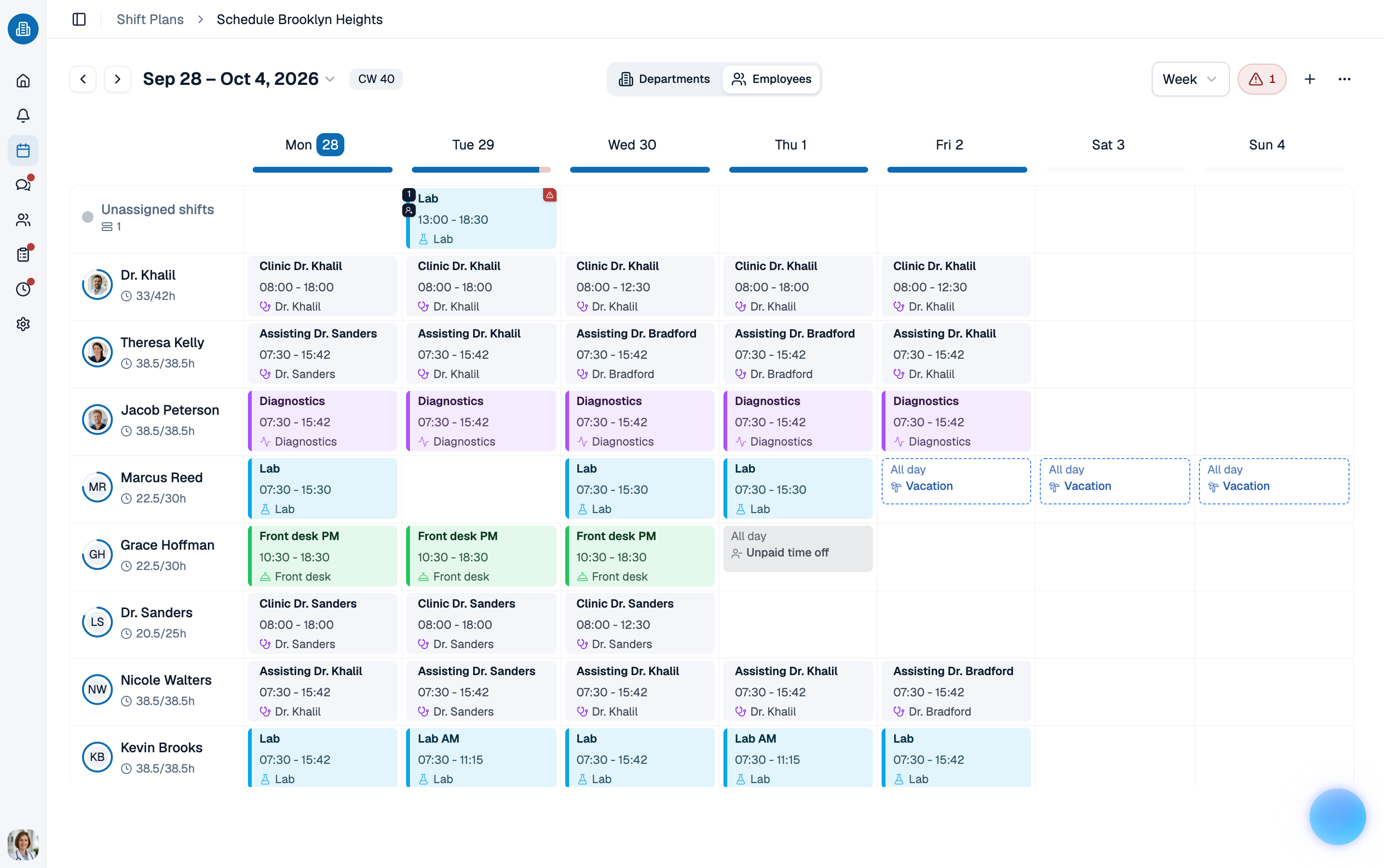
Weekly templates, the schedule check and the cover plan are part of medishift. Compare the plans.
Daily overtime on a DuPont schedule: 8 and 80 and California
Daily overtime turns every 12-hour shift of a DuPont schedule into 4 overtime hours when each workday starts at a shift change.
The 8 and 80 system for hospitals
Under the 8 and 80 system, a hospital or residential care establishment and its employee agree before the work on a 14-day period in place of the workweek, with overtime pay past 8 hours in a workday and 80 in the period. Under 29 CFR 778.601(d), the first workday begins with the period, daily overtime is due even below 80 hours, and daily premiums may be credited toward the overtime due beyond 80 hours. DOL Fact Sheet #54 (revised July 2009) adds that an employer may use both systems for different employees in the same workplace, "but they cannot use both for a single individual employee."
Example: The same pharmacy on 14-day periods from Sunday 7:00 AM, so every workday runs 7 AM to 7 AM and holds one whole shift. Each shift has 4 hours over 8, and 14 shifts make 56 daily overtime hours per cycle.
| Cycle day 1 on | Hours in the two periods | 8 and 80 overtime | Workweek overtime |
|---|---|---|---|
| Sunday | 120 and 48 | 40 + 16 = 56 | 48 |
| Monday or Saturday | 108 and 60 | 36 + 20 = 56 | 36 |
| Tuesday or Friday | 96 and 72 | 32 + 24 = 56 | 24 |
| Wednesday or Thursday | 84 and 84 | 28 + 28 = 56 | 16 |
The hours over 80 never exceed the daily hours, so crediting changes nothing. On workdays timed as in the example, the 14-day period costs a DuPont on 12-hour shifts more than any workweek placement.
What the start day costs a hospital pharmacy
Example: Four hospital pharmacy technicians on one post earn $22.00 an hour, the 2025 median pay for the occupation in the BLS Occupational Outlook Handbook, across all employers, not hospitals alone. No night differential; overtime at $33.00. Total hours stay at 168 per cycle, so only the extra half of $11.00 per overtime hour changes. 13 cycles make 364 days.
| Overtime basis | Overtime hours per person per year | Premium per person | Premium per post |
|---|---|---|---|
| Workweek, day 1 on Wed or Thu | 208 | $2,288 | $9,152 |
| Workweek, day 1 on Sunday | 624 | $6,864 | $27,456 |
| 8 and 80 | 728 | $8,008 | $32,032 |
The wrong start day costs this post $18,304 a year, and 8 and 80 costs $22,880 more than the best placement. A night differential raises every number, because the regular rate includes night differentials.
California daily overtime and the DuPont
California daily overtime is time and one-half for "all hours worked in excess of eight hours up to and including 12 hours in any workday" and double time for "all hours worked in excess of 12 hours in any workday", as the DLSE Overtime FAQ lists it. Without an alternative workweek schedule and with workdays starting at 7 AM, a DuPont cycle brings 56 such hours; any minute past 12 hours, such as a late handover, would be double time. One and one-half times the regular rate is also due "over 40 hours in the workweek", but only a six-shift workweek pushes the cycle above 56; in the pharmacy example, only cycle day 1 on Sunday creates that week. The DLSE seventh-day rule never applies, because a crew works at most four days in a row.
DuPont schedule fatigue: what NIOSH recommends
The DuPont schedule puts two blocks of four 12-hour shifts into every cycle. The NIOSH training for nurses on shift work (Publication No. 2015-115) advises: "Consider two rest days after three consecutive 12-hour shifts." It adds that "experts recommend avoiding several days of work followed by 4- to 7-day mini-vacations" and says to "Keep consecutive night shifts to a minimum for rotating shifts."
The DuPont departs from it three times:
- Four in a row: the night block and the day block each run four 12-hour shifts, one more than NIOSH puts before two rest days.
- One rest day after three: three day shifts, a single day off, then three nights.
- The 7-day break: four day shifts followed by seven days off is the mini-vacation pattern the NIOSH guidance advises avoiding.
The guidance is a recommendation for hospital nurses, not a rule, and checking the DuPont against it does not tell you the healthiest shift work schedule.
DuPont schedule vs Panama schedule (2-2-3)
The DuPont schedule is set against the Panama schedule on vendor pages such as Teambridge, which defines the Panama as "a rotating work schedule where employees work two days on, two days off, then three days on, followed by two days off, two days on, and three days off."
| Feature | DuPont schedule | Panama (2-2-3) schedule |
|---|---|---|
| Cycle length | 28 days | 14 days |
| Shifts per cycle | 14 | 7 |
| Longest work block | 4 shifts | 3 shifts |
| Longest break | 7 days | 3 days |
| Days and nights | Both in a cycle | Not part of the pattern |
Our 2-2-3 schedule guide works through that pattern's chart and overtime.
Sources
As of October 25, 2026 (eCFR, current version).
- Snap Schedule: DuPont shift schedule, retrieved October 25, 2026 (vendor page)
- allGeo: What is the DuPont schedule, retrieved October 25, 2026 (vendor page)
- Teambridge: DuPont vs Panama schedule, retrieved October 25, 2026 (vendor page)
- U.S. Department of Labor: Overtime pay, retrieved October 25, 2026
- U.S. Department of Labor: Fact Sheet #54, health care overtime, revised July 2009, retrieved October 25, 2026
- eCFR: 29 CFR 778.104, current version
- eCFR: 29 CFR 778.105, current version
- eCFR: 29 CFR 778.601, current version
- California DLSE: Overtime FAQ, retrieved October 25, 2026
- U.S. Bureau of Labor Statistics: Pharmacy technicians, retrieved October 25, 2026
- NIOSH: Training for nurses on shift work and long work hours, module 5, retrieved October 25, 2026