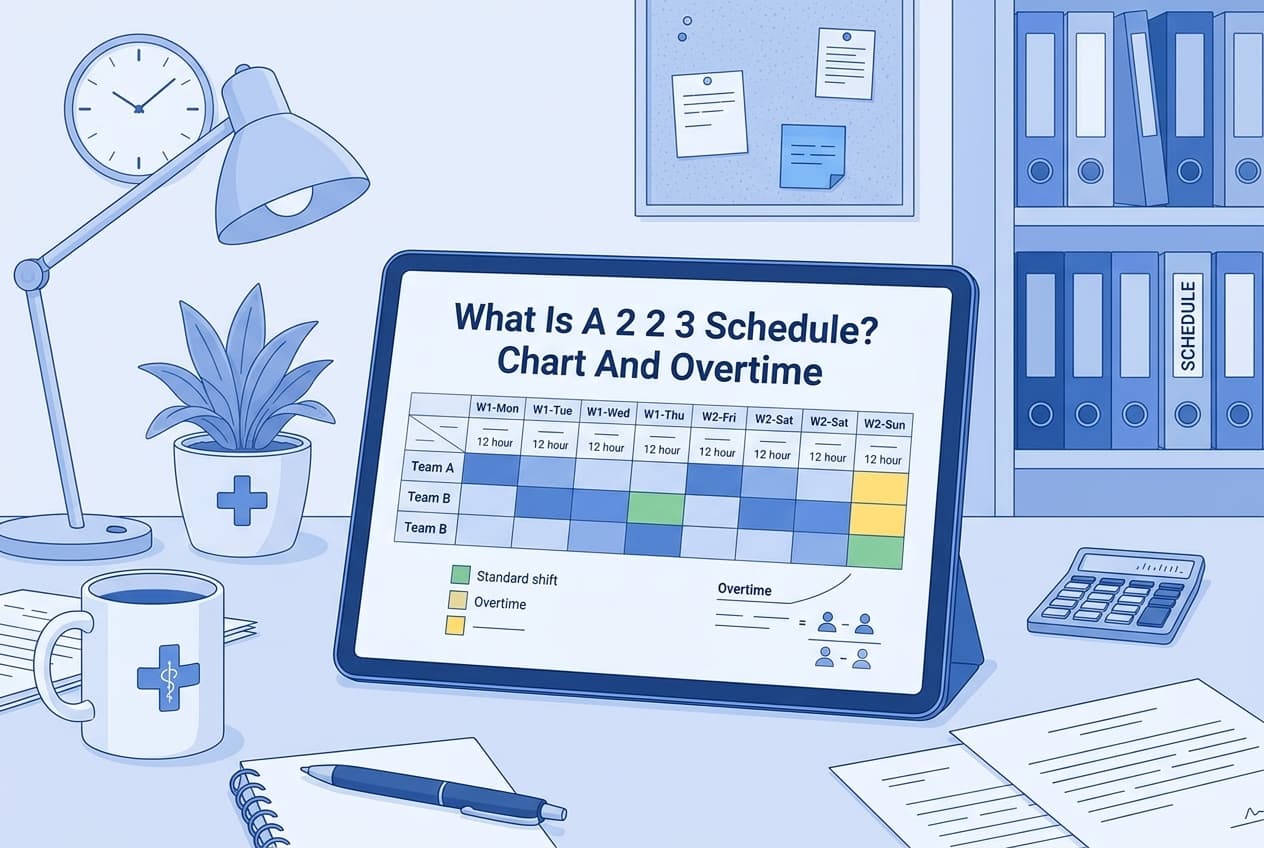

Time and a half is the federal overtime rate: an employee covered by the Fair Labor Standards Act (FLSA) who works more than 40 hours in a workweek must be paid at least one and one-half times the regular rate for each hour over 40 (29 U.S.C. 207(a)(1)). The rule does not reach exempt employees, and the 1.5 multiplies the regular rate, which includes night shift differentials (29 CFR 778.207(b)). Time and a half for holiday or weekend work, by contrast, is a premium federal law does not require, and an employer may credit it toward the overtime owed if the rate is at least 1.5 (29 U.S.C. 207(h)(2)).
Key takeaways
- Federal overtime is at least 1.5 times the regular rate past 40 hours in a workweek (29 U.S.C. 207(a)(1)).
- A single $25 hourly rate means at least $37.50 per overtime hour (29 CFR 778.110(a)).
- Night differentials raise the regular rate (29 CFR 778.207(b)).
- Holiday premiums below 1.5 raise the regular rate and are not creditable, unless paid for hours over eight a day, 40 a week or normal hours (29 CFR 778.203).
- Practicing licensed physicians and dentists are exempt regardless of salary (29 CFR 541.304(a)(1), (b), (d)).
- The overtime tax deduction counts only what 29 U.S.C. 207 requires (IRS FS-2026-13).
What time and a half overtime means under the FLSA
Time and a half overtime under the FLSA is a floor tied to the regular rate:
"Except as otherwise provided in this section, no employer shall employ any of his employees … for a workweek longer than forty hours unless such employee receives compensation … at a rate not less than one and one-half times the regular rate at which he is employed." (29 U.S.C. 207(a)(1))
The rule covers employees engaged in commerce or employed by an enterprise engaged in commerce, and it does not apply to employees exempt under 29 CFR Part 541.
The regular rate includes night differentials
The regular rate is the total pay for a workweek, minus the statutory exclusions, divided by the hours actually worked in that week (29 CFR 778.109). Night shift differentials belong in it, whether they are a percent of the base rate or so many cents per hour (29 CFR 778.207(b)), and so do bonuses that do not qualify for one of the exclusions (29 CFR 778.208). For nurses, the Department of Labor says overtime "must be calculated on the regular rate, which will exceed the hourly rate when shift differentials are paid" (DOL, Fact Sheet #54). How an evening differential plays out over a rotation is in does swing shift pay more.
For a nonexempt employee on a weekly salary, the regular rate is the salary divided by the hours it is meant to pay for: $350 for a 35-hour week gives $10 an hour, then $10 for each of the first 40 hours and $15 for each hour after that (29 CFR 778.113(a)).
Overtime counts per workweek, never averaged
An FLSA workweek is a fixed and regularly recurring period of 168 hours that can begin on any day and at any hour (29 CFR 778.105). Each workweek stands alone: 30 hours in one week and 50 in the next mean 10 overtime hours in the second week, even though the average is 40 (29 CFR 778.104). On 12-hour rotations the start of the workweek decides how many hours land above 40, as overtime on a 2-2-3 schedule shows.
Is overtime always time and a half?
Overtime is not always time and a half: exemptions remove it, 8 and 80 and California change which hours count, double time raises the rate.
Exempt employees get no premium
Apart from exceptions such as licensed physicians, an executive, administrative or professional employee can be exempt only if paid at least $684 per week (other amounts apply in some U.S. territories), as a salary or, for administrative and professional employees, also as a fee, and if the duties tests are met (29 CFR 541.600(a)). Since May 15, 2026, the regulation states that threshold again: the Department of Labor removed the text of the vacated 2024 rule and republished the earlier text (Federal Register, May 15, 2026).
Hospitals on the 8 and 80 system
A hospital, or an institution primarily caring for sick or aged people who reside on the premises, may agree with an employee before the work is done to replace the workweek with a 14-day period, and then owes time and a half for hours over eight in a workday and over 80 in the period (29 U.S.C. 207(j)). The rate stays at 1.5, only the counted hours change; see the 8 and 80 system in hospitals.
California daily overtime and double time
The FLSA does not excuse noncompliance with a state law or municipal ordinance that sets a higher minimum wage or a lower maximum workweek (29 U.S.C. 218(a)). California's Labor Commissioner says a nonexempt employee aged 18 or older, and certain 16- and 17-year-olds, must get one and one-half times the regular rate for hours over eight in a workday and over 40 in a workweek, and double the regular rate for hours over 12 in a workday and over eight on the seventh consecutive day of work in a workweek (California DIR, Overtime FAQ). Most of California's Industrial Welfare Commission Wage Orders allow an alternative workweek schedule of four 10-hour days or three 12-hour days; case F below assumes no such schedule.
Is overtime double or time and a half?
Under federal law, overtime is time and a half: 29 U.S.C. 207(a)(1) sets a rate "not less than one and one-half times" the regular rate, and the IRS describes double time as paying more than the FLSA requires (IRS, FS-2026-13). Double time is owed where a state law or a contract says so, as in California past 12 hours in a workday.
When is time and a half overtime pay, and when a premium?
Time and a half for a holiday or a Sunday is usually a premium, not overtime, because the FLSA "does not require overtime pay for work on Saturdays, Sundays, holidays, or regular days of rest, unless overtime is worked on such days" (DOL, Overtime Pay). Federal law keeps three kinds of premium out of the regular rate:
- Premiums for hours over eight in a day, over 40 in the workweek, or over the employee's normal working hours (29 U.S.C. 207(e)(5)).
- Premiums of at least 1.5 for work on weekends, holidays, regular days of rest, or the sixth or seventh day of the workweek (29 U.S.C. 207(e)(6)).
- Premiums of at least 1.5 under a contract or collective bargaining agreement for work outside its normal workday (at most eight hours) or workweek (29 U.S.C. 207(e)(7)).
All three are creditable toward the overtime the FLSA requires (29 U.S.C. 207(h)(2)). If a holiday or weekend premium is less than time and one-half, it must be included in the regular rate and cannot be credited toward the overtime due, unless it is a premium for hours over eight a day, over 40 in the workweek or over the normal working hours (29 CFR 778.203).
Overtime at $25 an hour: six cases worked through
Example: Each case assumes a nonexempt employee, a Sunday to Saturday workweek and a $25 hourly base rate. Settings: A, dental front desk; B, hospital night nurse; C and D, pharmacy technicians on a holiday; E, medical office on salary; F, California clinic.
In B and D, straight-time pay covers every hour; the table adds half the regular rate per overtime hour.
| Case | Hours | Calculation | Weekly pay |
|---|---|---|---|
| A. Hourly only | 46 | 40 × $25 + 6 × $37.50 | $1,225.00 |
| B. Night differential $2 | 46, 24 of them nights | ($1,150 + $48) ÷ 46 = $26.0435 regular rate; 6 × $13.0217 premium | $1,276.13 |
| C. Holiday premium 1.5 ($37.50) | 44, 8 of them on a holiday | 36 × $25 + 8 × $37.50; the $100 holiday premium covers the $50 owed | $1,200.00 |
| D. Holiday premium 1.25 ($31.25) | 44, 8 of them on a holiday | $1,150 ÷ 44 = $26.1364 regular rate; 4 × $13.0682 premium | $1,202.27 |
| E. Salary $875 for 35 hours | 42 | $875 + 5 × $25 + 2 × $37.50 | $1,075.00 |
| F. California, four 10-hour days | 40 | FLSA: no hour over 40; California: 8 daily hours × $12.50 premium | $1,000.00 (FLSA), $1,100.00 (California) |
At $25 an hour, each overtime hour pays $37.50: $25 straight time plus $12.50, half the rate (29 CFR 778.110(a)). Case B on the base rate alone would be $3.13 short. The smaller holiday premium in case D costs $2.27 more than case C, because it enters the regular rate. Case E pays hours 36 to 40 at straight time.
Tracking overtime hours in medishift
Payroll can only apply time and a half if it knows, per employee and fixed workweek, the hours actually worked and which carried a differential or holiday premium; take them from recorded time, not from the schedule.
medishift records working time by clock-in and clock-out and keeps an overtime balance per person: actual minus target hours. The schedule check flags weeks in which planned hours exceed the weekly target. medishift does not calculate FLSA overtime pay, the regular rate or 8 and 80. Because the balance counts against the contracted target, in case E it shows seven hours over while only two are FLSA overtime. More in our time and attendance software.
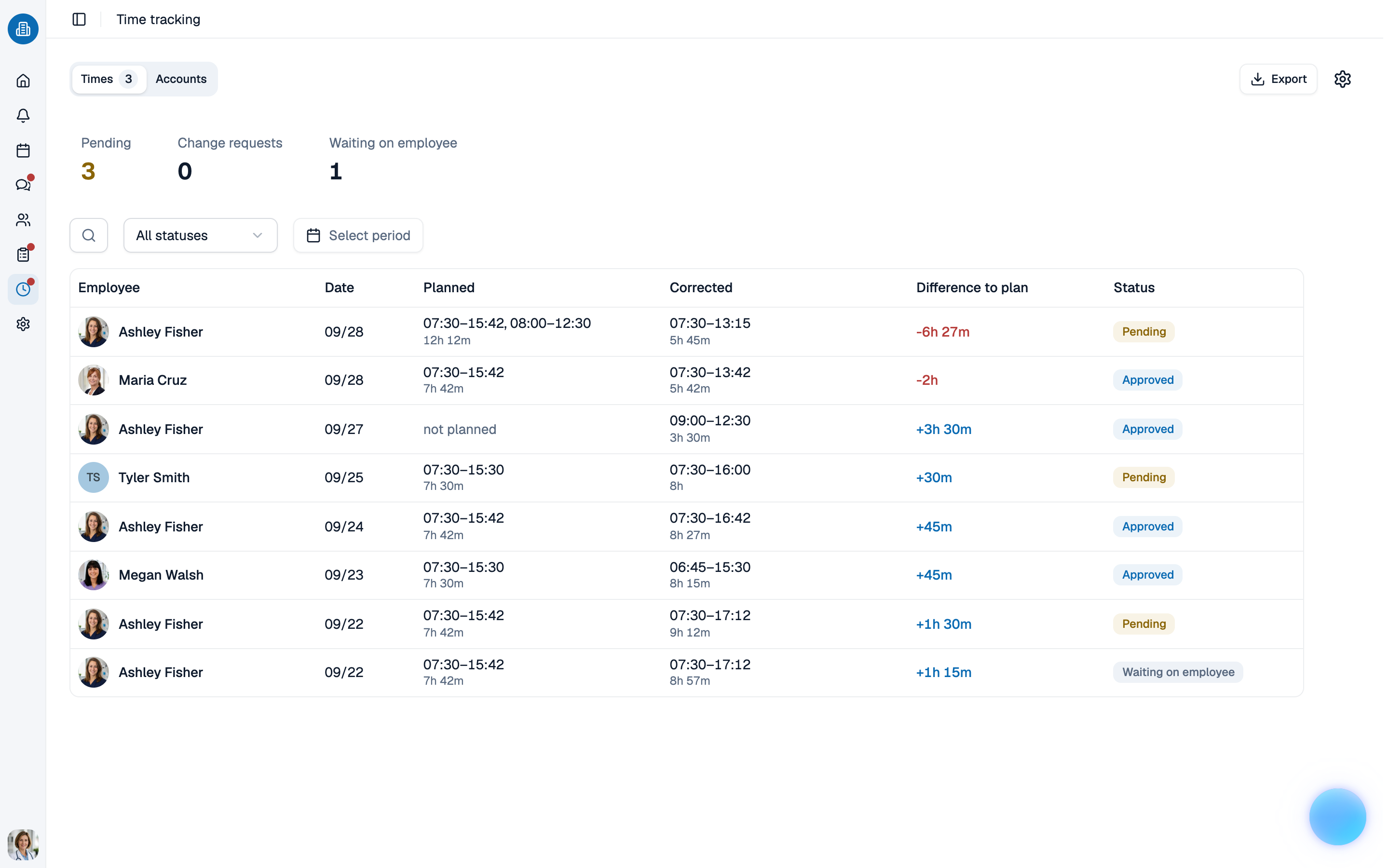
Time tracking and the overtime balance are part of medishift. See the plans.
Exceptions by industry, role and state
Hospitals, physicians, salaried professionals, California and contracts each change what a given employee is owed.
| Group | What applies | Source |
|---|---|---|
| Hospitals and residential care | Optional 14-day period, time and a half over 8 a day and over 80 | 29 U.S.C. 207(j), 29 CFR 778.601 |
| Licensed physicians and dentists | Exempt if licensed and practicing, no salary requirement | 29 CFR 541.304(a)(1), (b), (d) |
| Registered nurses | Duties test generally met; exempt only on a salary or fee of at least $684 a week (other amounts in some territories) | 29 CFR 541.301(e)(2), 541.300(a)(1) |
| Licensed practical nurses | Generally not exempt learned professionals | 29 CFR 541.301(e)(2) |
| Pharmacists, therapists, technologists | Salary or fee requirement applies | 29 CFR 541.600(e) |
| California | Time and a half over 8 a day, double time over 12 | California DIR |
| Contracts and union agreements | Premiums of at least 1.5 outside normal hours are creditable | 29 U.S.C. 207(e)(7), 207(h)(2) |
Nurses, physicians and LPNs: who gets time and a half
Physicians, including dentists, are exempt if they hold a valid license and actually practice, and the salary requirements do not apply to them (29 CFR 541.304(a)(1), (b), (d)). Registered nurses registered by the state examining board "generally meet the duties requirements for the learned professional exemption" (29 CFR 541.301(e)(2)). The exception from the salary or fee requirement does not apply to nurses, pharmacists, therapists or technologists (29 CFR 541.600(e)), so a nurse is exempt only if paid on a salary or fee basis of at least $684 per week, other amounts applying in some U.S. territories (29 CFR 541.300(a)(1)). A registered nurse paid by the hour and not on a salary or fee basis is therefore not exempt and gets time and a half for hours over 40, or, under an agreed hospital 8 and 80 system, for hours over eight a day and over 80 in 14 days. Licensed practical nurses "generally do not qualify as exempt learned professionals" (29 CFR 541.301(e)(2)).
The overtime tax deduction counts only the half
Employees can deduct qualified overtime compensation up to $12,500, or $25,000 on a joint return (IRS FS-2026-13); it shrinks above $150,000 modified adjusted gross income, $300,000 for joint filers. Only the amount needed to satisfy 29 U.S.C. 207 counts: when overtime is paid at one and one-half times the regular rate, the half is qualified, and overtime pay that only a state law, a union contract or the employer's own policy requires is not (IRS FS-2026-13, A16).
In case B the qualified amount is the $78.13 premium; California's $100 in case F does not count. Starting in 2026, employers must report qualified overtime compensation on Form W-2, box 12, code TT, and for tax years after 2025 employees may count no more than that amount (IRS FS-2026-13).
Sources
As of October 21, 2026 (eCFR up to date as of October 19, 2026).
- U.S. Code, 2024 edition, via govinfo: 29 U.S.C. 207 (last amended 2022) and 29 U.S.C. 218
- U.S. Department of Labor: Overtime Pay and Fact Sheet #54 (revised July 2009)
- eCFR, 29 CFR Part 778: 778.104, 778.105, 778.109, 778.110, 778.113, 778.203, 778.207, 778.208, 778.601
- eCFR, 29 CFR Part 541: 541.300, 541.301, 541.304, 541.600
- Federal Register: technical amendment to Part 541, May 15, 2026
- California Department of Industrial Relations: Overtime FAQ
- Internal Revenue Service: FS-2026-13, August 2026
This article is not legal or tax advice for an individual case.