A swing shift is an evening work shift between the day and night shift, usually from 3 or 4 PM until 11 PM or midnight. One scheduling vendor, WorkSight Flow, also uses it for the block between a crew's day and night weeks. The overtime regulation of the Fair Labor Standards Act (FLSA), 29 CFR Part 778, uses the term without defining it; the clock hours come from the dictionary and the Bureau of Labor Statistics.
Key takeaways
- A swing shift runs from 3 or 4 PM to 11 PM or midnight (Oxford Learner's Dictionary).
- 29 CFR Part 778 uses the term without defining it; the BLS counts a shift as evening work when most hours fall between 2 PM and midnight.
- It can mean fixed evenings or one vendor's block between day and night weeks; say which in the job posting.
- The FLSA requires no extra pay for night work; premiums such as nightshift differentials go into the regular rate (29 CFR 778.207(b)).
- A 28-day Southern Swing rotation yields 16 overtime hours per cycle (Sunday workweek).
What is a swing shift? Fixed evenings or a rotation
A swing shift means evening hours or, at one vendor, the block between day and night weeks.
The evening shift. The Oxford Learner's Dictionary defines it as "the shift (= period of time worked each day) from 3 or 4 o'clock in the afternoon until 11 or 12 at night", and also as "the workers who work this shift". In a hospital pharmacy with three 8-hour shifts, that is 3 PM to 11 PM, worked by the same staff every week.
The swing week of a rotation. A rotating shift, in the words of the Bureau of Labor Statistics, is one where "hours change periodically from days to evenings or nights". WorkSight Flow's Southern Swing is such a rotation: four crews move through day, swing and night weeks.
Which swing shift your job posting means
A posting that only says "swing shift" leaves both meanings open. Someone who wants steady evenings expects 3 PM to 11 PM; in a Southern Swing rotation, they also work a week of nights every four weeks. Put the clock times and "fixed" or "rotating" next to the term in the posting, offer letter and schedule.
The BLS test: most hours between 2 PM and midnight
A swing shift has no clock boundary in 29 CFR Part 778, where 29 CFR 778.203(c) uses the term for a rotating day of rest: a "swing shift schedule" in which "the schedule day of rest rotates in a definite pattern". The BLS does draw a checkable boundary in its survey: "Evening shift. The majority of time respondents worked was between 2 p.m. and midnight." Every shift inside the dictionary window passes. A 10-hour shift from 1 PM to 11 PM has 9 of its 10 hours in that window and only 5 in the BLS daytime window of 6 AM to 6 PM, so the survey would count it as evening work. The BLS sorts survey answers with these definitions; they set no pay or hours, and they do not use the word "swing".
Swing shift compared with night and rotating shifts
A swing shift sits next to the others, with BLS definitions and pharmacy example times:
| Feature | Swing shift | Night shift | Rotating shift |
|---|---|---|---|
| BLS survey definition | Most hours between 2 PM and midnight | Most hours between 9 PM and 8 AM | Hours change from days to evenings or nights |
| Same hours every week | Yes, unless part of a rotation | Yes, unless part of a rotation | No |
| Hospital pharmacy | 3 PM to 11 PM | 11 PM to 7 AM | 7 days, 7 swings, 7 nights in 28 days |
Related terms:
- Day shift: a "daytime schedule" for the BLS has most hours between 6 AM and 6 PM; in the pharmacy, 7 AM to 3 PM.
- Night shift: most hours between 9 PM and 8 AM. Oxford defines the graveyard shift as "a period of time working at night or in the very early morning".
- Evening shift: the BLS term that covers a fixed swing shift.
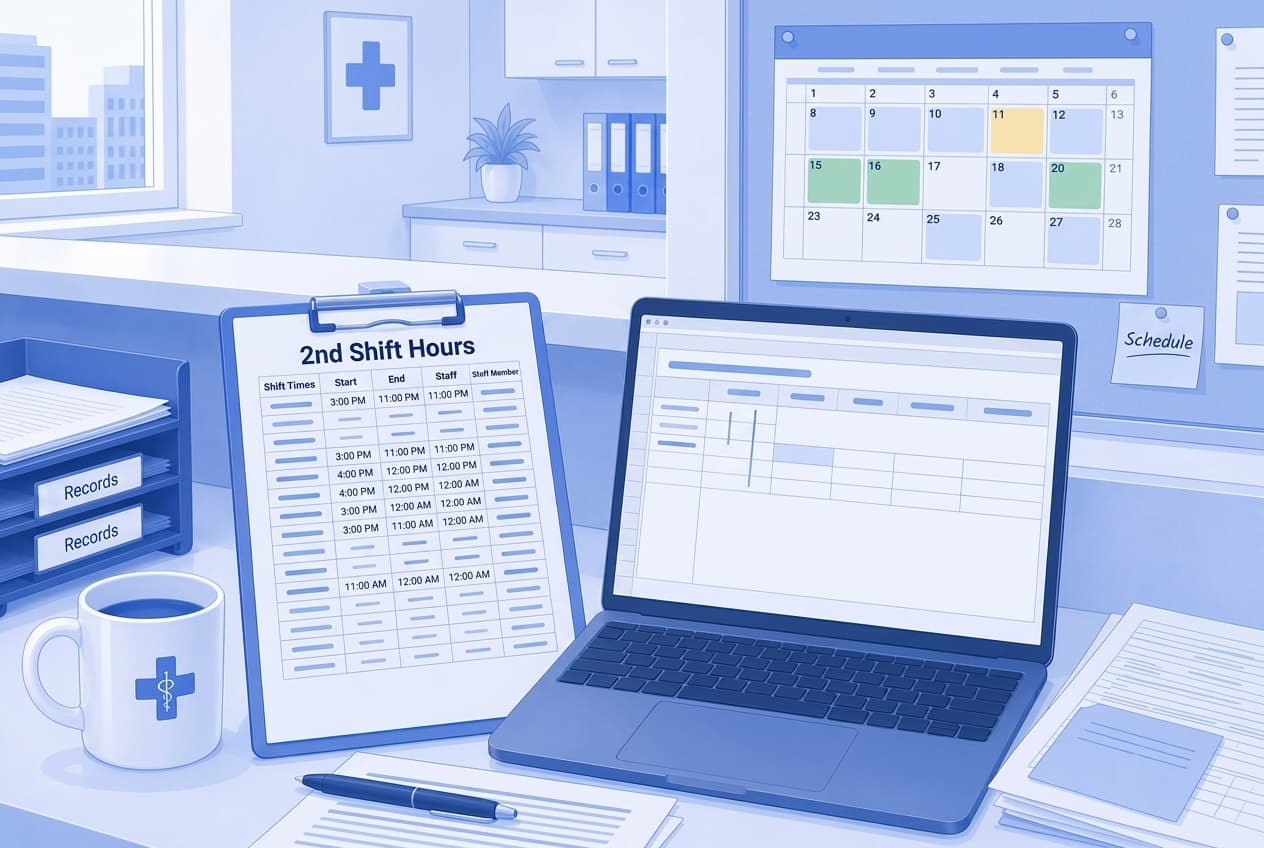
- Second shift: we found no primary source that equates it with the swing shift. Our guide to 2nd shift hours lists first, second and third shift times.
- Split shift: its own category in the BLS survey.
- Shift differential and overtime: see the pay section below.
In 2024-25, 5.3 percent of wage and salary workers usually worked an evening shift, 1.9 percent a rotating shift and 1.0 percent a split shift, according to the BLS shift work table. In education and health services, the same BLS table shows 3.0 percent on evening shifts in 2024-25; the group combines schools and health care, so it is not a hospital figure.
Swing shift hours on 8, 10 and 12-hour schedules
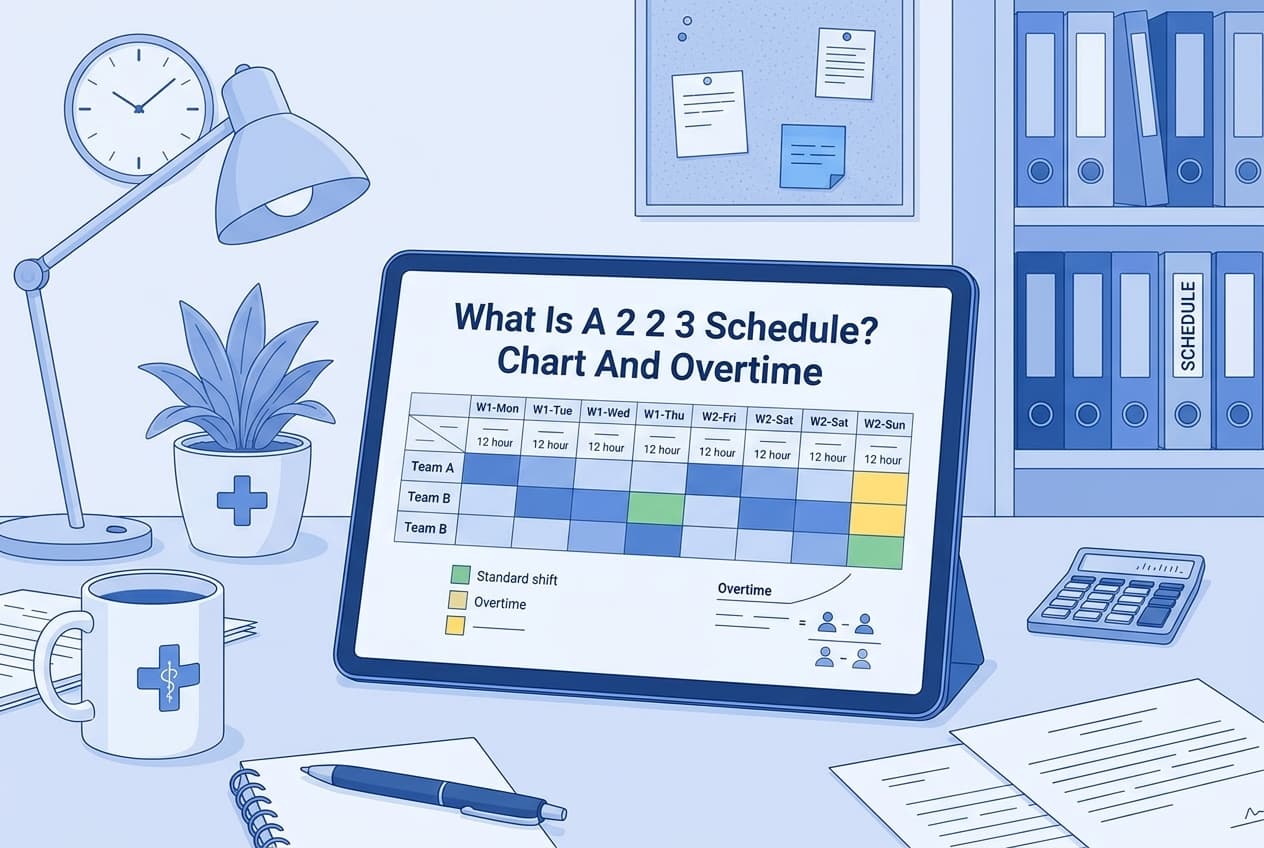
A swing shift on 8-hour schedules is the middle block of three: 3 PM to 11 PM in a hospital pharmacy. A 10-hour block from 2 PM to midnight stays fully inside the BLS evening window. On 12-hour shifts, the day splits into two halves with no middle block, as in the 2-2-3 schedule.
The handover makes swing shift hours grow. If the day shift ends and the swing shift starts at 3 PM, someone stays late or comes in early, and those minutes land on a timesheet. The 8 and 80 example below adds a handover to every shift.
Does swing shift pay more?
A swing shift pays more when a pay policy or an agreement adds a shift differential, an extra premium on top of the base rate. For night work, the Department of Labor says: "Extra pay for working night shifts is a matter of agreement between the employer and the employee (or the employee's representative). The Fair Labor Standards Act (FLSA) does not require extra pay for night work." The page names no separate rule for evening work, and state law and union contracts are not covered here.
What the FLSA does require is overtime: covered, nonexempt workers get at least time and one-half their regular rate for hours over 40 in a workweek. Under 29 CFR 778.207(b), the regular rate has to include extra premiums "such as nightshift differentials (whether they take the form of a percent of the base rate or an addition of so many cents per hour)". Our guide to 2nd shift hours works through the regular rate.
Southern Swing: a rotating swing shift worked through
In a rotating swing shift, the FLSA workweek and the rotation collide. Under 29 CFR 778.105, a workweek is "a fixed and regularly recurring period of 168 hours", it "may begin on any day and at any hour of the day", and once set it "remains fixed regardless of the schedule of hours worked".
Example: A hospital pharmacy runs 24/7 with four crews on the Southern Swing: 7 day shifts, 2 days off, 7 swing shifts, 2 days off, 7 night shifts, 3 days off. That is 21 shifts of 8 hours, 168 hours in 28 days, and the crews start 7 days apart, so each shift has one crew every day. Crew A starts on a Sunday. Day 7 AM to 3 PM, swing 3 PM to 11 PM, night 11 PM to 7 AM; the workweek runs from Sunday 12:00 AM to Sunday 12:00 AM.
| Workweek | Shifts in that week | Hours | Overtime |
|---|---|---|---|
| 1 | 7 day shifts, Sunday to Saturday | 56 | 16 |
| 2 | 2 days off, 5 swing shifts | 40 | 0 |
| 3 | 2 swing shifts, 2 days off, nights from Thursday 11 PM | 33 | 0 |
| 4 | rest of Saturday's night, 4 nights, 3 days off | 39 | 0 |
| Cycle | 21 shifts | 168 | 16 |
All 16 overtime hours come from the day week: its seven shifts sit inside one workweek, while Saturday midnight cuts the night block in two. Because the crews start exactly 7 days apart, every crew hits the 56-hour week once per cycle.
The start of the workweek changes that number. Same rotation, workweek starting at 12:00 AM:
| Workweek starts | Hours per week in the cycle | Overtime per cycle |
|---|---|---|
| Sunday | 56, 40, 33, 39 | 16 |
| Monday | 48, 48, 33, 39 | 16 |
| Tuesday | 40, 56, 33, 39 | 16 |
| Wednesday | 40, 48, 41, 39 | 9 |
| Thursday | 40, 40, 49, 39 | 9 |
| Friday | 40, 33, 55, 40 | 15 |
| Saturday | 40, 33, 47, 48 | 15 |
With a Wednesday start, the day block falls into two workweeks. You choose the start when you establish the workweek; after that, 29 CFR 778.105 allows a change only "if the change is intended to be permanent and is not designed to evade the overtime requirements of the Act."
The 8 and 80 system against a swing rotation
A swing rotation in a hospital can also be paid under the 8 and 80 system. Under 29 CFR 778.601(a), a hospital or residential care establishment and its employee can agree, before the work is done, on a 14-day period in place of the workweek, with time and one-half for hours over 8 in any workday and over 80 in the period. Under 29 CFR 778.601(c), the choice must be meant to last "permanently or for a substantial period of time", and switching back and forth to take advantage of the cheaper system is not permitted. Under 29 CFR 778.601(d), the first workday starts with the period and ends 24 hours later, daily overtime is due "whether or not more than 80 hours are worked in the period", and daily overtime premiums may be credited toward the overtime over 80.
Example: Crew A as above, 14-day periods from Sunday 12:00 AM, so each workday runs midnight to midnight. With handover, every shift ends 15 minutes later: day 7 AM to 3:15 PM, swing 3 PM to 11:15 PM, night 11 PM to 7:15 AM, 8.25 hours each. Every night crosses midnight, so a workday holds 7.25 hours of one night and the first hour of the next: 8.25 hours, a quarter hour over eight.
| 14-day period | Hours | Over 8 in a workday | Overtime |
|---|---|---|---|
| 1: 7 days, 5 swings, no handover | 96 | 0 | 16 |
| 2: 2 swings, 7 nights, no handover | 72 | 0 | 0 |
| 1: with 15 minutes handover | 99 | 3 | 19 |
| 2: with 15 minutes handover | 74.25 | 2 | 2 |
Without handover, 8 and 80 gives the same 16 overtime hours as the Sunday workweek. With handover, it gives 21 per cycle against 19.25 under the Sunday workweek (17.75, 1.25, 0 and 0.25 in the four weeks). In period 1 the premium for the 3 daily hours is credited toward the 19 hours over 80, as 29 CFR 778.601(d) allows, so the total is 19, not 22. In period 2 the crew stays far below 80 hours and still earns 2 overtime hours, a quarter hour from each of its 8 longest workdays.
Building a swing rotation in medishift
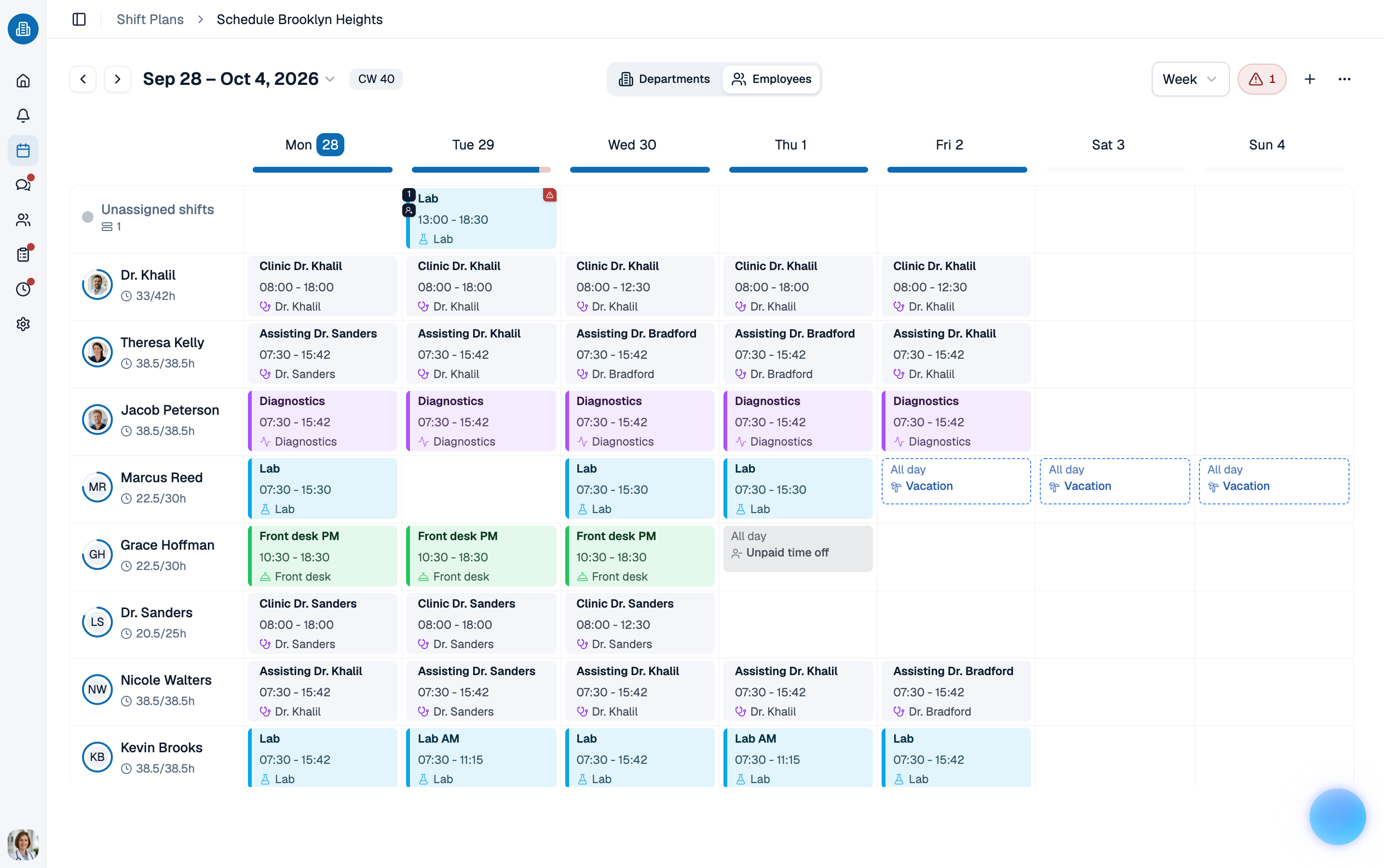
A swing rotation repeats every four weeks, so you set it up once. In medishift you save each week of the cycle as a weekly template, with or without people assigned, and apply each template to every fourth week for up to 12 months ahead. The schedule check compares each person's planned hours with their weekly target and shows the weeks that run over. It does not calculate FLSA overtime or 8 and 80; that stays with you and your payroll. More on evening and night coverage in our healthcare employee scheduling software.
Weekly templates and the schedule check are part of medishift. Compare the plans.
Sources
As of October 19, 2026 (eCFR, current version).
- Oxford Learner's Dictionaries: swing shift, American English, retrieved October 19, 2026
- U.S. Bureau of Labor Statistics: Shift work, technical note, retrieved October 19, 2026
- U.S. Bureau of Labor Statistics: Table 7, workers by shift usually worked, 2024-2025, retrieved October 19, 2026
- U.S. Department of Labor: Night work, retrieved October 19, 2026
- eCFR: 29 CFR 778.105, current version
- eCFR: 29 CFR 778.203, retrieved October 20, 2026
- eCFR: 29 CFR 778.207, current version
- eCFR: 29 CFR 778.601, current version
- WorkSight Flow: The Southern Swing shift pattern, retrieved October 19, 2026 (vendor page, used only for the name and structure of the pattern)
- Oxford Learner's Dictionaries: graveyard shift, American English, retrieved October 20, 2026