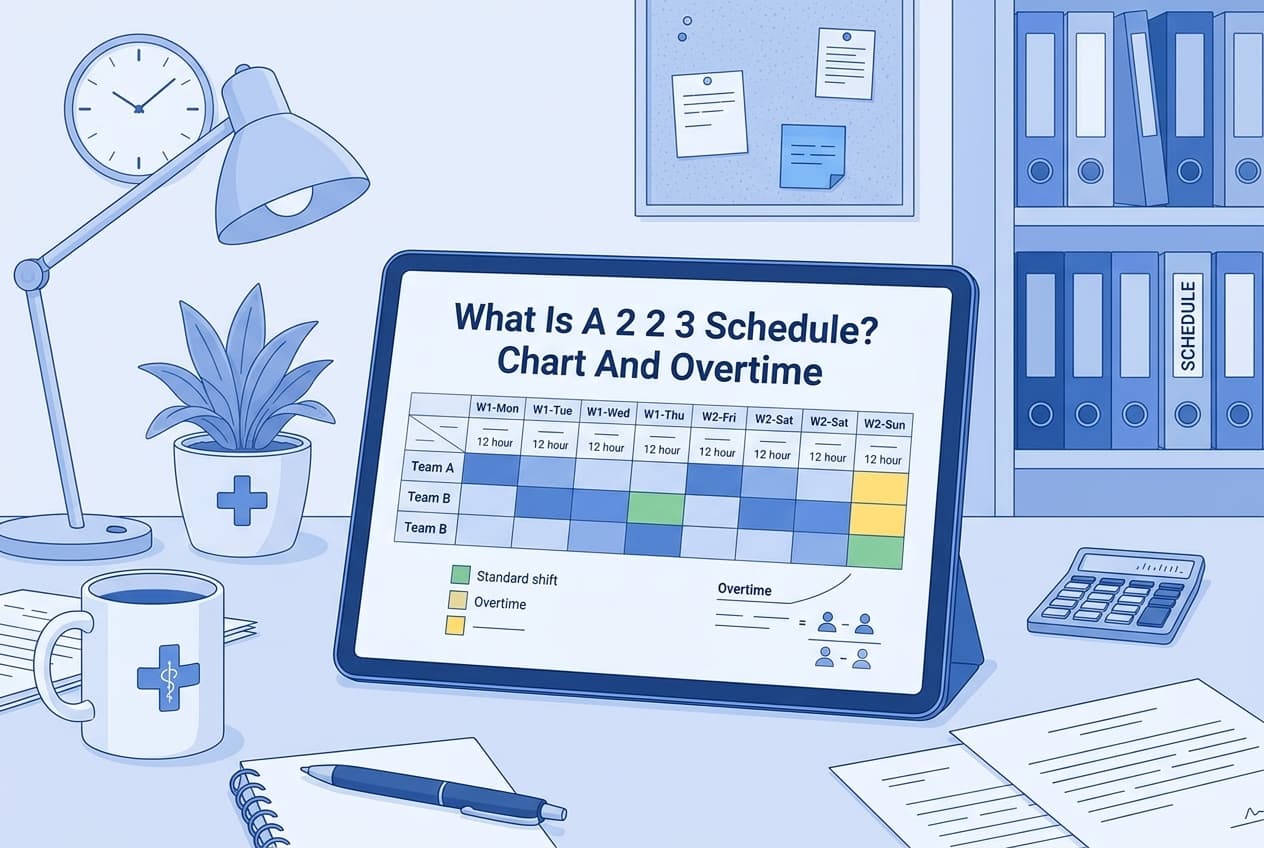

A work schedule is an employer's plan that sets the days, shifts and hours each employee is expected to work. The Fair Labor Standards Act (FLSA) leaves that plan to you: it does not define full-time or part-time employment, and it does not limit the hours of employees aged 16 and older. What it does fix is the workweek, a fixed and regularly recurring period of 168 hours: covered employees who are not exempt get one and one-half times their regular rate for hours over 40 in it. That is why the same 80 hours in two weeks can cost a practice overtime or nothing, depending on where its workweek starts; the example below shows when that holds.
Work schedule: key points
- The FLSA does not define full-time or part-time; the employer decides (DOL).
- Covered, non-exempt employees get overtime past 40 hours in a workweek; weeks cannot be averaged (29 CFR 778.104).
- The 30-hour full-time line counts only for ACA employer rules (IRS).
- A 9/80 with a Sunday workweek gives 44 and 36 hours; a workweek starting Friday at 12:30 PM gives 40 and 40, except in California and on the 8 and 80 system.
- The FLSA sets no hour cap from age 16, and federal law requires no breaks (DOL).
Work schedule, workweek and full-time status compared
A work schedule, the workweek and full-time status are three different things, and only the workweek is fixed by federal overtime law.
| Feature | Work schedule | Workweek | Full-time or part-time |
|---|---|---|---|
| What it is | Days, shifts, hours | Fixed 168-hour period | Label for usual hours |
| Who sets it | Employer | Employer, any start day and hour | Employer |
| What it decides | Who works when | Overtime past 40 hours, if covered and non-exempt | Your policies, ACA counting |
The workweek is the unit the FLSA counts in. Under 29 CFR 778.105, it "need not coincide with the calendar week but may begin on any day and at any hour of the day", and once its beginning is established, "it remains fixed regardless of the schedule of hours worked by him." The DOL overtime page adds that different workweeks may be set for different employees or groups of employees, and that "averaging of hours over two or more weeks is not permitted."
Full-time and part-time have three different lines in the US, and none of them is an FLSA rule. The DOL says the FLSA "does not define full-time employment or part-time employment", leaves it to the employer, and calling someone part-time does not change how the FLSA applies to them. The Bureau of Labor Statistics counts usual hours of 35 or more a week as full-time in the Current Population Survey, but calls these definitions "for statistical purposes only" and "not legal definitions." For the ACA employer shared responsibility provisions, the IRS counts as full-time an employee with on average at least 30 hours of service a week or 130 hours a month. Those provisions bind only an applicable large employer, one with at least 50 full-time employees, including full-time equivalents, on average in the prior year.
Work schedule types: from part-time to on-call
The types of work schedule a practice or hospital uses most are fixed full-time and part-time, flexible, compressed, shift and on-call schedules.
Fixed full-time and part-time schedules
A fixed schedule repeats the same days and hours every week, such as Monday to Friday, 8:00 AM to 4:30 PM with a 30-minute unpaid lunch, which makes 40 hours. Whether you call that full-time, and a dental hygienist's Tuesday to Thursday, 7:30 AM to 3:30 PM, part-time, is your decision, because the FLSA defines neither (DOL).
Flexible schedule (flextime)
A flexible schedule lets employees vary when they start and end work, often around core hours that you set. In a practice that opens at 8:00 AM, a billing specialist might start anywhere from 7:00 to 9:00 AM as long as she is in from 10:00 AM to 3:00 PM. In the BLS release on 2024-25 data, 57 percent of wage and salary workers had a flexible schedule in which they could vary the times they began and ended work, and 36 percent of those could change it frequently.
Compressed schedule: 4/10 and 9/80
A compressed schedule fits the full hours into fewer workdays: a 4/10 is four 10-hour days a week, and a 9/80 is eight 9-hour days and one 8-hour day in two weeks, with the tenth day off. Federal law defines a compressed schedule only for its own staff: 5 U.S.C. 6121(5) calls it, for a full-time employee, "an 80-hour biweekly basic work requirement which is scheduled for less than 10 workdays", and that subchapter applies to federal agencies, not private employers. For a private practice, the 40-hour workweek rule above still decides overtime on a compressed schedule (DOL). California's Labor Commissioner names an alternative workweek schedule of "four 10-hour days or three 12-hour days" under most Industrial Welfare Commission wage orders (DLSE overtime FAQ).
Shift schedules: rotating, split, 2-2-3 and DuPont
A shift schedule assigns people to set shifts, in hospitals often around the clock. In the BLS release on 2024-25 data, 85 percent of wage and salary workers worked a regular daytime schedule and 15 percent usually did not, including 5 percent on evenings and 3 percent on nights; the rest had a rotating shift, a split shift, an irregular schedule or some other schedule. A rotating shift moves the same person between day, evening and night shifts, and a split shift divides one day's work into two separate periods. How the evening shift compares with night and rotating shifts is in our swing shift guide. For 12-hour rotations, see the 2-2-3 schedule and the 28-day cycle of the DuPont schedule.
On-call schedule
An on-call schedule names who can be reached outside regular hours, for example a nurse who covers a unit's nights from home. Under 29 CFR 785.17, an employee who has to stay on call on the employer's premises or so close that they "cannot use the time effectively" for their own purposes is working, while one who only has to leave word where they can be reached is not.
Work schedule example: a 9/80 for a medical assistant
A 9/80 work schedule shows why the workweek matters more than the average. The FLSA covers enterprises with at least two employees and an annual dollar volume of sales or business done of at least $500,000, and hospitals regardless of volume (DOL Fact Sheet #14). An hourly paid medical assistant is not exempt as an executive, administrative or professional employee, because that exemption requires pay "on a salary basis" of at least $684 per week (29 CFR 541.600(a)).
Example: A family medicine practice with 9 employees and $1.2 million in annual revenue runs a 9/80 for its medical assistant, who earns $21 an hour. Monday to Thursday she works 7:30 AM to 5:00 PM with a 30-minute unpaid lunch, 9 hours, in both weeks. On Friday of week A she works 8:00 AM to 4:30 PM with an unpaid lunch from 12:00 to 12:30 PM, 8 hours; Friday of week B is off. That is 80 hours in two weeks.
Workweek First workweek Second workweek Overtime per cycle Sunday 12:00 AM to Saturday 44 hours 36 hours 4 hours, $126 Friday 12:30 PM to Friday 12:30 PM 40 hours 40 hours 0 With the Sunday workweek, week A has 36 + 8 = 44 hours and week B 36. The 4 overtime hours at $31.50 come to $126, so week A pays $840 + $126 = $966. Compared with straight time, that is 4 × $10.50 = $42 extra per cycle; over 26 cycles a year, 104 overtime hours and $1,092 per person. With a workweek that starts Friday at 12:30 PM, the first workweek holds the 4 hours of Friday A afternoon and 36 hours Monday to Thursday of week B, 40 in total. The next one holds 36 hours Monday to Thursday of the following week A and the 4 hours of that Friday morning, again 40.
Week B's 36 hours cannot make up for week A, because 29 CFR 778.104 does not permit averaging over 2 or more weeks, "even though the average number of hours worked in the 2 weeks is 40." Under 29 CFR 778.105, the beginning of a workweek may be changed only "if the change is intended to be permanent and is not designed to evade the overtime requirements of the Act"; set it when the 9/80 starts, for the group that works it, and let your payroll provider or counsel confirm it.
When the 9/80 example does not apply
A 9/80 whose workweek begins mid-Friday does not avoid overtime in California: the DLSE overtime FAQ requires time and one-half for hours over eight in any workday, so without an alternative workweek schedule each 9-hour day adds one overtime hour. Nor does that start prevent overtime in a hospital on the 8 and 80 system under 29 U.S.C. 207(j): with a 14-day period agreed before the work, overtime is due past eight hours in any workday and past 80 hours in the period, so each 9-hour day again brings one overtime hour.
Setting up an employee work schedule in medishift
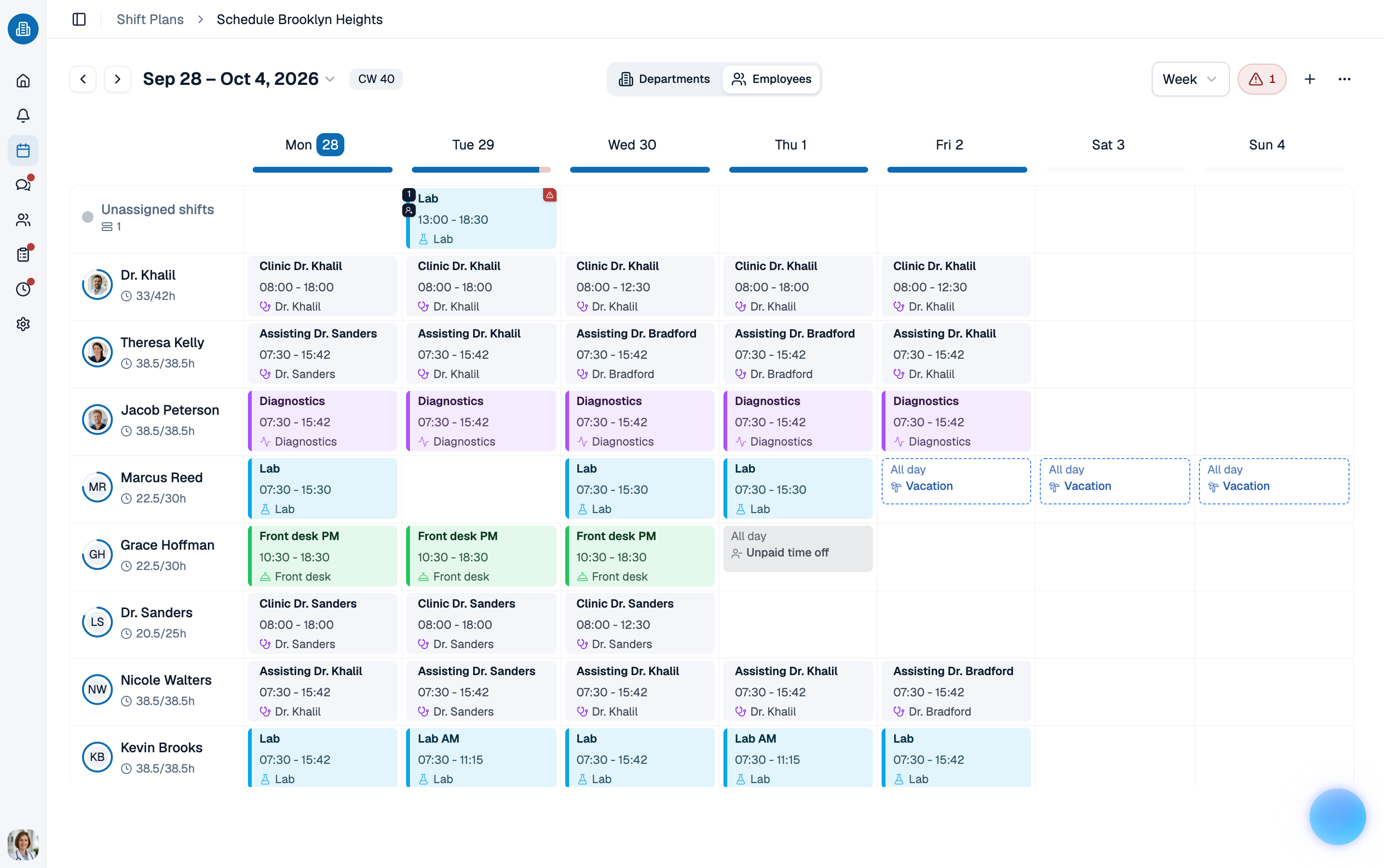
An employee work schedule with A and B weeks, like the 9/80, only has to be built twice in medishift. You save week A and week B each as a weekly template and apply each one to every second week, for up to 12 months ahead. With even and odd weeks switched on, a person's daily target hours can differ between the two weeks, such as Friday hours in one week and none in the other; which week applies follows the calendar week. Shifts stay drafts until you publish the week, and the team is notified when it goes out.
In our demos and onboarding we often see schedules kept on paper or in Word, or sent around in WhatsApp chats, where changes run through the same chats and the current version easily gets lost. The overtime account in medishift compares actual with target hours; it does not calculate FLSA overtime per workweek or use a workweek that starts on Friday at 12:30 PM, so that stays with your payroll. More on planning a practice or unit in our healthcare employee scheduling software.
Weekly templates and alternating weeks are part of medishift. Compare the plans.
Work schedule limits under federal law
A work schedule in the US has fewer limits under the FLSA than one scheduling guide suggests, which cites a 48-hour weekly cap, 8 to 11 hours of rest between shifts and one day off a week; none of these is an FLSA rule. The FLSA "does not limit the number of hours per day or per week" that employees aged 16 and older can be required to work, according to the DOL; state law can add limits. Federal law does not require lunch or coffee breaks, but short breaks of about 5 to 20 minutes that you do offer count as hours worked, and meal periods of typically at least 30 minutes do not (DOL); states can require breaks. Under 29 CFR 785.19(a), a meal period is not work time only if the employee is "completely relieved from duty", so a medical assistant who eats at the front desk and answers the phone is working.
How far ahead people see their schedule varies: in the BLS release on 2024-25 data, 59 percent of wage and salary workers knew their work schedule four weeks or more in advance, and 9 percent learned it one day or less in advance.
Frequently Asked Questions
Sources
As of November 4, 2026
- U.S. Department of Labor: Full-time employment, retrieved November 4, 2026
- U.S. Bureau of Labor Statistics: CPS definitions, retrieved November 4, 2026
- IRS: Identifying full-time employees, retrieved November 4, 2026
- IRS: Determining if an employer is an applicable large employer, retrieved November 4, 2026
- U.S. Department of Labor: elaws FLSA FAQ, hours of work, retrieved November 4, 2026
- U.S. Department of Labor, Wage and Hour Division: Overtime pay, retrieved November 4, 2026
- eCFR: 29 CFR 778.104 and 29 CFR 778.105, version of November 2, 2026
- govinfo: 29 U.S.C. 207, United States Code, 2024 edition
- govinfo: 5 U.S.C. 6121, United States Code, 2023 edition
- eCFR: 29 CFR 785.17 and 29 CFR 785.19, version of November 2, 2026
- California Labor Commissioner (DLSE): Overtime FAQ, retrieved November 4, 2026
- U.S. Bureau of Labor Statistics: Job flexibilities and work schedules, 2024-2025, retrieved November 4, 2026
- U.S. Department of Labor: Breaks and meal periods, retrieved November 4, 2026
- U.S. Department of Labor, Wage and Hour Division: Fact Sheet #14, coverage under the FLSA, retrieved November 4, 2026
- eCFR: 29 CFR 541.600, version of November 2, 2026