What Is a 2 2 3 Schedule? Chart and Overtime
What is a 2 2 3 schedule? A 14-day rotation of 12-hour shifts where two teams cover every day. Cycle chart, FLSA overtime math, staffing and rollout.
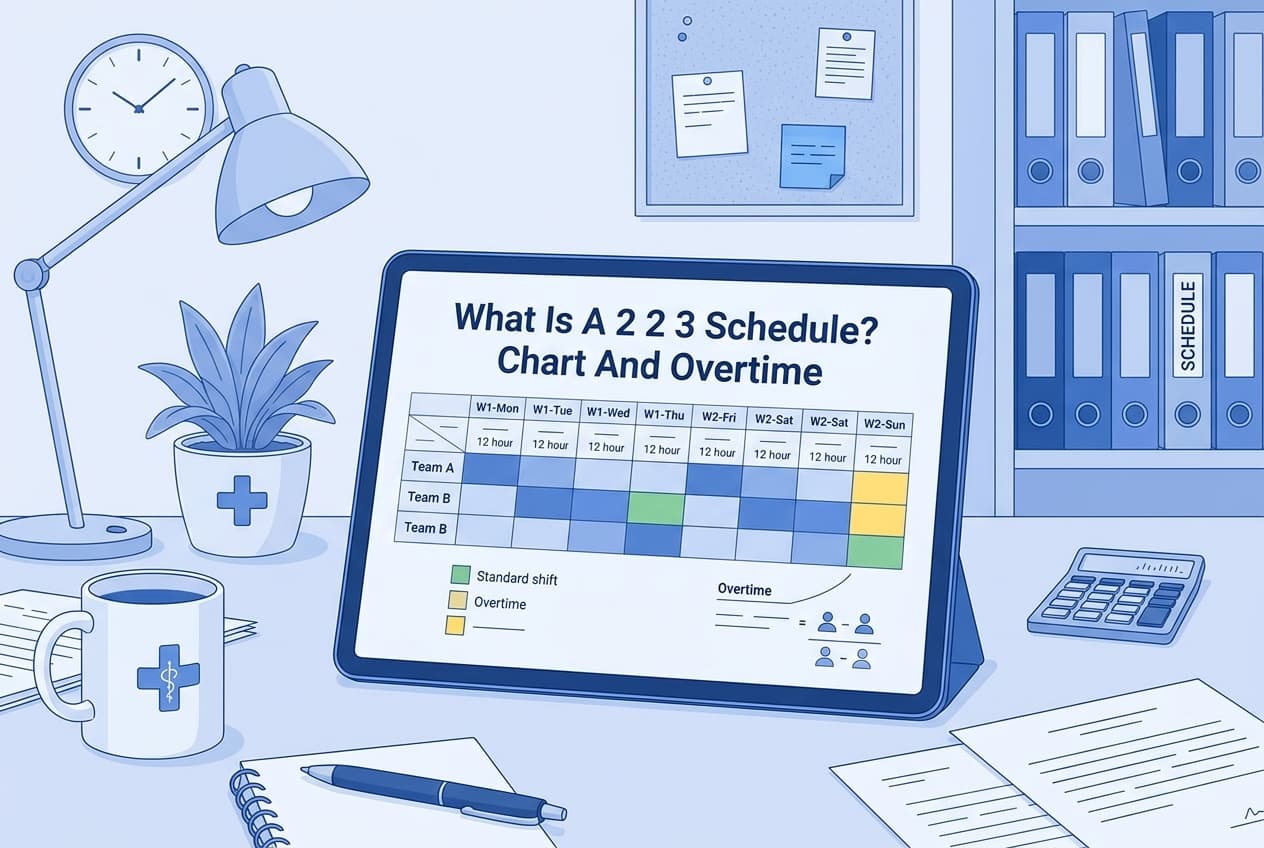
Table of Contents
What is a 2 2 3 schedule? It is a 14-day rotation of 12-hour shifts in which each team works 2 days, has 2 off, works 3, has 2 off, works 2 and then has 3 off, so that two teams together cover every single day. One team is always on, the other is always off, and each person works 7 of every 14 days. That is the whole definition, but it hides the parts that matter when you run one: why the weeks alternate between 36 and 48 hours, why the day your payroll week starts can push that to 60, what the 8 and 80 rule for hospitals and residential care does to it, and how many people one post really needs. This guide works through each of them for hospital units, nursing homes, labs and any other 24/7 operation.
Key takeaways at a glance
- A 2-2-3 work schedule repeats every 14 days: 2 on, 2 off, 3 on, 2 off, 2 on, 3 off. Two teams cover each day, usually with 12-hour shifts.
- Each person works 7 shifts per cycle, which averages 42 hours a week. On a Sunday-to-Saturday workweek the weeks alternate between 36 and 48 hours, so there are 8 overtime hours every second week.
- The FLSA does not let you average two weeks. Each workweek stands on its own, and a badly placed rotation start can turn the split into 24 and 60 hours.
- The 8 and 80 system for hospitals and residential care makes a 2-2-3 more expensive, not cheaper, because every 12-hour shift carries 4 daily overtime hours.
- One post covered 24/7 needs four people (two day teams, two night teams) before anyone takes PTO or calls in sick.
What is a 2 2 3 schedule?
The 2-2-3 is a fixed rotation: set once, so everyone knows their days off months ahead. In week one a team works 2 days, gets 2 off and works 3. In week two it flips: 2 off, 2 on, 3 off. The second team runs the same pattern one week later, so its days on are exactly the first team's days off.
The 14-day cycle for Team A and Team B
Here is the cycle with the first shift on a Monday. "A" means Team A works that day, "B" means Team B works.
| Week | Mon | Tue | Wed | Thu | Fri | Sat | Sun |
|---|---|---|---|---|---|---|---|
| Week 1 | A | A | B | B | A | A | A |
| Week 2 | B | B | A | A | B | B | B |
Team A works Monday, Tuesday, Friday, Saturday and Sunday in week 1, then only Wednesday and Thursday in week 2. Team B gets the mirror image. Every person works 7 shifts of 12 hours, or 84 hours, per 14 days.
Each team works every second weekend, and the weekend off is a long one: Team A is off Friday through Sunday of week 2. The longest stretch on is three days, and so is the longest stretch off.
To find out who is on duty on any given date, count the days since the first shift of the cycle and divide by 14. The remainder points to the day in the table: 0 to 6 falls in week 1, 7 to 13 in week 2, counted from Monday.
Pitman schedule, DuPont and 4-on-4-off
The Pitman schedule is another common name for the same 2-2-3 sequence. The term often describes the four-team version: Teams A and B run the 2-2-3 on days, Teams C and D run it on nights, and together they cover 24 hours, 7 days a week with 12-hour shifts. Some organizations keep each team on fixed days or fixed nights, others rotate the teams between days and nights every few weeks. The pattern of days on and off stays the same either way.
Two other 12-hour patterns often get mixed up with it:
- DuPont also uses four teams and 12-hour shifts, but the cycle runs 28 days and mixes days and nights inside it, ending with seven days off in a row. It trades a harder month for one long break.
- 4-on-4-off is an 8-day cycle: four 12-hour shifts, then four days off. It averages the same 42 hours a week, but the days off move through the calendar, so a fixed weekend pattern is gone.
The 2-2-3 sits between them. It has the shortest blocks of the three and the most predictable weekends.
Pros and cons of the 2-2-3 work schedule in nursing
For a nursing unit the strengths are clear. Every second weekend is free and runs three days. Nobody works more than three 12-hour shifts in a row. And because the pattern never changes, staff can plan childcare and appointments a year ahead.
The costs are just as concrete. A three-day block means 36 hours on the floor in three days, plus commute and handover, and that is where fatigue builds. The short blocks mean more switches between work and rest than a 4-on-4-off. A patient admitted on a Tuesday sees a different team on Wednesday. And the 48-hour weeks are built into the pattern, so the overtime is too.
2-2-3 overtime: what the FLSA says
Under the Fair Labor Standards Act, covered nonexempt employees must get at least time and a half for every hour over 40 in a workweek (DOL, Overtime Pay). The workweek is a fixed, recurring period of 168 hours, seven consecutive 24-hour periods, and it can start on any day the employer chooses (29 CFR 778.105). The key rule for a 2-2-3: each workweek stands alone, and hours cannot be averaged over two or more weeks (29 CFR 778.104).
Federal law sets no rest period between shifts and does not require meal or rest breaks for adults (DOL, Breaks and Meal Periods). Some states do, so check your state labor department before you rely on the federal floor. For 12-hour shifts the bigger state rule is daily overtime. California requires time and a half for every hour over 8 in a workday, so each 12-hour shift carries 4 overtime hours unless the unit works under an alternative workweek schedule adopted under Labor Code § 511 (California Labor Code § 510). Alaska also pays overtime after 8 hours in a day, but exempts hospital employees whose work includes medical service and employees on an approved flexible work hour plan (Alaska Department of Labor, Wage and Hour).
Why the weeks alternate 36 and 48 hours
Take the Monday-start cycle from the table and a Sunday-to-Saturday workweek, the example used throughout this section. Team A's first full workweek runs from Sunday of week 1 to Saturday of week 2. It contains Sunday, Wednesday and Thursday: 3 shifts, 36 hours. The next one runs from Sunday of week 2 to the following Saturday and contains Monday, Tuesday, Friday and Saturday: 4 shifts, 48 hours.
So the 42-hour average is really 36, 48, 36, 48. The short week does not offset the long one. Every second week, each person on a 2-2-3 work schedule earns 8 hours at time and a half. Over a year that is 26 long weeks, or 208 overtime hours per person. At an example base rate of $40 an hour, the premium half alone comes to $4,160 per person per year, before any shift differential.
The start day can turn 208 overtime hours into 520
Seven shifts in 14 days cannot be split evenly into two weeks. The best you can get is 3 and 4 shifts. But where the cycle starts relative to your workweek decides whether you get that best case. The rule of thumb: the split goes wrong when the cycle starts on the same weekday as the workweek, or three days later. With a Sunday-start workweek, that gives:
| First day of the cycle on | Team A weeks | Team B weeks | Overtime per person per 2 weeks |
|---|---|---|---|
| Mon, Tue, Thu, Fri or Sat | 36 and 48 | 48 and 36 | 8 hours |
| Sun or Wed | 60 and 24 | 24 and 60 | 20 hours |
The same applies to any other workweek: a Monday-start rotation on a Monday-start workweek lands every team in the bad split: 5 shifts in one week, 2 in the next, and 20 overtime hours every second week, or 520 a year per person instead of 208. Night shifts that cross the workweek boundary count in the week the hours are worked; since 778.105 lets the workweek start at any hour, a 7 a.m. or 7 p.m. start keeps whole shifts in one week. The fix is to choose where the cycle starts, not to move the workweek. The regulation allows a change of workweek only if it is meant to be permanent and is not designed to evade the overtime rules (29 CFR 778.105).
Meal breaks move the numbers once more. If staff take a bona fide 30-minute meal break, fully relieved from duty (29 CFR 785.19), a 12-hour shift is 11.5 paid hours, and the long week drops from 48 to 46 hours: 6 overtime hours instead of 8. If the nurse eats at the station and stays responsible for patients, the break is work time and the week stays at 48.
The 8 and 80 option for hospitals
Hospitals and residential care facilities can agree with employees, in advance, to use a fixed 14-day period instead of the workweek. Overtime is then due for hours over 8 in a workday and over 80 in the 14 days (DOL, Fact Sheet #54).
It looks made for a 14-day rotation. In practice it is the opposite. Every 12-hour shift has 4 hours over the daily 8, so the 7 shifts of one cycle produce 28 daily overtime hours. That is 28 hours at time and a half per 14 days, against 8 on a normal workweek. So for a 2-2-3 on 12-hour shifts the standard workweek is usually the cheaper basis; 8 and 80 fits units on 8-hour shifts better.
How to run a 2-2-3 12 hour shift schedule
Staffing: two people per post, four for 24/7
A post that needs one person on every 12-hour day shift needs two people on a 2-2-3: Team A and Team B, one each. Covering the same post around the clock takes four, one per team in the Pitman setup. The arithmetic checks out: 168 hours a week divided by 42 hours per person is exactly 4.
Those four people have no slack. If each takes 120 hours of PTO a year (an example figure, use your own policy), that is 480 hours, or 40 twelve-hour shifts, to cover per post, before sick days. One pickup in a long week takes a person from 48 to 60 hours. Plan the cover before the rotation goes live: a float pool, a part-time fifth person per post, or a rule for who picks up which gaps.
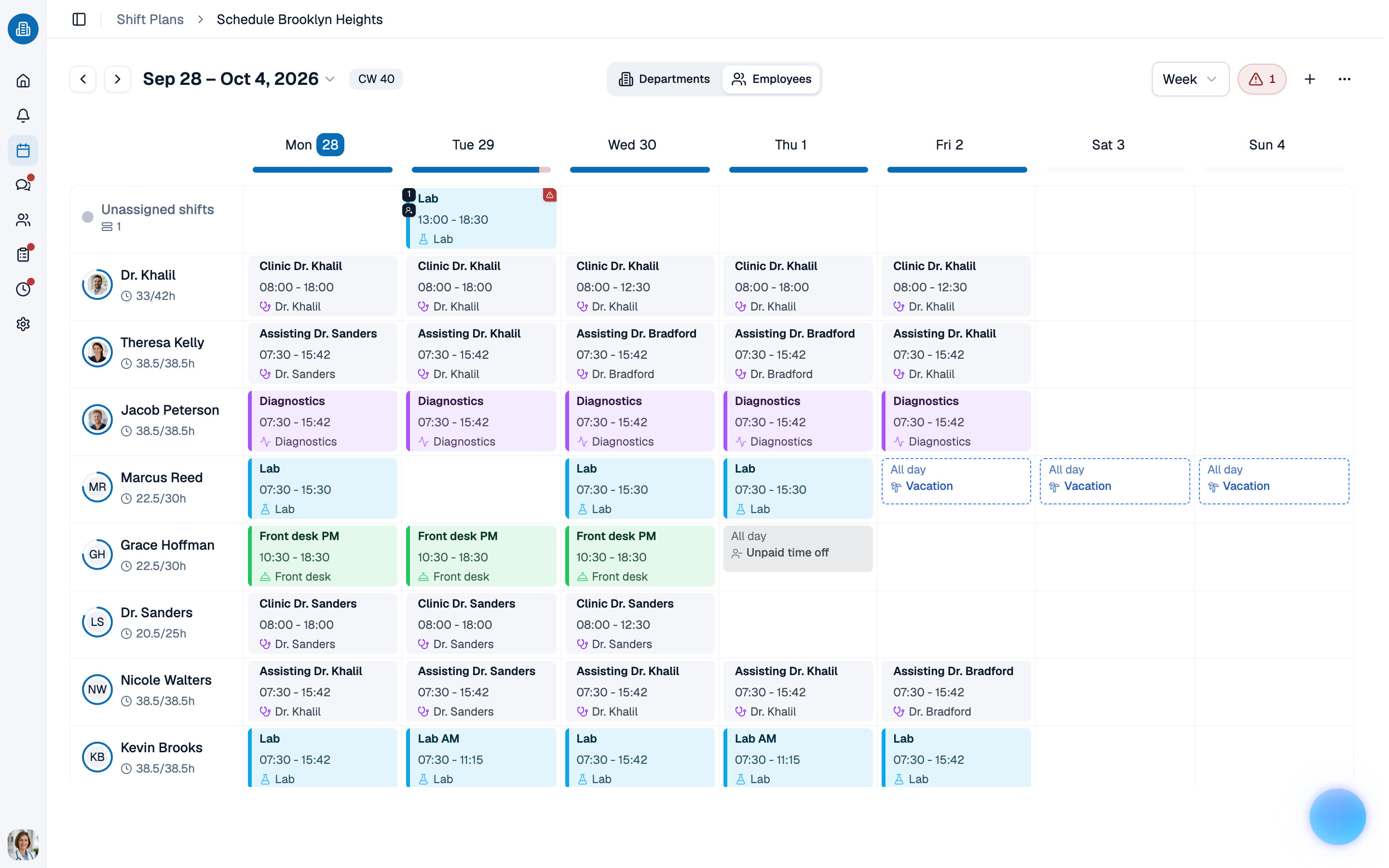 With medishift you set up a 2-2-3 rotation once and roll it out for the year. See the plans.
Handovers and the switch from days to nights
Twelve-hour shifts change hands twice a day, usually at 7 a.m. and 7 p.m. Report takes time, and if it happens after the end of the shift, those minutes are hours worked, because work the employer suffers or permits counts as working time (29 CFR 785.11). A 15-minute overlap at each end turns 12 hours into 12.5, and four of those in a long week make 50 hours instead of 48. Count the overlap in the template, not on the timesheet afterwards.
If the four teams rotate between days and nights, use the natural switch points: move a team from nights to days only after a block of two or three days off, never between two working days. For the 8-hour alternative with days, evenings and nights, see our guide to 2nd shift hours.
Rolling out a 2-2-3 schedule, step by step
- Count the posts. List every position that has to be filled each day and whether it needs nights as well.
- Fix the workweek before the rotation. Look up the day your payroll workweek starts on and start the cycle one, two, four, five or six days after the workweek begins, so that no week holds five shifts of one team.
- Build two week templates. One for week 1 of the cycle, one for week 2, each with Team A and Team B on their days. Repeat each every second week.
- Set rest and hour rules. A minimum rest time between shifts, a maximum number of hours per day and a maximum number of consecutive working days, so that swaps and pickups get flagged.
- Plan the cover. Decide who fills PTO and sick days, and check what each pickup does to that person's workweek.
- Review after two cycles. Compare scheduled and worked hours and ask the team how the three-day blocks feel.
In medishift, steps 3 to 6 map directly to the product. A week template can be applied to future weeks in one go, every 1st, 2nd, 3rd or 4th week and up to 12 months ahead, so a 2-2-3 is two week templates set to alternate every second week. Rules are set per location and cover minimum rest time between shifts, maximum hours per day and maximum consecutive working days. A violation shows as a warning on the shift rather than a block, so the scheduler still decides. The overtime account keeps a running balance of actual minus target hours for each person. Federal and state holidays are imported for the location. And Kira, the AI assistant, creates shifts and applies templates when you ask it in plain language. medishift does not calculate overtime pay or run payroll, but tracked times can be exported for whoever does.
Read more on healthcare employee scheduling software, auto scheduling, time and attendance for the hours that become overtime, and PTO tracking for the gaps your 2-2-3 has to absorb.