Nursing Scheduling Software: Home & Care Homes
What nursing scheduling software costs and where the free version is enough. Plus staff ratios, route planning and 24/7 shifts, home care and care homes.

Table of Contents
Scheduling in nursing care is a craft of its own. Shifts that have to be covered around the clock, a qualified staff ratio set by state law, and a team that is rarely at full strength: a calendar with boxes will not carry that. This article shows you how to recognise usable nursing scheduling software, what it costs, and where even the best planning tool stops. We say openly what medishift covers and what it does not.
Key Takeaways
- Nursing means continuous operation: early, late, night, 365 days a year. The software has to work out rest periods and maximum hours for you, not just distribute names.
- The qualified staff ratio is set by state law and depends on the type of facility. medishift does not monitor it automatically, and you should ask every vendor exactly this question.
- Route planning for home care services is a software category of its own. Shift planning and route planning are two tools, not one.
- The biggest everyday lever is qualification-based rules: "every early shift needs one registered nurse."
- For small teams there is free nursing scheduling software, at medishift for up to 10 employees.
Why Nursing Care Has Its Own Requirements
A general scheduling tool for medical practices already covers a lot, because qualifications and opening hours have to match there too. In nursing care, three things are added that make the difference, and you should check them before you commit to any nursing scheduling software.
Continuous Operation and Rest Periods
In a residential facility, no hour may be left uncovered. A typical three-shift operation runs from 6:00 to 14:00, from 13:30 to 21:30 and from 21:00 to 6:30, with handover times that deliberately overlap. Anyone planning this by hand mentally checks at every change whether the rest period still holds. That is exactly what the software should take over: it warns you when too little time sits between a late shift and the next morning's early shift.
The Qualified Staff Ratio
The much-quoted 50 percent ratio comes from § 5 (1) of the German Heimpersonalverordnung, and it is not unconditional: the threshold is more than 20 residents who do not need nursing care, or more than four who do. Above it, at least every second additional employee must be a qualified professional; below it, one qualified professional among the additional employees is enough. Since German federalism reform, the states regulate residential care law themselves, so the applicable ratio, how it is calculated, and its exceptions differ by state and by type of facility. For inpatient facilities, staffing assessment under § 113c SGB XI is added. In practice this means the ratio that applies to you is written in your state law, not in a piece of software.
Qualifications Instead of Just Names
Registered nurses, care assistants, and trainees have different authorisations. Nursing care scheduling software is worth something when it knows these attributes and checks the schedule against them continuously, instead of leaving them in the planner's head.
The Most Important Features of Nursing Scheduling Software
Before you compare vendors, it pays to write down the features you actually need. In practice these four separate the wheat from the chaff.
- Rule checking while planning: minimum rest period, maximum hours per day, maximum consecutive days. Not as a report afterwards, but as a warning at the moment of assignment.
- Qualifications on the employee profile: freely definable and usable inside planning rules.
- Absence handling: when a sick note arrives at six in the morning, finding a replacement has to take minutes, not phone chains.
- Mobile access: care workers do not sit at a desk.
How shift and vacation planning interlock cleanly is covered in our scheduling software overview.
What medishift Covers in Nursing Care and What It Does Not
Anyone searching for nursing scheduling software quickly lands on comparison lists that put ten products side by side and have never used any of them. We name only one product here, our own, and we do not claim to have tested it against the market. What we can offer instead is an honest list of what medishift does and what it explicitly does not do. Use the same list on every other vendor.
| Requirement | medishift | Note |
|---|---|---|
| Around-the-clock shift planning, weekly templates | yes | templates across many weeks from Plus |
| Professional groups on the employee profile | yes | included in the Free plan |
| Qualifications and attributes | yes | from Plus |
| Rules in plain language, schedule checked against them | yes | from Premium |
| Rest period, maximum hours, maximum consecutive days | yes | from Premium, as a warning, not a block |
| Replacement search and swap requests inside the team | yes | from Plus, targeted requests included |
| Mobile app for employees and planners | yes | included in the Free plan |
| Monitoring the qualified staff ratio automatically | no | there is no ratio model in the product |
| Route planning and route optimisation | no | you need nursing industry software |
| Connection to nursing documentation systems | no | no interface available |
| Handing tracked time over to payroll | no | not available |
The four "no" entries are the actual point of this section. If the qualified staff ratio and routes are your two hardest requirements, then a specialised nursing industry solution is the right tool and medishift is not. Those vendors tie nursing documentation, billing, and route planning into one system. What that costs in a given case and how deep the rollout goes depends on the vendor, and we have not measured it.
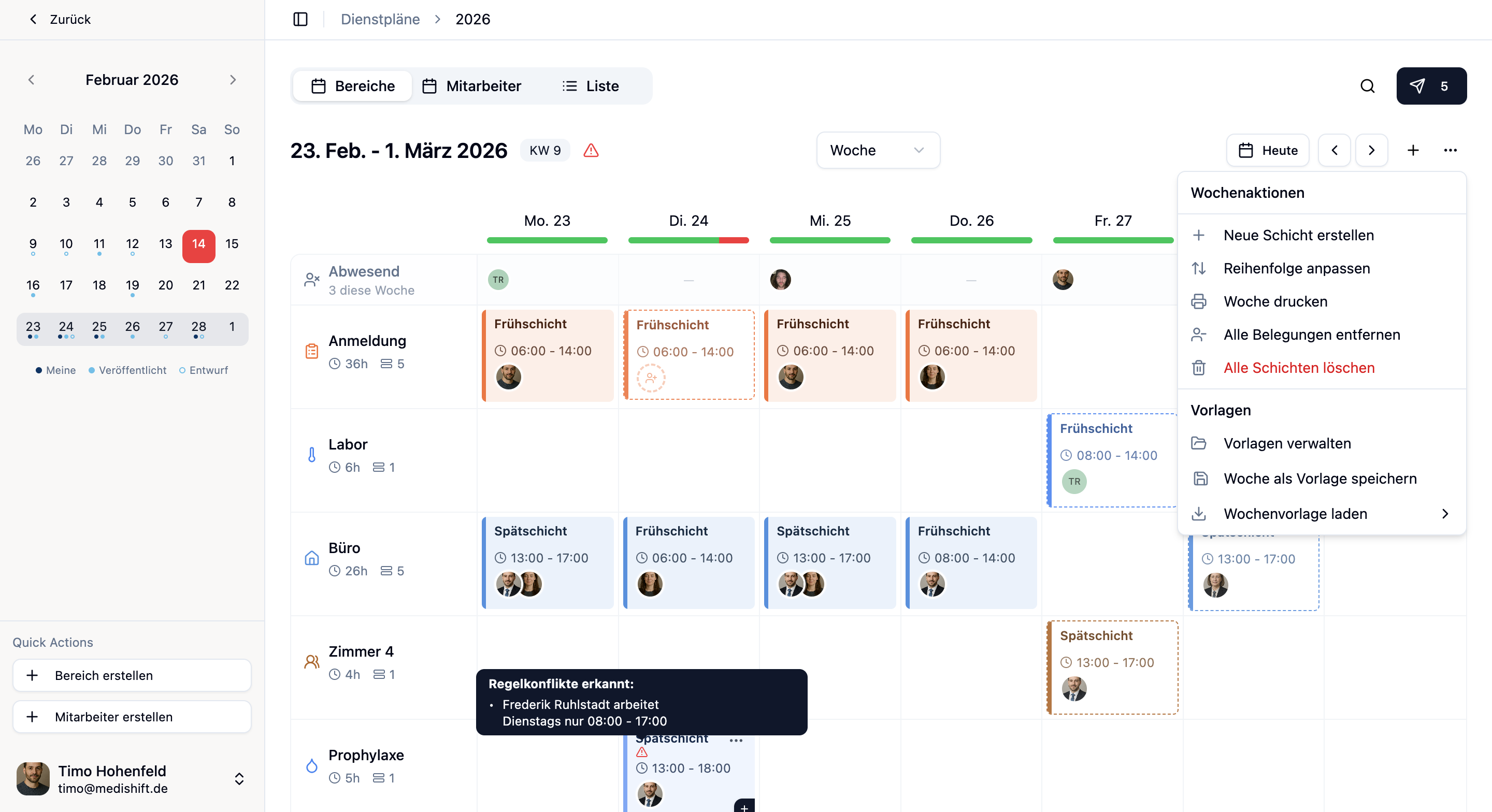
medishift fits where shift planning itself is the problem: day care, nursing practices, smaller facilities, and teams working today with spreadsheets and a notice board. The lever is rule checking. You write down in ordinary sentences what applies in your organisation, and the schedule is continuously checked against it, filled, and repaired.

High quality starts with your organization
Free yourselves from old tables and manual processes.

Home Care, Residential Care and Day Care
Requirements for nursing scheduling software differ sharply by facility type. A tool that shines in a care home can miss the mark at a home care service.
Home Care Services
Here the tour is at the centre: who visits which patients, in what order, with which qualification. Shift planning only says who is on duty at all. Industry systems with a routing module can bring both together; general planning tools cannot.
Residential Care and Nursing Homes
In a care home the focus is on seamless coverage of all units and on the staffing key. This is where nursing care scheduling software that knows weekly templates and can map A/B week rhythms pays off, so you do not rebuild every week from scratch.
Day Care and Short-Term Care
Limited opening hours, but fluctuating guest numbers. Demand changes at short notice, so you need fast replanning and reliable notification of the team more than elaborate shift models.
Nursing Schedule App: Mobile Planning and Communication
A mobile app is not a comfort in nursing care, it is a precondition. Anyone moving through a unit or driving between visits opens the schedule on a phone or not at all.
What an App Has to Deliver
With a nursing schedule app, your employees carry the current state with them. Changes arrive by push, absences can be reported, vacation requested. What matters is the separation between draft and publication: the team should only see what actually applies.
The Morning Absence
The case every nursing schedule app has to be measured against is the short-notice sick note. Solved well, it means the person is removed from their shifts in one step, candidates with reasons are presented for every open duty, and the request goes out either to selected colleagues or to the whole work area. The handover is binding as soon as someone accepts.
Free Nursing Scheduling Software: Possibilities and Limits
Yes, there is free nursing scheduling software as an entry point. The question is how far it carries.
According to our pricing page, the Free plan covers up to 10 employees, plus one location, one schedule, the mobile app, vacation planning, and professional groups. Plus costs €49 per month with annual billing there, includes 20 employees, and unlocks qualifications and attributes. Premium, according to the same page, sits at €109 per month, includes 50 employees, and adds rules in plain language.
For a small day care service or a nursing practice, the free entry point is often enough. As soon as you plan several units, real qualification rules, or more than one location, you need a paid plan. If you want to start from a spreadsheet first, our free nursing schedule template lays out early, late, and night shifts as a grid.
Working Time Law and Documentation in Nursing Care
German working time law applies in nursing care as everywhere, with one exception written for this sector.
Rest Period and Maximum Working Hours
According to § 3 ArbZG, a maximum of eight hours per working day is permitted, extendable to ten if an average of eight hours is maintained over six months or 24 weeks. The rest period under § 5 (1) ArbZG is eleven uninterrupted hours. For facilities for the treatment, nursing, and care of people, § 5 (2) ArbZG allows it to be shortened by up to one hour, provided every reduction is compensated within one calendar month or four weeks by extending another rest period to at least twelve hours: in nursing care, ten hours instead of eleven can therefore be planned. Separate from that, § 5 (3) ArbZG covers the unplanned case, where call-outs during on-call duty cut into the rest period: those reductions may not exceed half the rest period and have to be compensated at other times. Software can monitor these limits, but the responsibility stays with the employer. This overview is not legal advice; if in doubt, check the rule that applies to you.
Being Able to Prove It
During inspections by the care regulator or the medical service, you have to be able to show who was scheduled when and who made the change. Make sure your tool logs changes and can output the schedule as a document.
Frequently Asked Questions About Nursing Scheduling Software
Conclusion: The Right Software for Your Care Facility
The choice becomes simple once you split it into two questions. First: do you need route planning and a connection to nursing documentation? Then the path leads to nursing industry software. Second: is shift planning itself your bottleneck, because rest periods, qualifications, and absences eat your time? Then you need a tool that knows rules and is reachable on a phone.
Good nursing scheduling software takes the mental arithmetic off you and makes the schedule verifiable. It does not take away your responsibility for the qualified staff ratio, and no vendor should promise you that. Anyone who does should be able to show it to you in the product.